 Add to Chrome
 Add to Firefox
 Add to Edge
An AI agent for treatment reasoning over a biomedical tool universe
Jun 27, 2026
Treatment reasoning underpins every therapeutic decision, integrating disease context, comorbidities, medications, contraindications, and evolving biomedical knowledge to select an appropriate therapy. It is inherently iterative: candidates are weighed against many constraints, revised as evidence emerges, and grounded in verifiable sources. Here we introduce ATHENA-R1, an AI agent for treatment reasoning across all FDA approved drugs since 1939, trained by reinforcement learning over a universe of 212 biomedical tools. At each step it identifies missing information, selects and runs relevant tools, and incorporates the evidence. To train it without human-annotated traces, we build a two-level self-learning framework: multi-agent systems construct the tools, tasks, and reasoning trajectories for supervised fine-tuning, then reinforcement learning with scientific feedback rewards reasoning quality (evidence gathering, grounded tool use, logical non-redundancy). Across five benchmarks of 3,168 drug reasoning tasks and 456 patient treatment cases, ATHENA-R1 outperforms language models and tool-use systems, reaching 94.7% accuracy on open-ended drug reasoning and 82.9% on treatment reasoning, 17.8 and 10.7 points above GPT-5. In blinded evaluations by experts from 28 rare disease organizations, it is preferred over reference models on all criteria, and physicians rated it favorably on complex hospitalized cardiovascular and infectious-disease cases. Adverse-event hypotheses it generated, tested in electronic health records from 5.4 million patients, reached adjusted odds ratios of 1.48-1.84, with no elevation among negative controls. Because it requires knowing what evidence to seek before concluding, treatment reasoning has long been hard for AI; we show it can be reframed as a learnable process of iterative evidence gathering that reinforcement learning can train AI to perform.

What Does the AI Doctor Value? Auditing Pluralism in the Clinical Ethics of Language Models
May 18, 2026Medicine is inherently pluralistic. Principles such as autonomy, beneficence, nonmaleficence, and justice routinely conflict, and such ethical dilemmas often sharply divide reasonable physicians. Good clinical practice navigates these tensions in concert with each patient's values rather than imposing a single ethical stance. The ethical values that large language models bring to medical advice, however, have not been systematically examined. We present a framework for auditing value pluralism in medical AI, comprising a benchmark of clinician-verified dilemmas and an attribution method that recovers value priorities directly from decisions. The ecosystem of frontier models spans physician-level value heterogeneity, and models discuss competing values in their reasoning (Overton pluralism) before committing to a decision. However, individual model decisions are near-deterministic across repeated sampling and semantic variations, failing to reproduce the distributional pluralism of the physician panel. Across benchmark cases, these consistent decisions reflect committed, systematic value preferences. While most model priorities fall within the natural range of inter-physician variation, some significantly underweight patient autonomy. A single LLM deployed without regard for its value priorities could amplify those priorities at scale to every patient it serves. Without explicit efforts to balance ethical perspectives with one or multiple models, these tools risk replacing clinical pluralism with a deployment monoculture.
Learning Normal Representations for Blood Biomarkers
May 18, 2026Blood-based biomarkers underpin clinical diagnosis and management, yet their interpretation relies largely on fixed population reference intervals that ignore stable, intra-patient variability. As such, population-based interpretation can mask meaningful deviation from an individual's baseline, risking delayed disease detection. To remedy this, there have been increasing efforts to personalize blood biomarker interpretation using individual testing histories. However, these methods may overfit to sparse data, inflating false-positive rates and unnecessary follow-up, and can also unwittingly include unrecognized or subclinical disease. Here, we leverage nearly 2 billion longitudinal laboratory measurements from over 1.6 million individuals across North America, the Middle East, and East Asia, to show that while laboratory values are highly individual, purely personalized intervals routinely overfit, classifying up to 68% of measurements as abnormal, without corresponding associations with adverse clinical outcomes. We then introduce NORMA, a conditional transformer-based framework that generates reference intervals by conditioning on both a patient's history and population-level data about "normal" variation. NORMA-derived intervals achieve higher precision for predicting outcomes, including mortality, acute kidney injury, and chronic disease. These findings caution against over-personalization in laboratory medicine and demonstrate that anchoring individual trajectories to population-level priors outperforms either approach alone. To promote transparency, we publicly release the model, code, and an interactive user interface for accessible, individualized laboratory interpretation.
Graph AI generates neurological hypotheses validated in molecular, organoid, and clinical systems
Dec 13, 2025Neurological diseases are the leading global cause of disability, yet most lack disease-modifying treatments. We present PROTON, a heterogeneous graph transformer that generates testable hypotheses across molecular, organoid, and clinical systems. To evaluate PROTON, we apply it to Parkinson's disease (PD), bipolar disorder (BD), and Alzheimer's disease (AD). In PD, PROTON linked genetic risk loci to genes essential for dopaminergic neuron survival and predicted pesticides toxic to patient-derived neurons, including the insecticide endosulfan, which ranked within the top 1.29% of predictions. In silico screens performed by PROTON reproduced six genome-wide $α$-synuclein experiments, including a split-ubiquitin yeast two-hybrid system (normalized enrichment score [NES] = 2.30, FDR-adjusted $p < 1 \times 10^{-4}$), an ascorbate peroxidase proximity labeling assay (NES = 2.16, FDR $< 1 \times 10^{-4}$), and a high-depth targeted exome sequencing study in 496 synucleinopathy patients (NES = 2.13, FDR $< 1 \times 10^{-4}$). In BD, PROTON predicted calcitriol as a candidate drug that reversed proteomic alterations observed in cortical organoids derived from BD patients. In AD, we evaluated PROTON predictions in health records from $n = 610,524$ patients at Mass General Brigham, confirming that five PROTON-predicted drugs were associated with reduced seven-year dementia risk (minimum hazard ratio = 0.63, 95% CI: 0.53-0.75, $p < 1 \times 10^{-7}$). PROTON generated neurological hypotheses that were evaluated across molecular, organoid, and clinical systems, defining a path for AI-driven discovery in neurological disease.
One Patient, Many Contexts: Scaling Medical AI Through Contextual Intelligence
Jun 11, 2025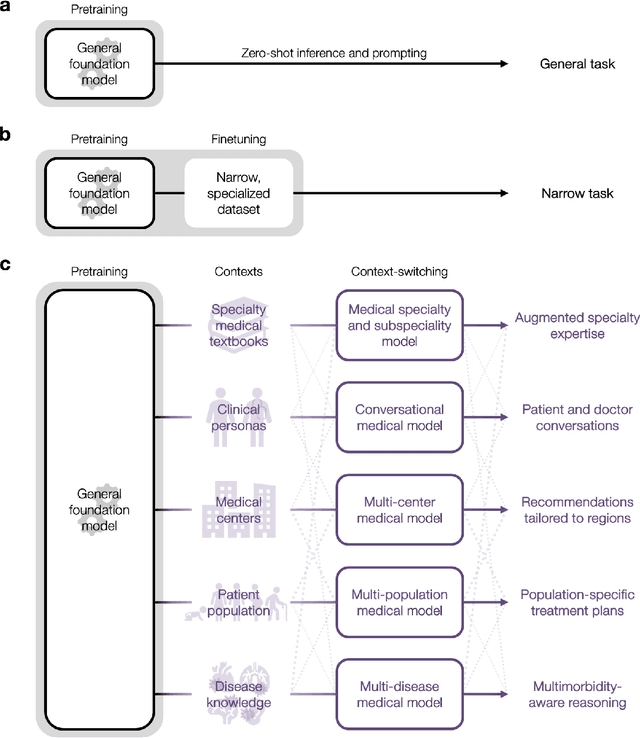
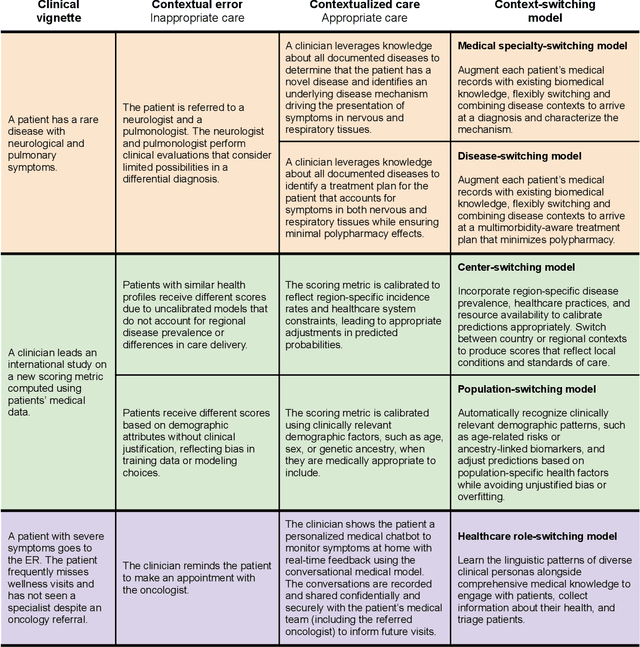
Medical foundation models, including language models trained on clinical notes, vision-language models on medical images, and multimodal models on electronic health records, can summarize clinical notes, answer medical questions, and assist in decision-making. Adapting these models to new populations, specialties, or settings typically requires fine-tuning, careful prompting, or retrieval from knowledge bases. This can be impractical, and limits their ability to interpret unfamiliar inputs and adjust to clinical situations not represented during training. As a result, models are prone to contextual errors, where predictions appear reasonable but fail to account for critical patient-specific or contextual information. These errors stem from a fundamental limitation that current models struggle with: dynamically adjusting their behavior across evolving contexts of medical care. In this Perspective, we outline a vision for context-switching in medical AI: models that dynamically adapt their reasoning without retraining to new specialties, populations, workflows, and clinical roles. We envision context-switching AI to diagnose, manage, and treat a wide range of diseases across specialties and regions, and expand access to medical care.