 Add to Chrome
 Add to Firefox
 Add to Edge
SpikeRestormer: Towards Energy-Efficient All-in-One Image Restoration via Unified Event Reasoning
Aug 03, 2026
ANN-based All-in-One image restoration (AiOIR) unifies diverse degradation handling but incurs high computational costs, limiting its real-time deployment. While Spiking Neural Networks (SNNs) offer a low-power alternative, applying them to static images remains challenging. This difficulty arises because explicit event signals are absent, and degradation cues are heavily entangled with scene structures, hindering the learning of reliable restoration-oriented spike events. To address these issues, we propose SpikeRestormer, an energy-efficient SNN for AiOIR that performs event reasoning over internally generated spike cues. Specifically, we propose a degradation-event perception process to extract spike-based degradation events through Subtractive Degradation Event Attention (SDEA). Moreover, we introduce Hierarchical Bayesian Skip Masking (HBSM) and Additive Restoration Event Attention (AREA) processes for event-reliability inference and restoration-event construction, respectively. By integrating these complementary processes, SpikeRestormer formulates restoration as a unified process of degradation-event perception, degradation-event reliability inference, and restoration-event construction, liberating the potential of SNNs for energy-efficient AiOIR. Extensive experiments show that SpikeRestormer delivers competitive performance against ANN-based methods and establishes new state-of-the-art results among SNN-based methods with significantly lower energy consumption.

Single-stage Rotate Object Detector via Two Points with Solar Corona Heatmap
Feb 14, 2022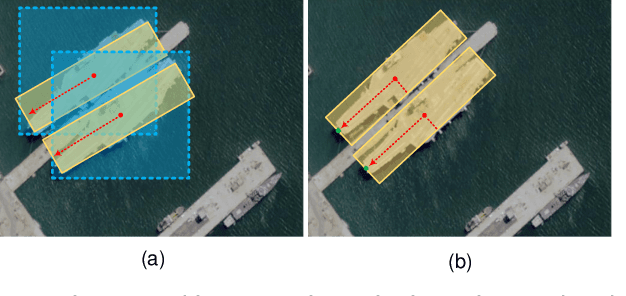

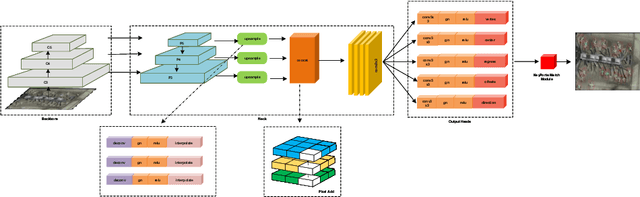
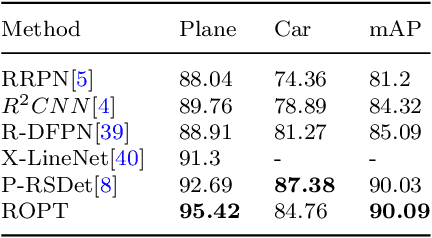
Oriented object detection is a crucial task in computer vision. Current top-down oriented detection methods usually directly detect entire objects, and not only neglecting the authentic direction of targets, but also do not fully utilise the key semantic information, which causes a decrease in detection accuracy. In this study, we developed a single-stage rotating object detector via two points with a solar corona heatmap (ROTP) to detect oriented objects. The ROTP predicts parts of the object and then aggregates them to form a whole image. Herein, we meticulously represent an object in a random direction using the vertex, centre point with width, and height. Specifically, we regress two heatmaps that characterise the relative location of each object, which enhances the accuracy of locating objects and avoids deviations caused by angle predictions. To rectify the central misjudgement of the Gaussian heatmap on high-aspect ratio targets, we designed a solar corona heatmap generation method to improve the perception difference between the central and non-central samples. Additionally, we predicted the vertex relative to the direction of the centre point to connect two key points that belong to the same goal. Experiments on the HRSC 2016, UCASAOD, and DOTA datasets show that our ROTP achieves the most advanced performance with a simpler modelling and less manual intervention.