 Add to Chrome
 Add to Firefox
 Add to Edge
GSAM: A Generalizable and Safe Robotic Framework for Articulated Object Manipulation
May 29, 2026
Articulated object manipulation is a unique challenge for service robots. Existing methods employ end-to-end policy learning, visionmotion planning, and large-language/visual-language model (LLM/VLM), but often overlook the diversity of articulated objects and the complexity of interactions between end-effector and handle, leading to limited generalization and destructive collisions. To address this, we propose GSAM, a generalizable and safe robotic framework for articulated object manipulation. Specifically, a vision-based perceiver generates the kinematic parameters. Considering that pre-trained markers in perceiver yield raw estimations that may deviate from commonsense, we present a f ine-tuned VLM-based refiner, using chain-of-thought (COT) commonsense reasoning to refine perception. To prevent destructive collisions, we design an interaction constraint function generator, integrating articulated object, interaction pose, and obstacle avoidance knowledge into a base. LLM then functionalize these constraints and apply them to trajectory and posture planning. A kinematic-aware manipulation planner verifies reachability for trajectory and posture. Experiments on 50 hinge tasks across 5 object categories and 50 randomly initialized end-effectorhandle configurations show that GSAM reduces standard deviation by 3.1% and improves manipulation success rate by 36.0% compared to the best baseline, respectively demonstrating the superior object generalization and interaction safety of GSAM in practical scenarios.

MoMa-Pos: Where Should Mobile Manipulators Stand in Cluttered Environment Before Task Execution?
Mar 29, 2024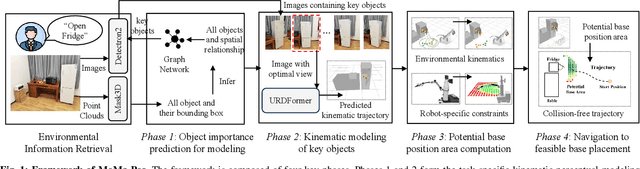


Mobile manipulators always need to determine feasible base positions prior to carrying out navigation-manipulation tasks. Real-world environments are often cluttered with various furniture, obstacles, and dozens of other objects. Efficiently computing base positions poses a challenge. In this work, we introduce a framework named MoMa-Pos to address this issue. MoMa-Pos first learns to predict a small set of objects that, taken together, would be sufficient for finding base positions using a graph embedding architecture. MoMa-Pos then calculates standing positions by considering furniture structures, robot models, and obstacles comprehensively. We have extensively evaluated the proposed MoMa-Pos across different settings (e.g., environment and algorithm parameters) and with various mobile manipulators. Our empirical results show that MoMa-Pos demonstrates remarkable effectiveness and efficiency in its performance, surpassing the methods in the literature. %, but also is adaptable to cluttered environments and different robot models. Supplementary material can be found at \url{https://yding25.com/MoMa-Pos}.