 Add to Chrome
 Add to Firefox
 Add to Edge
Variance Reduction for Non-Log-Concave Sampling with Applications to Inverse Problems
Jun 15, 2026
Sampling from high-dimensional, non-log-concave distributions with unnormalized densities is a fundamental challenge in machine learning, particularly when the exact gradient of the potential is unavailable and must be approximated via stochastic gradients that exhibit high variance under a fixed budget of gradient computations per iteration. Although variance reduction techniques such as SGD with momentum, STORM, and PAGE have demonstrated improved convergence properties in non-convex optimization, their implications for sampling from non-log-concave distributions remain largely unexplored. In this work, we develop the first unified analysis of these estimators for sampling from non-log-concave distributions. We establish improved non-asymptotic convergence rates in $\varepsilon$-relative Fisher information and, under a Poincaré inequality assumption, in squared total variation distance, and further prove weak convergence to the target distribution. We extend our analysis to solving inverse problems with score-based generative priors. We empirically validate our theory and demonstrate that, under a fixed gradient computations per iteration, variance-reduction techniques consistently improve sample quality in two standard imaging applications.

Zeroth-Order Non-Log-Concave Sampling with Variance Reduction and Applications to Inverse Problems
May 28, 2026Sampling from high-dimensional, non-log-concave distributions with unnormalized densities remains a fundamental challenge in machine learning, particularly in black-box settings where gradient information is inaccessible or computationally prohibitive. While Langevin dynamics provides a principled framework for sampling when gradients are accessible, its extension to the black-box settings suffers from high variance and lacks non-asymptotic convergence guarantees for non-log-concave sampling. To address these limitations, we propose a variance-reduced zeroth-order Langevin sampling method. Our method employs a gradient estimator that substantially reduces the variance of the classical batched zeroth-order estimator and eliminates the unfavorable dimensional dependence of the batch size required for accurate estimation, enabling practical and stable sampling. We establish the first non-asymptotic convergence guarantees for zeroth-order non-log-concave sampling in terms of $\varepsilon$-relative Fisher information, and, under a Poincaré inequality assumption, squared total variation distance. We further propose ZO-APMC, a posterior sampling algorithm for black-box inverse problems with pre-trained score-based generative priors, establishing the first non-asymptotic convergence guarantees for such methods. We validate our theory through synthetic experiments and demonstrate strong empirical performance on practical linear and nonlinear inverse problems.
Improved Robustness for Deep Learning-based Segmentation of Multi-Center Myocardial Perfusion MRI Datasets Using Data Adaptive Uncertainty-guided Space-time Analysis
Aug 09, 2024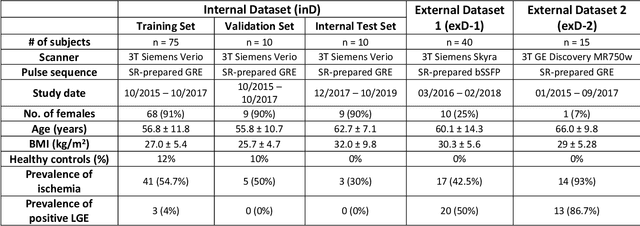


Background. Fully automatic analysis of myocardial perfusion MRI datasets enables rapid and objective reporting of stress/rest studies in patients with suspected ischemic heart disease. Developing deep learning techniques that can analyze multi-center datasets despite limited training data and variations in software and hardware is an ongoing challenge. Methods. Datasets from 3 medical centers acquired at 3T (n = 150 subjects) were included: an internal dataset (inD; n = 95) and two external datasets (exDs; n = 55) used for evaluating the robustness of the trained deep neural network (DNN) models against differences in pulse sequence (exD-1) and scanner vendor (exD-2). A subset of inD (n = 85) was used for training/validation of a pool of DNNs for segmentation, all using the same spatiotemporal U-Net architecture and hyperparameters but with different parameter initializations. We employed a space-time sliding-patch analysis approach that automatically yields a pixel-wise "uncertainty map" as a byproduct of the segmentation process. In our approach, a given test case is segmented by all members of the DNN pool and the resulting uncertainty maps are leveraged to automatically select the "best" one among the pool of solutions. Results. The proposed DAUGS analysis approach performed similarly to the established approach on the internal dataset (p = n.s.) whereas it significantly outperformed on the external datasets (p < 0.005 for exD-1 and exD-2). Moreover, the number of image series with "failed" segmentation was significantly lower for the proposed vs. the established approach (4.3% vs. 17.1%, p < 0.0005). Conclusions. The proposed DAUGS analysis approach has the potential to improve the robustness of deep learning methods for segmentation of multi-center stress perfusion datasets with variations in the choice of pulse sequence, site location or scanner vendor.
Temporal Uncertainty Localization to Enable Human-in-the-loop Analysis of Dynamic Contrast-enhanced Cardiac MRI Datasets
Aug 25, 2023Dynamic contrast-enhanced (DCE) cardiac magnetic resonance imaging (CMRI) is a widely used modality for diagnosing myocardial blood flow (perfusion) abnormalities. During a typical free-breathing DCE-CMRI scan, close to 300 time-resolved images of myocardial perfusion are acquired at various contrast "wash in/out" phases. Manual segmentation of myocardial contours in each time-frame of a DCE image series can be tedious and time-consuming, particularly when non-rigid motion correction has failed or is unavailable. While deep neural networks (DNNs) have shown promise for analyzing DCE-CMRI datasets, a "dynamic quality control" (dQC) technique for reliably detecting failed segmentations is lacking. Here we propose a new space-time uncertainty metric as a dQC tool for DNN-based segmentation of free-breathing DCE-CMRI datasets by validating the proposed metric on an external dataset and establishing a human-in-the-loop framework to improve the segmentation results. In the proposed approach, we referred the top 10% most uncertain segmentations as detected by our dQC tool to the human expert for refinement. This approach resulted in a significant increase in the Dice score (p<0.001) and a notable decrease in the number of images with failed segmentation (16.2% to 11.3%) whereas the alternative approach of randomly selecting the same number of segmentations for human referral did not achieve any significant improvement. Our results suggest that the proposed dQC framework has the potential to accurately identify poor-quality segmentations and may enable efficient DNN-based analysis of DCE-CMRI in a human-in-the-loop pipeline for clinical interpretation and reporting of dynamic CMRI datasets.