 Add to Chrome
 Add to Firefox
 Add to Edge
Variance Reduction for Non-Log-Concave Sampling with Applications to Inverse Problems
Jun 15, 2026
Sampling from high-dimensional, non-log-concave distributions with unnormalized densities is a fundamental challenge in machine learning, particularly when the exact gradient of the potential is unavailable and must be approximated via stochastic gradients that exhibit high variance under a fixed budget of gradient computations per iteration. Although variance reduction techniques such as SGD with momentum, STORM, and PAGE have demonstrated improved convergence properties in non-convex optimization, their implications for sampling from non-log-concave distributions remain largely unexplored. In this work, we develop the first unified analysis of these estimators for sampling from non-log-concave distributions. We establish improved non-asymptotic convergence rates in $\varepsilon$-relative Fisher information and, under a Poincaré inequality assumption, in squared total variation distance, and further prove weak convergence to the target distribution. We extend our analysis to solving inverse problems with score-based generative priors. We empirically validate our theory and demonstrate that, under a fixed gradient computations per iteration, variance-reduction techniques consistently improve sample quality in two standard imaging applications.

Zeroth-Order Non-Log-Concave Sampling with Variance Reduction and Applications to Inverse Problems
May 28, 2026Sampling from high-dimensional, non-log-concave distributions with unnormalized densities remains a fundamental challenge in machine learning, particularly in black-box settings where gradient information is inaccessible or computationally prohibitive. While Langevin dynamics provides a principled framework for sampling when gradients are accessible, its extension to the black-box settings suffers from high variance and lacks non-asymptotic convergence guarantees for non-log-concave sampling. To address these limitations, we propose a variance-reduced zeroth-order Langevin sampling method. Our method employs a gradient estimator that substantially reduces the variance of the classical batched zeroth-order estimator and eliminates the unfavorable dimensional dependence of the batch size required for accurate estimation, enabling practical and stable sampling. We establish the first non-asymptotic convergence guarantees for zeroth-order non-log-concave sampling in terms of $\varepsilon$-relative Fisher information, and, under a Poincaré inequality assumption, squared total variation distance. We further propose ZO-APMC, a posterior sampling algorithm for black-box inverse problems with pre-trained score-based generative priors, establishing the first non-asymptotic convergence guarantees for such methods. We validate our theory through synthetic experiments and demonstrate strong empirical performance on practical linear and nonlinear inverse problems.
Communication-Efficient Zeroth-Order Distributed Online Optimization: Algorithm, Theory, and Applications
Jun 09, 2023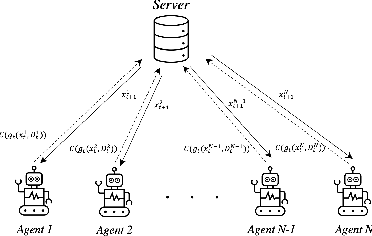

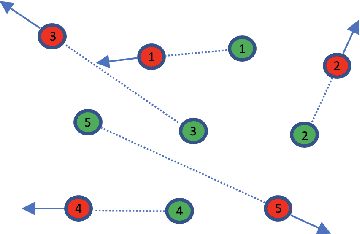
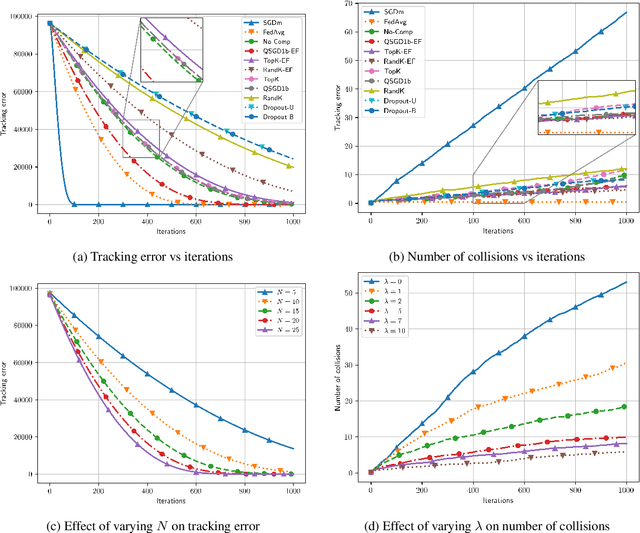
This paper focuses on a multi-agent zeroth-order online optimization problem in a federated learning setting for target tracking. The agents only sense their current distances to their targets and aim to maintain a minimum safe distance from each other to prevent collisions. The coordination among the agents and dissemination of collision-prevention information is managed by a central server using the federated learning paradigm. The proposed formulation leads to an instance of distributed online nonconvex optimization problem that is solved via a group of communication-constrained agents. To deal with the communication limitations of the agents, an error feedback-based compression scheme is utilized for agent-to-server communication. The proposed algorithm is analyzed theoretically for the general class of distributed online nonconvex optimization problems. We provide non-asymptotic convergence rates that show the dominant term is independent of the characteristics of the compression scheme. Our theoretical results feature a new approach that employs significantly more relaxed assumptions in comparison to standard literature. The performance of the proposed solution is further analyzed numerically in terms of tracking errors and collisions between agents in two relevant applications.