 Add to Chrome
 Add to Firefox
 Add to Edge
Physics of Agents: Statistical Mechanics Predicts Collective Behavior of AI Agents
Aug 17, 2026
AI agents increasingly operate as part of interacting systems rather than in isolation. As agents exchange information and jointly make decisions, their interactions can improve collective reasoning but may also produce herding, polarization, or amplify shared biases. Understanding and predicting these collective dynamics is therefore important for designing effective and aligned multi-agent systems. Here, we study over 10,000 communities of language-model agents that repeatedly exchange messages and revise their opinions across objective mathematics questions and subjective political statements. Despite substantial diversity in possible behavior, the individual and group dynamics can be represented by three characteristic regimes: indifference, polarization, and consensus. AI agents start indifferent and build conviction as they interact. On objective questions, communication improves collective accuracy, while on subjective questions it often drifts group opinions toward the right in the political spectrum. We explain these observations with a statistical-mechanics formalism in which agents stochastically favor lower social pressure. Given only initial opinions, our model predicts individual trajectories, outperforms all standard baselines, generalizes to unseen community graphs, and reproduces the observed group archetype distributions. Our fitted model parameters reveal the mechanics underlying our key observations: i) communities operate below the critical social temperature, which explains conviction buildup; ii) attractive ties outweigh repulsive ones, which favors consensus; and iii) agents holding the correct answer exert the strongest pull, which drives truth-seeking. Overall, our results demonstrate that collective behavior of AI agents, like that of other complex systems, follows compact and predictive dynamical laws.

TERMS-Bench: Diagnosing LLM Negotiation Agents Beyond Deal Rate
May 13, 2026Negotiation is a central mechanism of economic exchange, shaping markets, procurement, labor agreements, and resource allocation. It is also a canonical testbed for agentic language models, requiring multi-turn interaction under hidden preferences, strategic communication, and binding constraints. These properties make negotiation hard to evaluate: unlike math or code, it has no intrinsic verifier. Existing LLM negotiation evaluations rely on LLM-vs.-LLM interaction or aggregate outcomes such as deal rate, leaving failures opaque. We introduce Terms-Bench, short for Testbed for Economic Reasoning in Multi-turn Strategy, a Bayesian-game framework that makes the environment itself the verifier by specifying the counterpart's latent type, policy, and payoff structure. We instantiate it in bilateral price negotiation, where the counterpart's private state and simulator policy are hidden from the agent but observable to the evaluator. This turns the counterpart from a black-box opponent into a diagnostic instrument, enabling agent-attributable failure analysis and oracle-reference optimality gaps. Evaluating 13 LLM agents spanning frontier systems from major providers, Terms-Bench turns negotiation evaluation from aggregate ranking into actionable diagnosis: where agents fail, why they fail, and what to strengthen. Empirically, frontier models saturate deal rate yet diverge in surplus extraction, cue use, belief calibration, and compliance, revealing agent-specific bargaining bottlenecks masked by prior benchmarks.
Multi-Agent Teams Hold Experts Back
Feb 03, 2026Multi-agent LLM systems are increasingly deployed as autonomous collaborators, where agents interact freely rather than execute fixed, pre-specified workflows. In such settings, effective coordination cannot be fully designed in advance and must instead emerge through interaction. However, most prior work enforces coordination through fixed roles, workflows, or aggregation rules, leaving open the question of how well self-organizing teams perform when coordination is unconstrained. Drawing on organizational psychology, we study whether self-organizing LLM teams achieve strong synergy, where team performance matches or exceeds the best individual member. Across human-inspired and frontier ML benchmarks, we find that -- unlike human teams -- LLM teams consistently fail to match their expert agent's performance, even when explicitly told who the expert is, incurring performance losses of up to 37.6%. Decomposing this failure, we show that expert leveraging, rather than identification, is the primary bottleneck. Conversational analysis reveals a tendency toward integrative compromise -- averaging expert and non-expert views rather than appropriately weighting expertise -- which increases with team size and correlates negatively with performance. Interestingly, this consensus-seeking behavior improves robustness to adversarial agents, suggesting a trade-off between alignment and effective expertise utilization. Our findings reveal a significant gap in the ability of self-organizing multi-agent teams to harness the collective expertise of their members.
Cost-of-Pass: An Economic Framework for Evaluating Language Models
Apr 17, 2025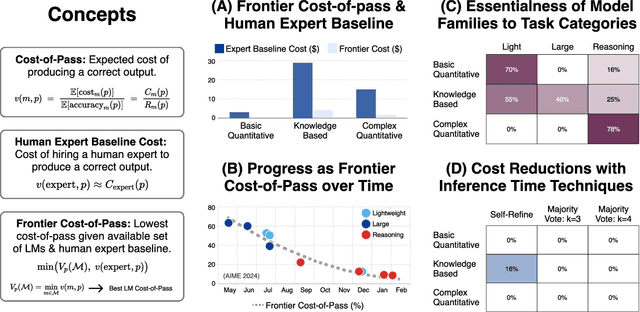
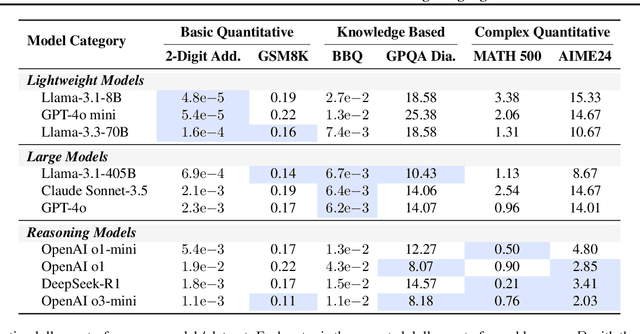
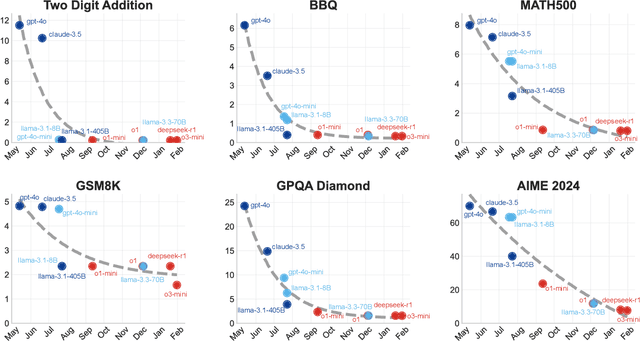

The widespread adoption of AI systems in the economy hinges on their ability to generate economic value that outweighs their inference costs. Evaluating this tradeoff requires metrics that account for both performance and costs. We propose a framework grounded in production theory for evaluating language models by combining accuracy and inference cost. We introduce "cost-of-pass", the expected monetary cost of generating a correct solution. We then define the "frontier cost-of-pass" as the minimum cost-of-pass achievable across available models or the "human-expert, using the approximate cost of hiring an expert. Our analysis reveals distinct economic insights. First, lightweight models are most cost-effective for basic quantitative tasks, large models for knowledge-intensive ones, and reasoning models for complex quantitative problems, despite higher per-token costs. Second, tracking this frontier cost-of-pass over the past year reveals significant progress, particularly for complex quantitative tasks where the cost has roughly halved every few months. Third, to trace key innovations driving this progress, we examine counterfactual frontiers: estimates of cost-efficiency without specific model classes. We find that innovations in lightweight, large, and reasoning models have been essential for pushing the frontier in basic quantitative, knowledge-intensive, and complex quantitative tasks, respectively. Finally, we assess the cost-reductions afforded by common inference-time techniques like majority voting and self-refinement, finding that their marginal accuracy gains rarely justify their costs. Our findings underscore that complementary model-level innovations are the primary drivers of cost-efficiency, and our economic framework provides a principled tool for measuring this progress and guiding deployment.
Towards Mechanistic Interpretability of Graph Transformers via Attention Graphs
Feb 17, 2025We introduce Attention Graphs, a new tool for mechanistic interpretability of Graph Neural Networks (GNNs) and Graph Transformers based on the mathematical equivalence between message passing in GNNs and the self-attention mechanism in Transformers. Attention Graphs aggregate attention matrices across Transformer layers and heads to describe how information flows among input nodes. Through experiments on homophilous and heterophilous node classification tasks, we analyze Attention Graphs from a network science perspective and find that: (1) When Graph Transformers are allowed to learn the optimal graph structure using all-to-all attention among input nodes, the Attention Graphs learned by the model do not tend to correlate with the input/original graph structure; and (2) For heterophilous graphs, different Graph Transformer variants can achieve similar performance while utilising distinct information flow patterns. Open source code: https://github.com/batu-el/understanding-inductive-biases-of-gnns