 Add to Chrome
 Add to Firefox
 Add to Edge
Child-directed speech facilitates production, not comprehension, in BabyLMs
May 31, 2026
Recent studies suggest that child-directed speech is not conducive to language learning in BabyLMs. However, current evaluations focus predominantly on comprehension and not production, which is central to usage-based theories of language acquisition which argue how CDS facilitates early language use through constructional ''frames'' (frequent lexical patterns with open slots). We introduce a novel generation-based evaluation inspired by such theories in form of a frame-completion task, and compare Llama models trained with CDS, the BabyLM corpus, and web-crawl data (FineWeb-edu) on comprehension benchmarks and our novel framework. Our results reveal a clear dissociation between models' comprehension and production capabilities: while FineWeb-trained models excel at minimal pairs, CDS-trained models produce grammatical completions substantially earlier in training and concentrate probability mass on appropriate slot-fillers. These findings show that comprehension benchmarks underestimate what CDS affords to BabyLMs.

CAIT: A Syntactic Parsing Toolkit for Child-Adult InTeractions
May 19, 2026CHILDES is a paramount resource for language acquisition studies -- yet computational tools for analyzing its syntactic structure remain limited. Leveraging the recent release of the UD-English-CHILDES treebank with gold-standard Universal Dependencies (UD) annotations, we train a state-of-the-art dependency parser specifically tailored to CHILDES. The parser more accurately captures syntactic patterns in child--adult interactions, outperforming widely used off-the-shelf English parsers, including SpaCy and Stanza. Alongside the parser, we also release a Part-of-Speech tagger and an utterance-level construction tagger, which together form the open-source Syntactic Parsing Toolkit for Child--Adult InTeractions (CAIT). Through a detailed error analysis and a case study tracking the distribution of syntactic constructions across developmental time in CHILDES, we demonstrate the practical utility of the toolkit for large-scale, reproducible research on language acquisition.
Dialogue Is Not Enough to Make a Communicative BabyLM (But Neither Is Developmentally Inspired Reinforcement Learning)
Oct 23, 2025We investigate whether pre-training exclusively on dialogue data results in formally and functionally apt small language models. Based on this pre-trained llamalogue model, we employ a variety of fine-tuning strategies to enforce "more communicative" text generations by our models. Although our models underperform on most standard BabyLM benchmarks, they excel at dialogue continuation prediction in a minimal pair setting. While PPO fine-tuning has mixed to adversarial effects on our models, DPO fine-tuning further improves their performance on our custom dialogue benchmark.
Do Construction Distributions Shape Formal Language Learning In German BabyLMs?
Mar 14, 2025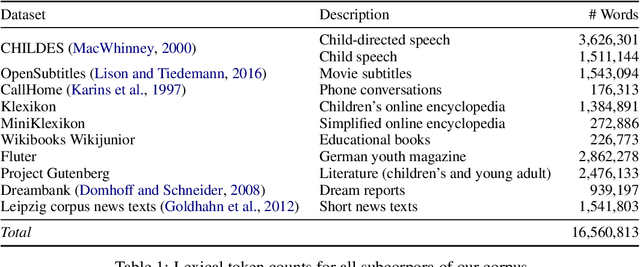
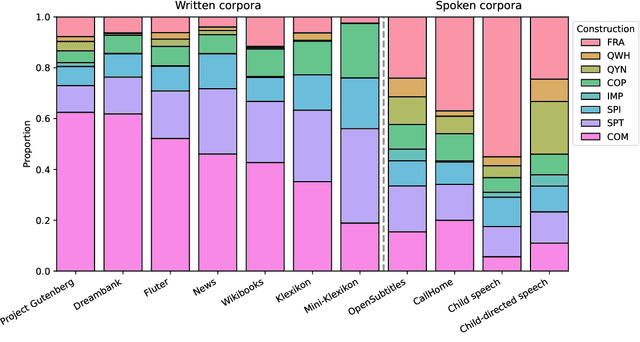
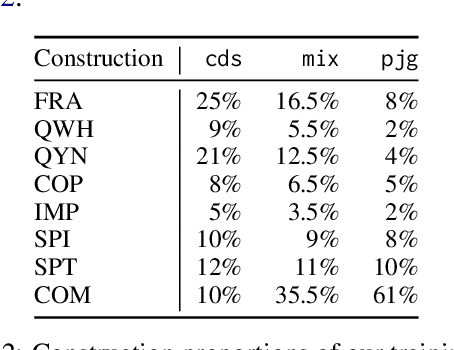
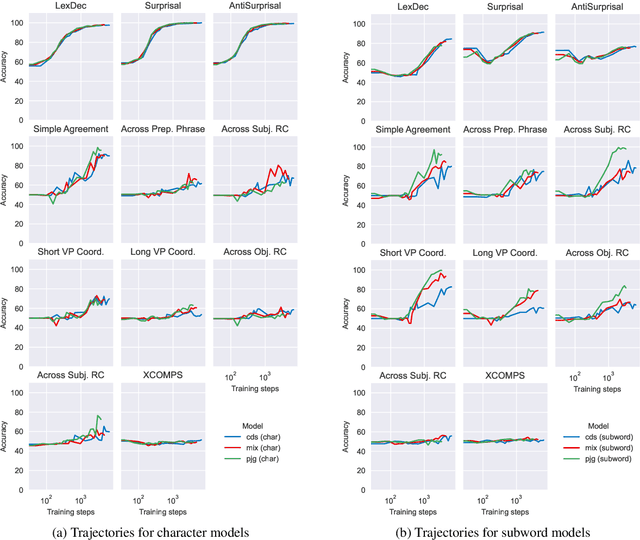
We analyze the influence of utterance-level construction distributions in German child-directed speech on the resulting formal linguistic competence and the underlying learning trajectories for small language models trained on a novel collection of developmentally plausible language data for German. We find that trajectories are surprisingly robust for markedly different distributions of constructions in the training data, which have little effect on final accuracies and almost no effect on global learning trajectories. While syntax learning benefits from more complex utterances, lexical learning culminates in better scores with more fragmentary data. We argue that LMs trained on developmentally plausible data can contribute to debates on how rich or impoverished linguistic stimuli actually are.
Subword models struggle with word learning, but surprisal hides it
Feb 18, 2025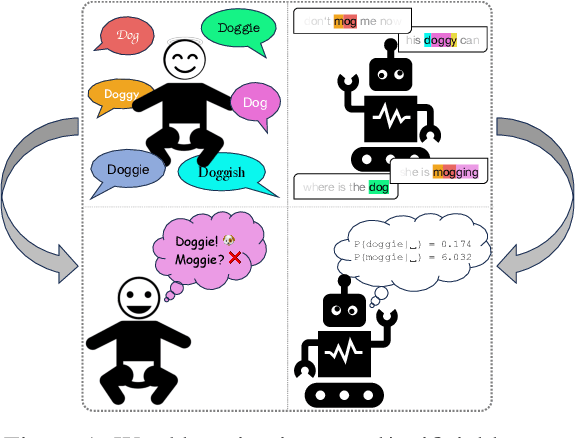
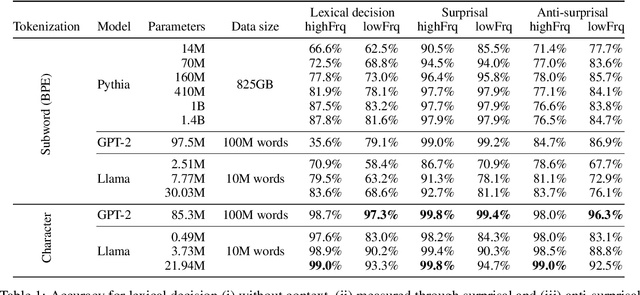
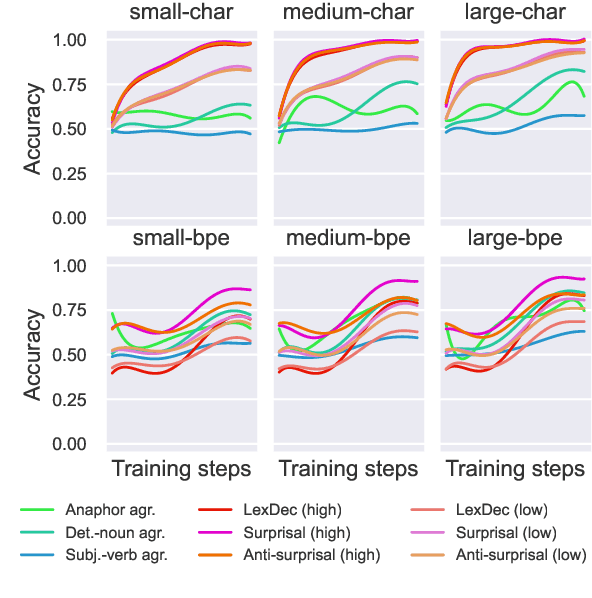
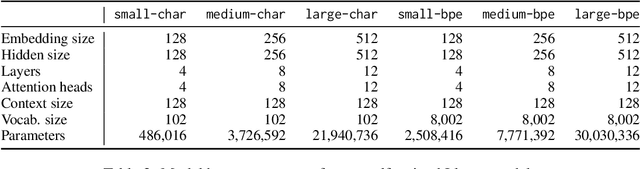
We study word learning in subword and character language models with the psycholinguistic lexical decision task. While subword LMs struggle to discern words and non-words with high accuracy, character LMs solve this task easily and consistently. Furthermore, when comparing word learning and syntactic learning, both processes are separable in character LM where word learning predates syntactic learning, whereas these processes are simultaneous in subword LM. This raises questions about the adequacy of subword LMs for modeling language acquisition and positions character LMs as a viable alternative.
Small Language Models Like Small Vocabularies: Probing the Linguistic Abilities of Grapheme- and Phoneme-Based Baby Llamas
Oct 02, 2024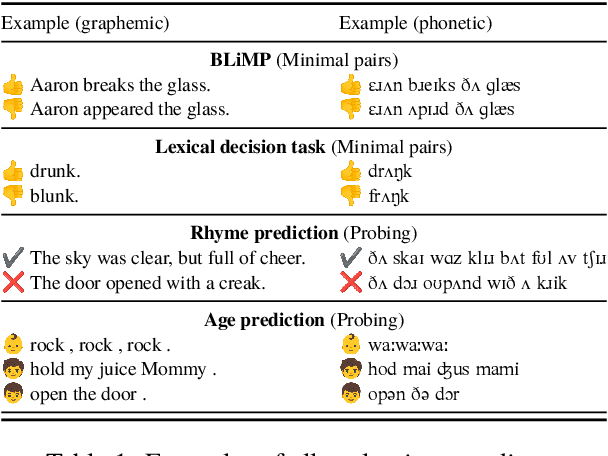

Current language models use subword-based tokenization algorithms like Byte Pair Encoding, which put their validity as models of linguistic representations into question. In this paper, we explore the potential of tokenization-free, phoneme- and grapheme-based language models. We demonstrate that small models based on the Llama architecture can achieve strong linguistic performance on standard syntactic and novel lexical/phonetic benchmarks when trained with character-level vocabularies. We further show that phoneme-based models without any graphemic biases almost match grapheme-based models in standard tasks and novel evaluations. Our findings suggest a promising direction for creating more linguistically plausible language models that are better suited for computational studies of language acquisition and processing.