 Add to Chrome
 Add to Firefox
 Add to Edge
Unifying Graph Neural Networks Through a Common Layer Equation
Aug 17, 2026
Graph neural networks are commonly described through family-specific equations whose notation obscures shared computations and structural differences. We introduce a common layer equation that represents covered architectures through seven components: an update domain, channel set, propagation bank, per-channel message maps, channel-fusion operator, ego/residual map, and update map. The central factorization separates where information moves, encoded by the propagation bank, from what moves, encoded by the message maps. Function-valued fillings extend the same equation across local message passing, attention, spectral filtering, global communication, relation-specific channels, higher-order domains, and geometric messages. We make this unification explicit and checkable through worked reductions of canonical layers and component assignments spanning seven nonexclusive architectural families. A fixed slot discipline assigns operations by computational role and defines the framework's coverage boundary. The decomposition also yields component-level theoretical insights: under endpoint-local messages and node-local updates, operator support bounds one-layer dependencies, and one-layer global mixing requires a full effective operator row under the stated hypotheses. The resulting framework organizes more than 200 architectures in a common design space, enables component-wise comparison and generation of structurally consistent architectures, and connects propagation choices to oversmoothing, oversquashing, heterophily, and expressivity. It further exposes the empirical inverse problem of mapping measurable graph and task properties to validated component choices.

Same Graph Cross-Task Transfer in GNNs: Protocols and Predictors
Jul 30, 2026Many real-world graphs support multiple predictive tasks over the same underlying structure, creating an opportunity to reuse supervision across node classification (NC) and link prediction (LP). However, existing evaluations often rely on incompatible splits, observed-graph assumptions, and negative sampling rules, making conclusions about same-graph cross-task transfer unreliable. We formalize same-graph NC-LP transfer and propose a leakage-free protocol that fixes node and edge splits, uses a shared message-passing graph that excludes evaluated edges, and employs fixed negatives for LP. Across three backbones (GCN, GraphSAGE, GPS), we find that transfer is strongly directional and predictable: NC $\to$ LP is consistently beneficial on homophilic graphs, while LP $\to$ NC is fragile and can even degrade accuracy under naive representation reuse. LP $\to$ NC becomes reliably positive mainly in a structure-dominant regime where LP is easy but NC is unsaturated, suggesting that LP acts as structural pretraining. Finally, we introduce the CoTask Score (CTS) to summarize joint NC+LP utility when a shared encoder must serve both tasks, and show that simple dataset statistics, especially homophily, can guide mechanism choice and help avoid negative transfer.
* 17 pages, 2 figures
TopoFormer: Topology Meets Attention for Graph Learning
Jul 30, 2026We introduce Topoformer, a lightweight and scalable framework for graph representation learning that encodes topological structure into attention-friendly sequences. At the core of our method is Topo-Scan, a novel module that decomposes a graph into a short, ordered sequence of topological tokens by slicing over node or edge filtrations. These sequences capture multi-scale structural patterns, from local motifs to global organization, and are processed by a Transformer to produce expressive graph-level embeddings. Unlike traditional persistent homology pipelines, Topo-Scan is parallelizable, avoids costly diagram computations, and integrates seamlessly with standard deep learning architectures. We provide theoretical guarantees on the stability of our topological encodings and demonstrate state-of-the-art performance across graph classification and molecular property prediction benchmarks. Our results show that Topoformer matches or exceeds strong GNN and topology-based baselines while offering predictable and efficient compute. This work opens a new path for parallelizable and unifying approaches to graph representation learning that integrate topological inductive biases into attention frameworks.
* 26 pages, 5 figures
TopOC: Topological Deep Learning for Ovarian and Breast Cancer Diagnosis
Oct 13, 2024Microscopic examination of slides prepared from tissue samples is the primary tool for detecting and classifying cancerous lesions, a process that is time-consuming and requires the expertise of experienced pathologists. Recent advances in deep learning methods hold significant potential to enhance medical diagnostics and treatment planning by improving accuracy, reproducibility, and speed, thereby reducing clinicians' workloads and turnaround times. However, the necessity for vast amounts of labeled data to train these models remains a major obstacle to the development of effective clinical decision support systems. In this paper, we propose the integration of topological deep learning methods to enhance the accuracy and robustness of existing histopathological image analysis models. Topological data analysis (TDA) offers a unique approach by extracting essential information through the evaluation of topological patterns across different color channels. While deep learning methods capture local information from images, TDA features provide complementary global features. Our experiments on publicly available histopathological datasets demonstrate that the inclusion of topological features significantly improves the differentiation of tumor types in ovarian and breast cancers.
ClassContrast: Bridging the Spatial and Contextual Gaps for Node Representations
Oct 03, 2024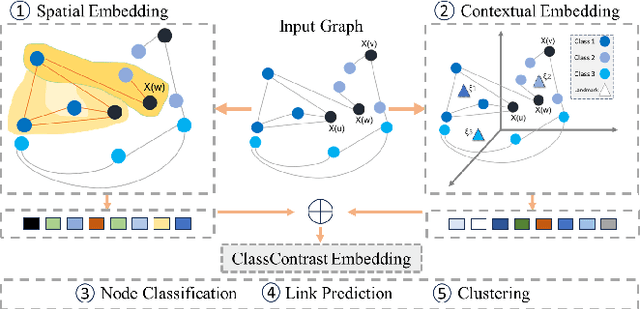
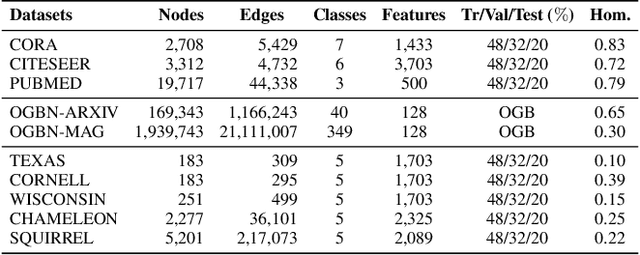
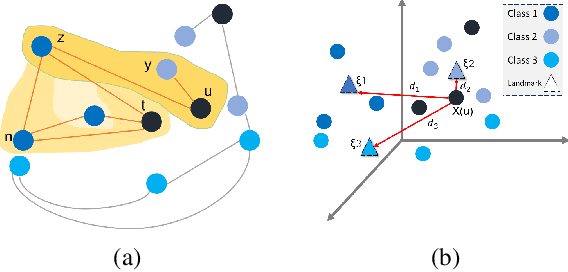
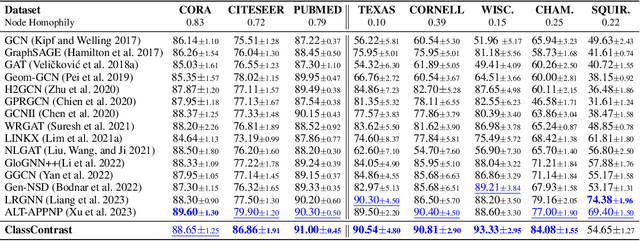
Graph Neural Networks (GNNs) have revolutionized the domain of graph representation learning by utilizing neighborhood aggregation schemes in many popular architectures, such as message passing graph neural networks (MPGNNs). This scheme involves iteratively calculating a node's representation vector by aggregating and transforming the representation vectors of its adjacent nodes. Despite their effectiveness, MPGNNs face significant issues, such as oversquashing, oversmoothing, and underreaching, which hamper their effectiveness. Additionally, the reliance of MPGNNs on the homophily assumption, where edges typically connect nodes with similar labels and features, limits their performance in heterophilic contexts, where connected nodes often have significant differences. This necessitates the development of models that can operate effectively in both homophilic and heterophilic settings. In this paper, we propose a novel approach, ClassContrast, grounded in Energy Landscape Theory from Chemical Physics, to overcome these limitations. ClassContrast combines spatial and contextual information, leveraging a physics-inspired energy landscape to model node embeddings that are both discriminative and robust across homophilic and heterophilic settings. Our approach introduces contrast-based homophily matrices to enhance the understanding of class interactions and tendencies. Through extensive experiments, we demonstrate that ClassContrast outperforms traditional GNNs in node classification and link prediction tasks, proving its effectiveness and versatility in diverse real-world scenarios.
PROXI: Challenging the GNNs for Link Prediction
Oct 02, 2024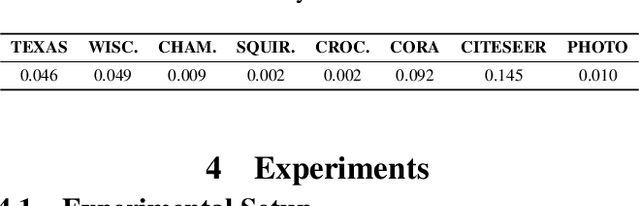
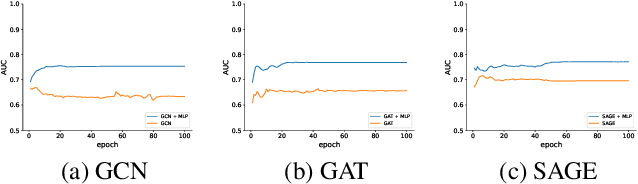
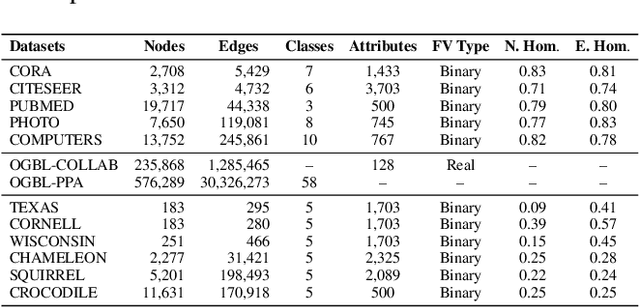
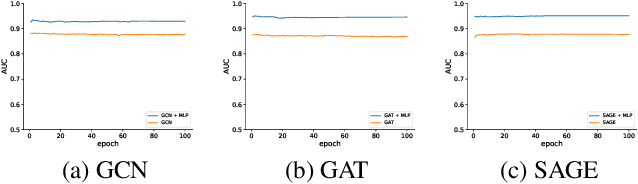
Over the past decade, Graph Neural Networks (GNNs) have transformed graph representation learning. In the widely adopted message-passing GNN framework, nodes refine their representations by aggregating information from neighboring nodes iteratively. While GNNs excel in various domains, recent theoretical studies have raised concerns about their capabilities. GNNs aim to address various graph-related tasks by utilizing such node representations, however, this one-size-fits-all approach proves suboptimal for diverse tasks. Motivated by these observations, we conduct empirical tests to compare the performance of current GNN models with more conventional and direct methods in link prediction tasks. Introducing our model, PROXI, which leverages proximity information of node pairs in both graph and attribute spaces, we find that standard machine learning (ML) models perform competitively, even outperforming cutting-edge GNN models when applied to these proximity metrics derived from node neighborhoods and attributes. This holds true across both homophilic and heterophilic networks, as well as small and large benchmark datasets, including those from the Open Graph Benchmark (OGB). Moreover, we show that augmenting traditional GNNs with PROXI significantly boosts their link prediction performance. Our empirical findings corroborate the previously mentioned theoretical observations and imply that there exists ample room for enhancement in current GNN models to reach their potential.
TopER: Topological Embeddings in Graph Representation Learning
Oct 02, 2024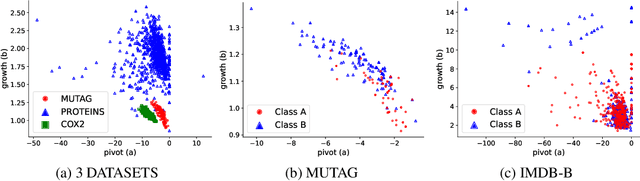
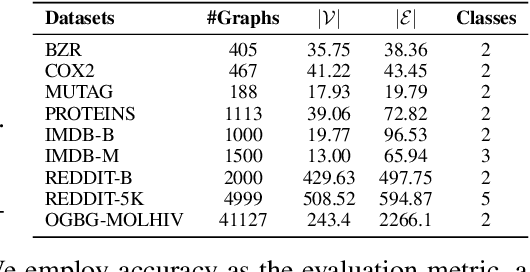
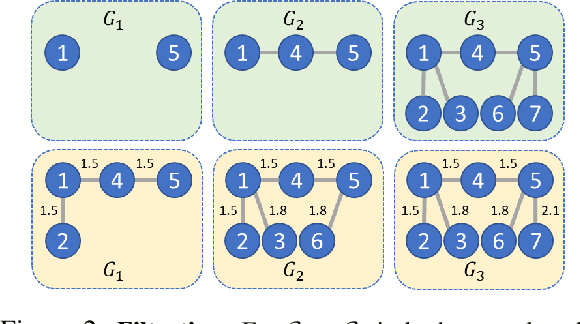
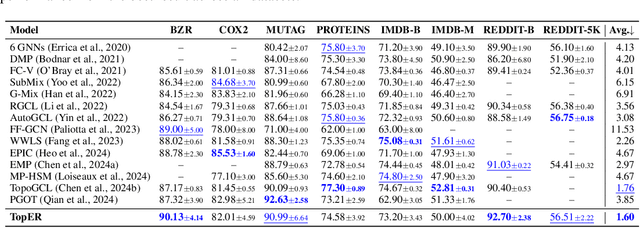
Graph embeddings play a critical role in graph representation learning, allowing machine learning models to explore and interpret graph-structured data. However, existing methods often rely on opaque, high-dimensional embeddings, limiting interpretability and practical visualization. In this work, we introduce Topological Evolution Rate (TopER), a novel, low-dimensional embedding approach grounded in topological data analysis. TopER simplifies a key topological approach, Persistent Homology, by calculating the evolution rate of graph substructures, resulting in intuitive and interpretable visualizations of graph data. This approach not only enhances the exploration of graph datasets but also delivers competitive performance in graph clustering and classification tasks. Our TopER-based models achieve or surpass state-of-the-art results across molecular, biological, and social network datasets in tasks such as classification, clustering, and visualization.
Topological Methods in Machine Learning: A Tutorial for Practitioners
Sep 04, 2024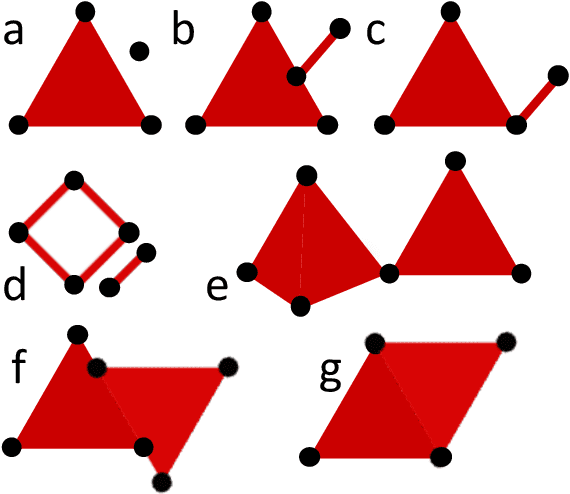
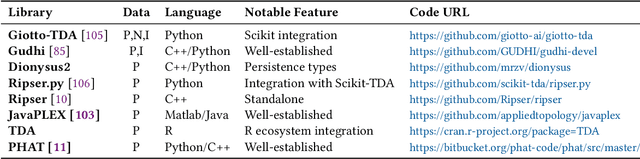
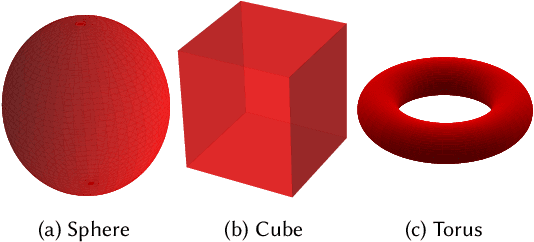
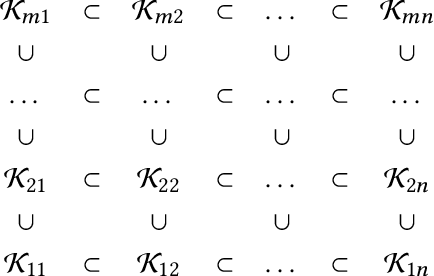
Topological Machine Learning (TML) is an emerging field that leverages techniques from algebraic topology to analyze complex data structures in ways that traditional machine learning methods may not capture. This tutorial provides a comprehensive introduction to two key TML techniques, persistent homology and the Mapper algorithm, with an emphasis on practical applications. Persistent homology captures multi-scale topological features such as clusters, loops, and voids, while the Mapper algorithm creates an interpretable graph summarizing high-dimensional data. To enhance accessibility, we adopt a data-centric approach, enabling readers to gain hands-on experience applying these techniques to relevant tasks. We provide step-by-step explanations, implementations, hands-on examples, and case studies to demonstrate how these tools can be applied to real-world problems. The goal is to equip researchers and practitioners with the knowledge and resources to incorporate TML into their work, revealing insights often hidden from conventional machine learning methods. The tutorial code is available at https://github.com/cakcora/TopologyForML
Towards Neural Scaling Laws for Foundation Models on Temporal Graphs
Jun 14, 2024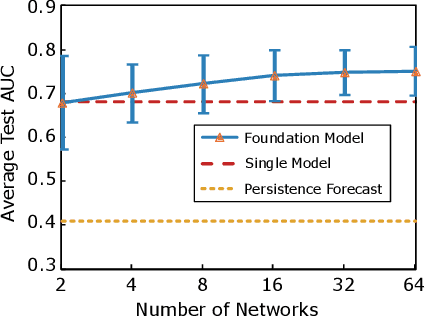

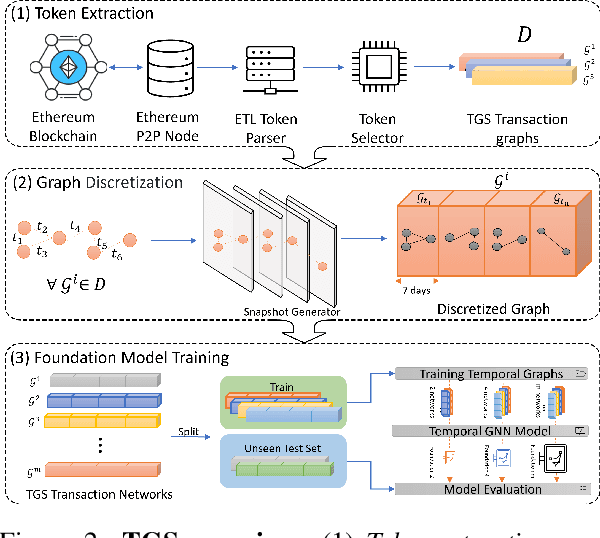

The field of temporal graph learning aims to learn from evolving network data to forecast future interactions. Given a collection of observed temporal graphs, is it possible to predict the evolution of an unseen network from the same domain? To answer this question, we first present the Temporal Graph Scaling (TGS) dataset, a large collection of temporal graphs consisting of eighty-four ERC20 token transaction networks collected from 2017 to 2023. Next, we evaluate the transferability of Temporal Graph Neural Networks (TGNNs) for the temporal graph property prediction task by pre-training on a collection of up to sixty-four token transaction networks and then evaluating the downstream performance on twenty unseen token networks. We find that the neural scaling law observed in NLP and Computer Vision also applies in temporal graph learning, where pre-training on greater number of networks leads to improved downstream performance. To the best of our knowledge, this is the first empirical demonstration of the transferability of temporal graphs learning. On downstream token networks, the largest pre-trained model outperforms single model TGNNs on thirteen unseen test networks. Therefore, we believe that this is a promising first step towards building foundation models for temporal graphs.
EMP: Effective Multidimensional Persistence for Graph Representation Learning
Jan 24, 2024Topological data analysis (TDA) is gaining prominence across a wide spectrum of machine learning tasks that spans from manifold learning to graph classification. A pivotal technique within TDA is persistent homology (PH), which furnishes an exclusive topological imprint of data by tracing the evolution of latent structures as a scale parameter changes. Present PH tools are confined to analyzing data through a single filter parameter. However, many scenarios necessitate the consideration of multiple relevant parameters to attain finer insights into the data. We address this issue by introducing the Effective Multidimensional Persistence (EMP) framework. This framework empowers the exploration of data by simultaneously varying multiple scale parameters. The framework integrates descriptor functions into the analysis process, yielding a highly expressive data summary. It seamlessly integrates established single PH summaries into multidimensional counterparts like EMP Landscapes, Silhouettes, Images, and Surfaces. These summaries represent data's multidimensional aspects as matrices and arrays, aligning effectively with diverse ML models. We provide theoretical guarantees and stability proofs for EMP summaries. We demonstrate EMP's utility in graph classification tasks, showing its effectiveness. Results reveal that EMP enhances various single PH descriptors, outperforming cutting-edge methods on multiple benchmark datasets.
* arXiv admin note: text overlap with arXiv:2401.13157