 Add to Chrome
 Add to Firefox
 Add to Edge
TopoFormer: Topology Meets Attention for Graph Learning
Jul 30, 2026
We introduce Topoformer, a lightweight and scalable framework for graph representation learning that encodes topological structure into attention-friendly sequences. At the core of our method is Topo-Scan, a novel module that decomposes a graph into a short, ordered sequence of topological tokens by slicing over node or edge filtrations. These sequences capture multi-scale structural patterns, from local motifs to global organization, and are processed by a Transformer to produce expressive graph-level embeddings. Unlike traditional persistent homology pipelines, Topo-Scan is parallelizable, avoids costly diagram computations, and integrates seamlessly with standard deep learning architectures. We provide theoretical guarantees on the stability of our topological encodings and demonstrate state-of-the-art performance across graph classification and molecular property prediction benchmarks. Our results show that Topoformer matches or exceeds strong GNN and topology-based baselines while offering predictable and efficient compute. This work opens a new path for parallelizable and unifying approaches to graph representation learning that integrate topological inductive biases into attention frameworks.
* 26 pages, 5 figures

ClassContrast: Bridging the Spatial and Contextual Gaps for Node Representations
Oct 03, 2024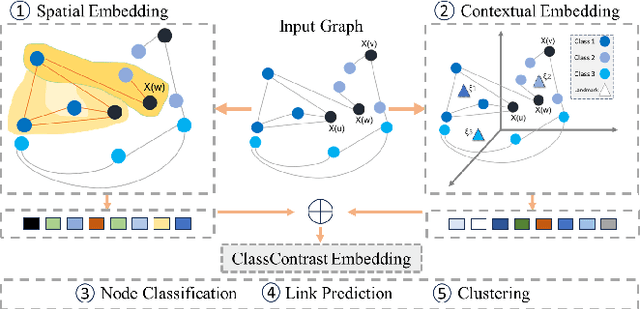
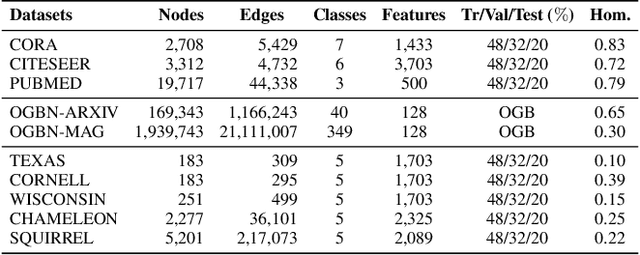
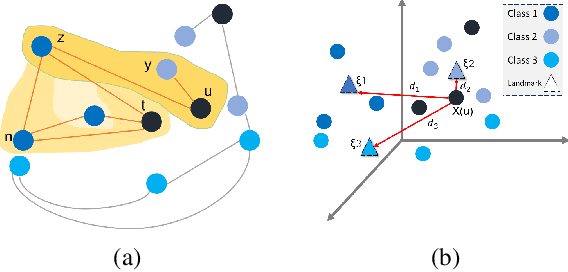
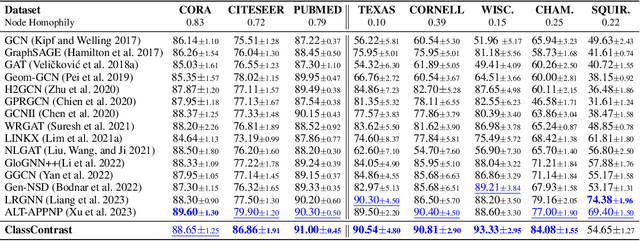
Graph Neural Networks (GNNs) have revolutionized the domain of graph representation learning by utilizing neighborhood aggregation schemes in many popular architectures, such as message passing graph neural networks (MPGNNs). This scheme involves iteratively calculating a node's representation vector by aggregating and transforming the representation vectors of its adjacent nodes. Despite their effectiveness, MPGNNs face significant issues, such as oversquashing, oversmoothing, and underreaching, which hamper their effectiveness. Additionally, the reliance of MPGNNs on the homophily assumption, where edges typically connect nodes with similar labels and features, limits their performance in heterophilic contexts, where connected nodes often have significant differences. This necessitates the development of models that can operate effectively in both homophilic and heterophilic settings. In this paper, we propose a novel approach, ClassContrast, grounded in Energy Landscape Theory from Chemical Physics, to overcome these limitations. ClassContrast combines spatial and contextual information, leveraging a physics-inspired energy landscape to model node embeddings that are both discriminative and robust across homophilic and heterophilic settings. Our approach introduces contrast-based homophily matrices to enhance the understanding of class interactions and tendencies. Through extensive experiments, we demonstrate that ClassContrast outperforms traditional GNNs in node classification and link prediction tasks, proving its effectiveness and versatility in diverse real-world scenarios.