 Add to Chrome
 Add to Firefox
 Add to Edge
VIOLET: High-Fidelity Violin Synthesis with Techniques and Dynamics
Aug 08, 2026
Neural synthesis for musical instruments has the potential to revolutionize current practices that use concatenative synthesis and a sample library. However, most research focused on piano synthesis and expressive performance generation; little work has been done on continuously articulated instruments like the violin, let alone rendering them with playing techniques and dynamics. We present VIOLET, a latent-diffusion framework for controllable violin synthesis, which uses a Diffusion Transformer (DiT) with rectified flow to synthesize high-fidelity audio from MIDI notes, playing techniques, and continuous dynamics. To train VIOLET, in addition to using a few existing datasets, we curate a new dataset named CSV-TD, which contains 39 h of 48 kHz synthetic audio and time-aligned annotations of MIDI notes, note-level techniques, and continuous dynamics curves. Objective and subjective evaluations show that VIOLET synthesizes violin performances with high technique adherence, accurate pitch and timing alignment, and good dynamics control. It outperforms the current state-of-the-art neural violin synthesis system and approaches a top commercial virtual instrument in terms of technique clarity, naturalness, and dynamics following.

Exploring Unified Perspective For Fast Shapley Value Estimation
Nov 02, 2023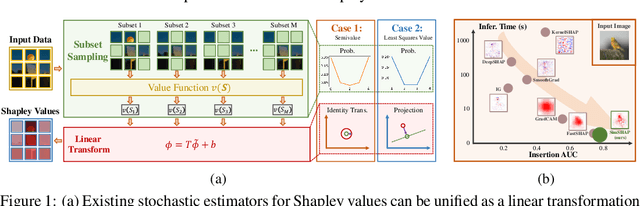
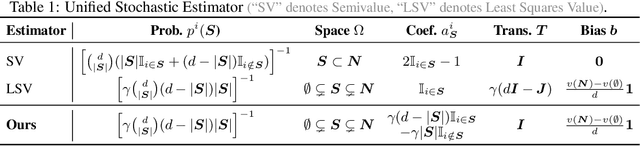

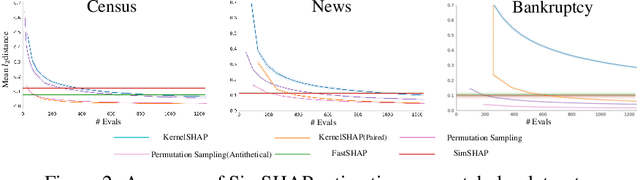
Shapley values have emerged as a widely accepted and trustworthy tool, grounded in theoretical axioms, for addressing challenges posed by black-box models like deep neural networks. However, computing Shapley values encounters exponential complexity in the number of features. Various approaches, including ApproSemivalue, KernelSHAP, and FastSHAP, have been explored to expedite the computation. We analyze the consistency of existing works and conclude that stochastic estimators can be unified as the linear transformation of importance sampling of feature subsets. Based on this, we investigate the possibility of designing simple amortized estimators and propose a straightforward and efficient one, SimSHAP, by eliminating redundant techniques. Extensive experiments conducted on tabular and image datasets validate the effectiveness of our SimSHAP, which significantly accelerates the computation of accurate Shapley values.