 Add to Chrome
 Add to Firefox
 Add to Edge
Tokens are All You Need: Dual-purpose Semantic IDs for Achieving LLM-Level I/O Efficiency in recommendation systems
Jul 26, 2026
Large-scale recommendation systems face "Memory Wall" bottlenecks due to massive, dense embedding tables. While generative retrieval uses discrete tokens for IDs, high-dimensional context still relies on inefficient dense formats. Inspired by computer vision data compression, we propose Dual-purpose Semantic IDs to achieve LLM-level I/O efficiency. Our methodology uses hierarchical quantization to condense continuous embeddings into discrete Semantic IDs performing two concurrent roles: (1) Collaborative Identity: modeling user-item interactions via learnable embedding table; and (2) Content Reconstruction: using a lightweight Semantic Decoder for on-the-fly embedding approximation. This approach replaces massive vector storage with on-demand reconstruction, reducing system overhead and data footprints. We demonstrate the efficacy of our framework through offline evaluations and successful online deployment in production-scale ranking and retrieval systems at a major video sharing platform, showing that discrete tokens are indeed all you need for highly efficient, content-rich recommendation.

LiGNN: Graph Neural Networks at LinkedIn
Feb 17, 2024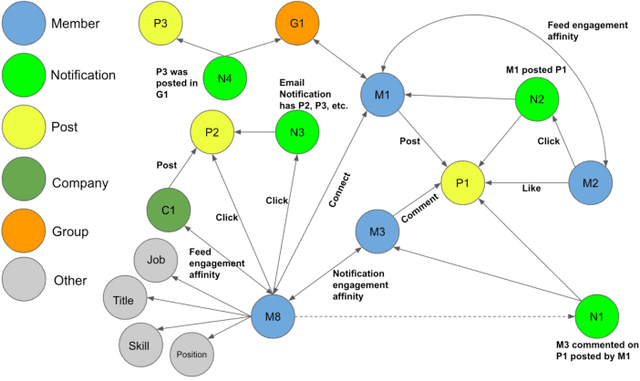
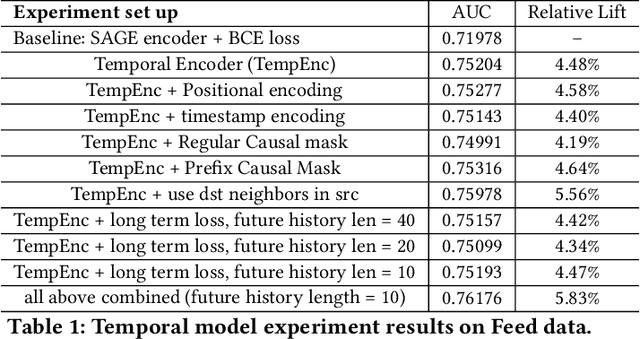
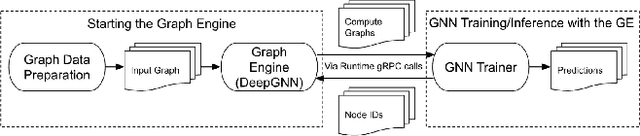
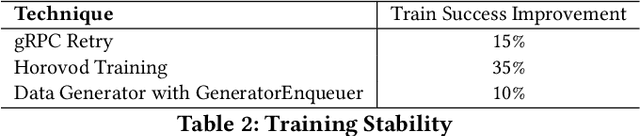
In this paper, we present LiGNN, a deployed large-scale Graph Neural Networks (GNNs) Framework. We share our insight on developing and deployment of GNNs at large scale at LinkedIn. We present a set of algorithmic improvements to the quality of GNN representation learning including temporal graph architectures with long term losses, effective cold start solutions via graph densification, ID embeddings and multi-hop neighbor sampling. We explain how we built and sped up by 7x our large-scale training on LinkedIn graphs with adaptive sampling of neighbors, grouping and slicing of training data batches, specialized shared-memory queue and local gradient optimization. We summarize our deployment lessons and learnings gathered from A/B test experiments. The techniques presented in this work have contributed to an approximate relative improvements of 1% of Job application hearing back rate, 2% Ads CTR lift, 0.5% of Feed engaged daily active users, 0.2% session lift and 0.1% weekly active user lift from people recommendation. We believe that this work can provide practical solutions and insights for engineers who are interested in applying Graph neural networks at large scale.