 Add to Chrome
 Add to Firefox
 Add to Edge
A Vision-Language-Action Model with Visual Prompt for OFF-Road Autonomous Driving
Jan 07, 2026
Efficient trajectory planning in off-road terrains presents a formidable challenge for autonomous vehicles, often necessitating complex multi-step pipelines. However, traditional approaches exhibit limited adaptability in dynamic environments. To address these limitations, this paper proposes OFF-EMMA, a novel end-to-end multimodal framework designed to overcome the deficiencies of insufficient spatial perception and unstable reasoning in visual-language-action (VLA) models for off-road autonomous driving scenarios. The framework explicitly annotates input images through the design of a visual prompt block and introduces a chain-of-thought with self-consistency (COT-SC) reasoning strategy to enhance the accuracy and robustness of trajectory planning. The visual prompt block utilizes semantic segmentation masks as visual prompts, enhancing the spatial understanding ability of pre-trained visual-language models for complex terrains. The COT- SC strategy effectively mitigates the error impact of outliers on planning performance through a multi-path reasoning mechanism. Experimental results on the RELLIS-3D off-road dataset demonstrate that OFF-EMMA significantly outperforms existing methods, reducing the average L2 error of the Qwen backbone model by 13.3% and decreasing the failure rate from 16.52% to 6.56%.

When Will AI Exceed Human Performance? Evidence from AI Experts
May 03, 2018

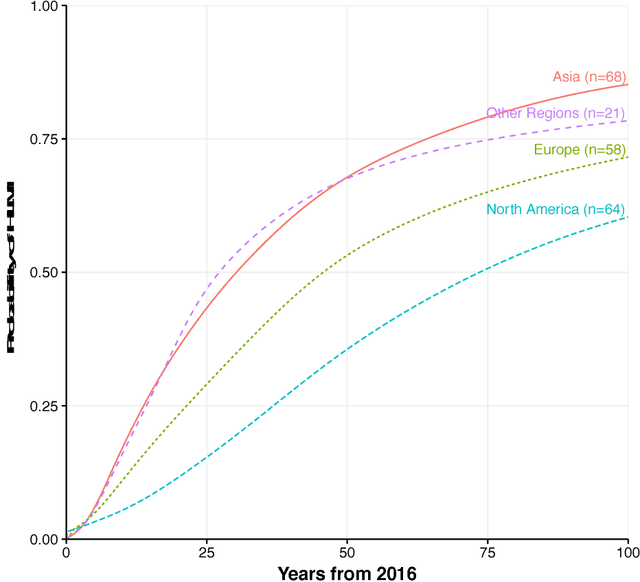

Advances in artificial intelligence (AI) will transform modern life by reshaping transportation, health, science, finance, and the military. To adapt public policy, we need to better anticipate these advances. Here we report the results from a large survey of machine learning researchers on their beliefs about progress in AI. Researchers predict AI will outperform humans in many activities in the next ten years, such as translating languages (by 2024), writing high-school essays (by 2026), driving a truck (by 2027), working in retail (by 2031), writing a bestselling book (by 2049), and working as a surgeon (by 2053). Researchers believe there is a 50% chance of AI outperforming humans in all tasks in 45 years and of automating all human jobs in 120 years, with Asian respondents expecting these dates much sooner than North Americans. These results will inform discussion amongst researchers and policymakers about anticipating and managing trends in AI.