 Add to Chrome
 Add to Firefox
 Add to Edge
Lyapunov-Based Completion-Aware Scheduling for PDU Set-Based Real-Time XR Traffic
Aug 06, 2026
Real-time extended reality (XR) services impose stringent throughput, latency, and reliability requirements. An XR media unit is commonly segmented into a protocol data unit (PDU) set that is useful only when all required PDUs are delivered within its delay budget. Existing PDU set-aware medium access control (MAC) schedulers generally prioritize transmissions according to urgency or progress, without explicitly accounting for whether a PDU set can still be completed on time. In this paper, we propose a Lyapunov-based completion-aware MAC scheduler that jointly captures the set-level completion dependency, deadline urgency, and completion feasibility of each head-of-line PDU set. Long-term quality-of-service (QoS) requirements are represented through virtual debt queues, and resources are allocated according to their marginal contribution to the timely-completion probability of each head-of-line PDU set. These components are integrated into a drift-plus-penalty scheduling metric that balances long-term reliability requirements against current completion opportunities. System-level simulations demonstrate that the proposed scheduler improves PDU set delivery reliability and lower-tail performance under resource contention, while providing robust performance across heterogeneous traffic demands and network conditions.

Positional Attention-based Graph Neural Network for Learning Permutation Non-equivariant Wireless Policies
Jul 14, 2026Graph neural networks (GNNs) have emerged as a promising approach to learning wireless policies efficiently by leveraging topology prior and incorporating relational inductive biases. However, when the optimal policy is not permutation equivariant (PE), conventional GNNs suffer from mismatched inductive biases, leading to degraded performance or poor generalizability. This issue arises in wireless tasks with expected objectives, such as channel estimation and end-to-end (E2E) precoding, where the PE property of the optimal policy depends on the underlying channel distribution. In this paper, we propose a novel positional attention-based GNN to learn permutation nonequivariant policies efficiently. The core idea is to incorporate relative positions of vertices into the attention mechanism via an embedding function, enabling the GNNs to capture asymmetric relationships. Consequently, the proposed GNN can represent permutation non-equivariant functions, while retaining high learning efficiency and size generalizability through parameter sharing. We consider channel estimation and E2E precoding as case studies, and prove that their policies are PE to users but not to antennas under spatially correlated channels. We employ the proposed GNN to learn the policies, where the embedding function is designed based on the channel covariance matrix. Simulation results demonstrate that the proposed GNN outperforms existing channel estimation and E2E precoding methods, requires fewer samples for training, and can be generalized to systems with different numbers of antennas and users.
Understanding the Performance of Learning Precoding Policy with GNN and CNNs
Nov 27, 2022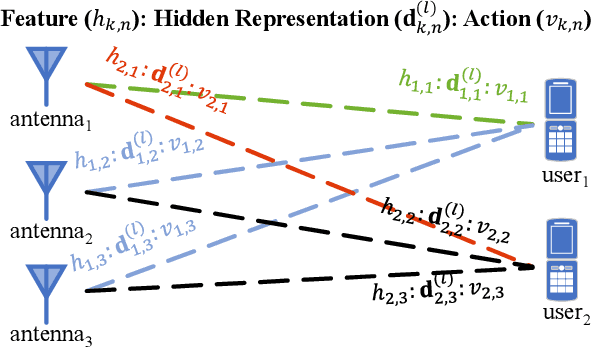
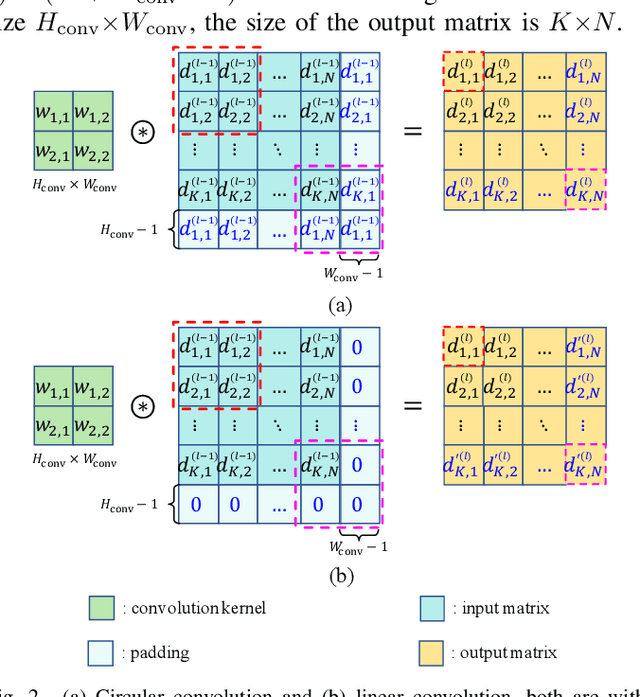
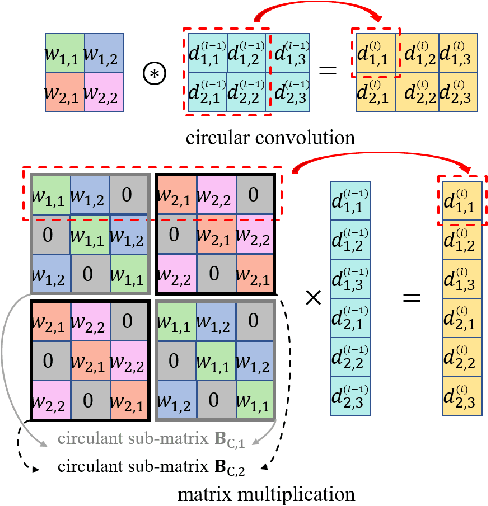
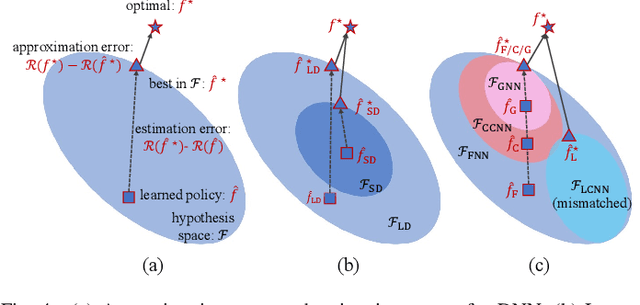
Learning-based precoding has been shown able to be implemented in real-time, jointly optimized with channel acquisition, and robust to imperfect channels. Yet previous works rarely explain the design choices and learning performance, and existing methods either suffer from high training complexity or depend on problem-specific models. In this paper, we address these issues by analyzing the properties of precoding policy and inductive biases of neural networks, noticing that the learning performance can be decomposed into approximation and estimation errors where the former is related to the smoothness of the policy and both depend on the inductive biases of neural networks. To this end, we introduce a graph neural network (GNN) to learn precoding policy and analyze its connection with the commonly used convolutional neural networks (CNNs). By taking a sum rate maximization precoding policy as an example, we explain why the learned precoding policy performs well in the low signal-to-noise ratio regime, in spatially uncorrelated channels, and when the number of users is much fewer than the number of antennas, as well as why GNN is with higher learning efficiency than CNNs. Extensive simulations validate our analyses and evaluate the generalization ability of the GNN.