 Add to Chrome
 Add to Firefox
 Add to Edge
Vibe-FDTR: An agent-oriented framework for reproducible frequency-domain thermoreflectance data analysis
Jul 30, 2026
Frequency-domain thermoreflectance (FDTR) is a laser pump-probe technique widely used to measure thermal properties at the micro- and nanoscale; however, it relies on a complex data analysis procedure that demands substantial domain expertise and is susceptible to subtle human errors. Here, we present Vibe-FDTR, an agent-oriented framework that enables large language model (LLM) agents to perform reliable and reproducible FDTR analyses directly from natural language requests. This framework couples a configuration-driven FDTR code package, which enforces physical and parametric consistency, with procedural agent skills that translate user intentions into organized and verifiable analysis steps. We evaluate Vibe-FDTR using a controlled benchmark with two levels: synthetic single-step tasks and real-data multi-step tasks based on measurements of gold-coated graphite samples. Across the two levels, agents using Vibe-FDTR achieve success rates of 100% and 98.9%, respectively. In sharp contrast, ablating skills (Code-agent) reduces performance to 91.4% and 36.7%, which drops further to 38.6% and 0% when the domain package is also omitted (Agent-only). Beyond success rate, Vibe-FDTR also reduces computational cost by 87.7% relative to the Code-agent variant and cuts execution time by more than 60%. Finally, an optional expert mode supports experimental planning via autonomous sensitivity and uncertainty evaluations, and formulates physically grounded recommendations for underspecified tasks. These results demonstrate that encapsulating domain code and expert knowledge into agent skills offers a promising route toward low-barrier, autonomous, and trustworthy thermal metrology.

GUI-Rise: Structured Reasoning and History Summarization for GUI Navigation
Oct 31, 2025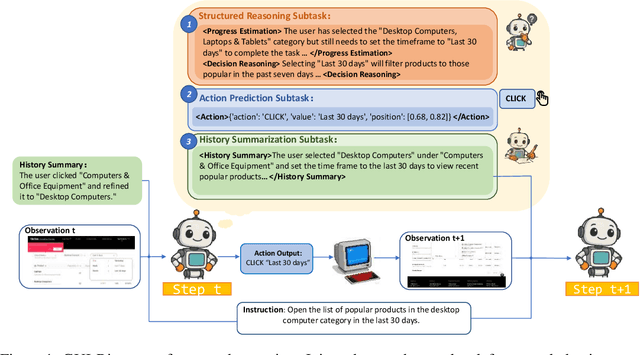
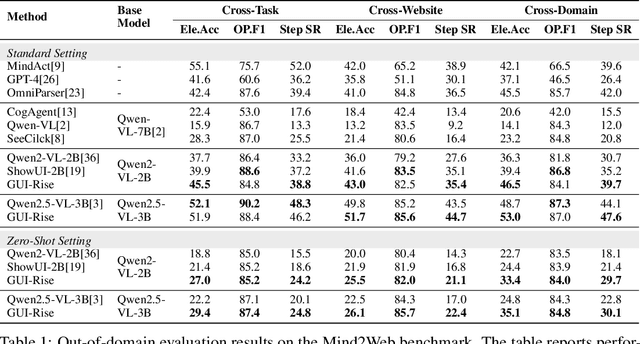
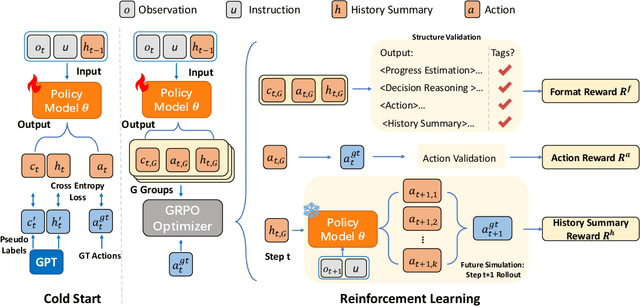
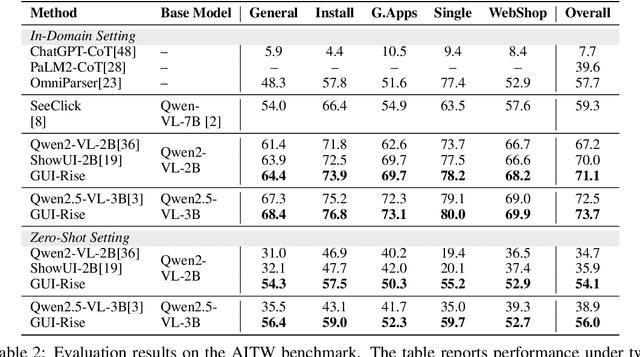
While Multimodal Large Language Models (MLLMs) have advanced GUI navigation agents, current approaches face limitations in cross-domain generalization and effective history utilization. We present a reasoning-enhanced framework that systematically integrates structured reasoning, action prediction, and history summarization. The structured reasoning component generates coherent Chain-of-Thought analyses combining progress estimation and decision reasoning, which inform both immediate action predictions and compact history summaries for future steps. Based on this framework, we train a GUI agent, \textbf{GUI-Rise}, through supervised fine-tuning on pseudo-labeled trajectories and reinforcement learning with Group Relative Policy Optimization (GRPO). This framework employs specialized rewards, including a history-aware objective, directly linking summary quality to subsequent action performance. Comprehensive evaluations on standard benchmarks demonstrate state-of-the-art results under identical training data conditions, with particularly strong performance in out-of-domain scenarios. These findings validate our framework's ability to maintain robust reasoning and generalization across diverse GUI navigation tasks. Code is available at https://leon022.github.io/GUI-Rise.
VMRF: View Matching Neural Radiance Fields
Jul 06, 2022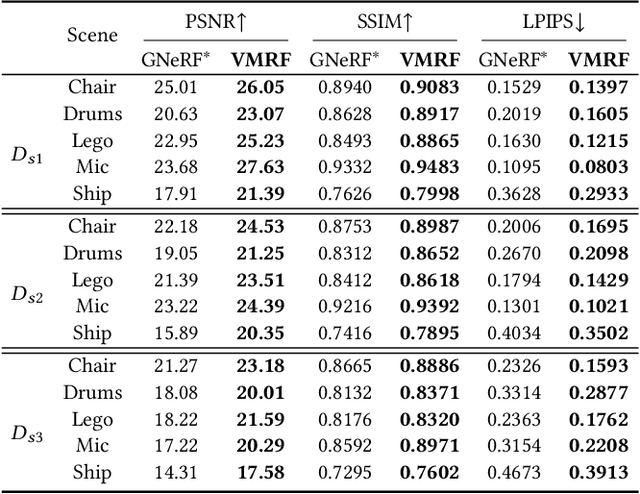
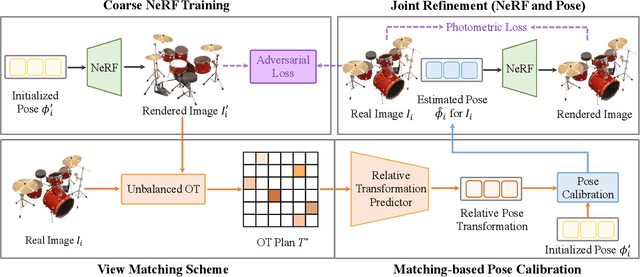
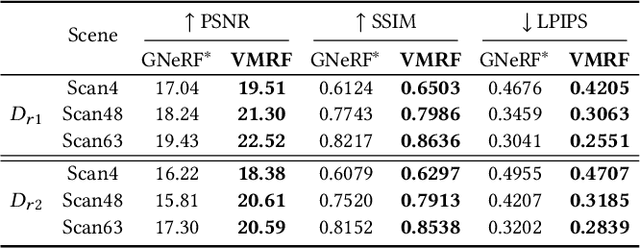
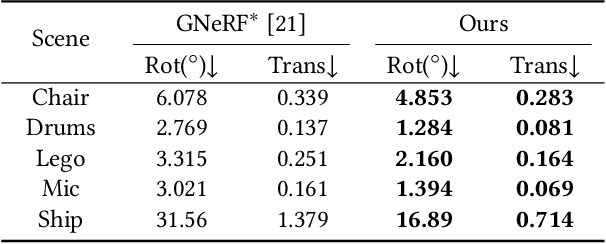
Neural Radiance Fields (NeRF) have demonstrated very impressive performance in novel view synthesis via implicitly modelling 3D representations from multi-view 2D images. However, most existing studies train NeRF models with either reasonable camera pose initialization or manually-crafted camera pose distributions which are often unavailable or hard to acquire in various real-world data. We design VMRF, an innovative view matching NeRF that enables effective NeRF training without requiring prior knowledge in camera poses or camera pose distributions. VMRF introduces a view matching scheme, which exploits unbalanced optimal transport to produce a feature transport plan for mapping a rendered image with randomly initialized camera pose to the corresponding real image. With the feature transport plan as the guidance, a novel pose calibration technique is designed which rectifies the initially randomized camera poses by predicting relative pose transformations between the pair of rendered and real images. Extensive experiments over a number of synthetic and real datasets show that the proposed VMRF outperforms the state-of-the-art qualitatively and quantitatively by large margins.