 Add to Chrome
 Add to Firefox
 Add to Edge
Towards AI-Supported Research: a Vision of the TIB AIssistant
Dec 18, 2025
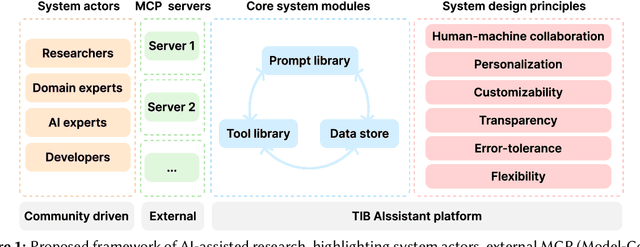
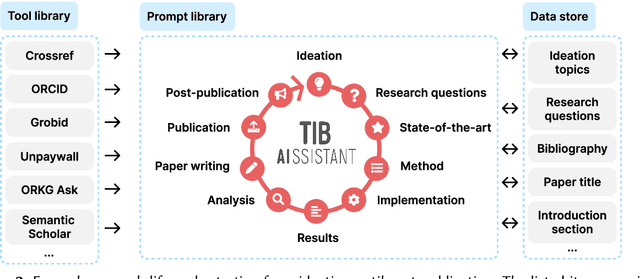
The rapid advancements in Generative AI and Large Language Models promise to transform the way research is conducted, potentially offering unprecedented opportunities to augment scholarly workflows. However, effectively integrating AI into research remains a challenge due to varying domain requirements, limited AI literacy, the complexity of coordinating tools and agents, and the unclear accuracy of Generative AI in research. We present the vision of the TIB AIssistant, a domain-agnostic human-machine collaborative platform designed to support researchers across disciplines in scientific discovery, with AI assistants supporting tasks across the research life cycle. The platform offers modular components - including prompt and tool libraries, a shared data store, and a flexible orchestration framework - that collectively facilitate ideation, literature analysis, methodology development, data analysis, and scholarly writing. We describe the conceptual framework, system architecture, and implementation of an early prototype that demonstrates the feasibility and potential impact of our approach.

Secu-Table: a Comprehensive security table dataset for evaluating semantic table interpretation systems
Nov 09, 2025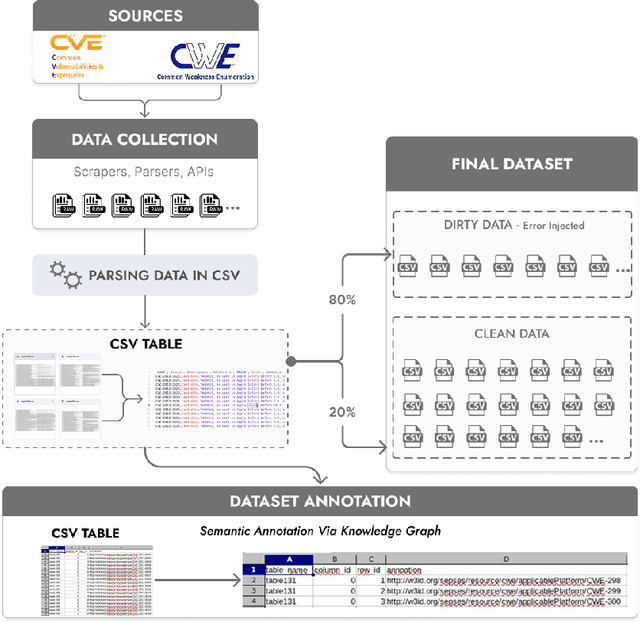

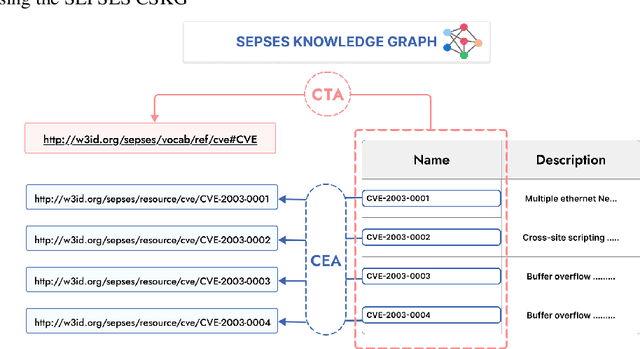
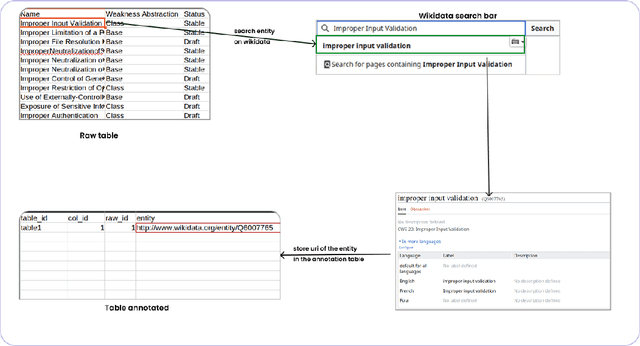
Evaluating semantic tables interpretation (STI) systems, (particularly, those based on Large Language Models- LLMs) especially in domain-specific contexts such as the security domain, depends heavily on the dataset. However, in the security domain, tabular datasets for state-of-the-art are not publicly available. In this paper, we introduce Secu-Table dataset, composed of more than 1500 tables with more than 15k entities constructed using security data extracted from Common Vulnerabilities and Exposures (CVE) and Common Weakness Enumeration (CWE) data sources and annotated using Wikidata and the SEmantic Processing of Security Event Streams CyberSecurity Knowledge Graph (SEPSES CSKG). Along with the dataset, all the code is publicly released. This dataset is made available to the research community in the context of the SemTab challenge on Tabular to Knowledge Graph Matching. This challenge aims to evaluate the performance of several STI based on open source LLMs. Preliminary evaluation, serving as baseline, was conducted using Falcon3-7b-instruct and Mistral-7B-Instruct, two open source LLMs and GPT-4o mini one closed source LLM.
An approach based on Open Research Knowledge Graph for Knowledge Acquisition from scientific papers
Aug 23, 2023A scientific paper can be divided into two major constructs which are Metadata and Full-body text. Metadata provides a brief overview of the paper while the Full-body text contains key-insights that can be valuable to fellow researchers. To retrieve metadata and key-insights from scientific papers, knowledge acquisition is a central activity. It consists of gathering, analyzing and organizing knowledge embedded in scientific papers in such a way that it can be used and reused whenever needed. Given the wealth of scientific literature, manual knowledge acquisition is a cumbersome task. Thus, computer-assisted and (semi-)automatic strategies are generally adopted. Our purpose in this research was two fold: curate Open Research Knowledge Graph (ORKG) with papers related to ontology learning and define an approach using ORKG as a computer-assisted tool to organize key-insights extracted from research papers. This approach was used to document the "epidemiological surveillance systems design and implementation" research problem and to prepare the related work of this paper. It is currently used to document "food information engineering", "Tabular data to Knowledge Graph Matching" and "Question Answering" research problems and "Neuro-symbolic AI" domain.