 Add to Chrome
 Add to Firefox
 Add to Edge
Learning to Play Blackjack: A Curriculum Learning Perspective
Apr 02, 2026
Reinforcement Learning (RL) agents often struggle with efficiency and performance in complex environments. We propose a novel framework that uses a Large Language Model (LLM) to dynamically generate a curriculum over available actions, enabling the agent to incorporate each action individually. We apply this framework to the game of Blackjack, where the LLM creates a multi-stage training path that progressively introduces complex actions to a Tabular Q-Learning and a Deep Q-Network (DQN) agent. Our evaluation in a realistic 8-deck simulation over 10 independent runs demonstrates significant performance gains over standard training methods. The curriculum-based approach increases the DQN agent's average win rate from 43.97% to 47.41%, reduces the average bust rate from 32.9% to 28.0%, and accelerates the overall workflow by over 74%, with the agent's full training completing faster than the baseline's evaluation phase alone. These results validate that LLM-guided curricula can build more effective, robust, and efficient RL agents.

Towards AI-Supported Research: a Vision of the TIB AIssistant
Dec 18, 2025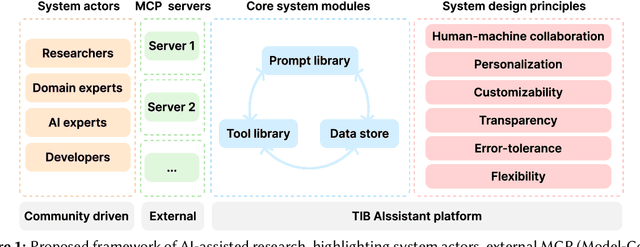
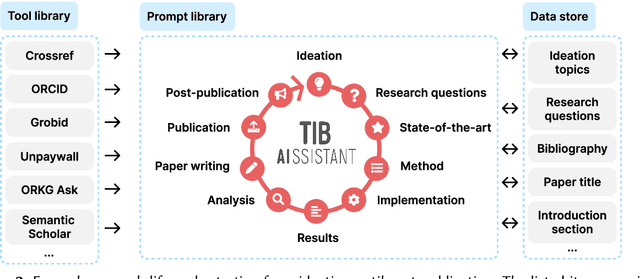
The rapid advancements in Generative AI and Large Language Models promise to transform the way research is conducted, potentially offering unprecedented opportunities to augment scholarly workflows. However, effectively integrating AI into research remains a challenge due to varying domain requirements, limited AI literacy, the complexity of coordinating tools and agents, and the unclear accuracy of Generative AI in research. We present the vision of the TIB AIssistant, a domain-agnostic human-machine collaborative platform designed to support researchers across disciplines in scientific discovery, with AI assistants supporting tasks across the research life cycle. The platform offers modular components - including prompt and tool libraries, a shared data store, and a flexible orchestration framework - that collectively facilitate ideation, literature analysis, methodology development, data analysis, and scholarly writing. We describe the conceptual framework, system architecture, and implementation of an early prototype that demonstrates the feasibility and potential impact of our approach.