 Add to Chrome
 Add to Firefox
 Add to Edge
Towards AI-Supported Research: a Vision of the TIB AIssistant
Dec 18, 2025
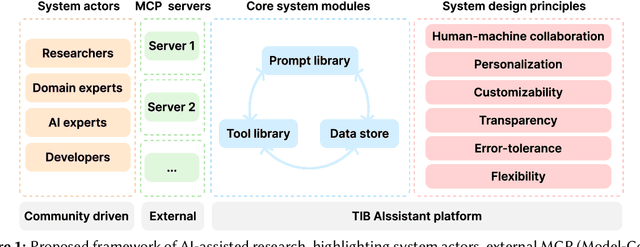
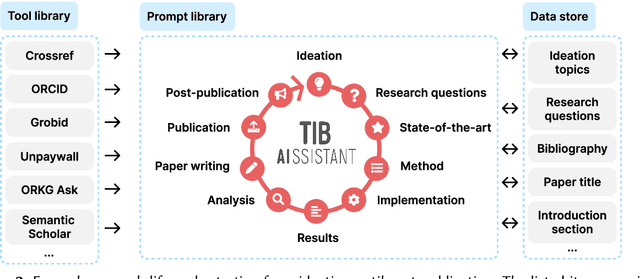
The rapid advancements in Generative AI and Large Language Models promise to transform the way research is conducted, potentially offering unprecedented opportunities to augment scholarly workflows. However, effectively integrating AI into research remains a challenge due to varying domain requirements, limited AI literacy, the complexity of coordinating tools and agents, and the unclear accuracy of Generative AI in research. We present the vision of the TIB AIssistant, a domain-agnostic human-machine collaborative platform designed to support researchers across disciplines in scientific discovery, with AI assistants supporting tasks across the research life cycle. The platform offers modular components - including prompt and tool libraries, a shared data store, and a flexible orchestration framework - that collectively facilitate ideation, literature analysis, methodology development, data analysis, and scholarly writing. We describe the conceptual framework, system architecture, and implementation of an early prototype that demonstrates the feasibility and potential impact of our approach.

Accelerating Medical Knowledge Discovery through Automated Knowledge Graph Generation and Enrichment
Apr 21, 2024Knowledge graphs (KGs) serve as powerful tools for organizing and representing structured knowledge. While their utility is widely recognized, challenges persist in their automation and completeness. Despite efforts in automation and the utilization of expert-created ontologies, gaps in connectivity remain prevalent within KGs. In response to these challenges, we propose an innovative approach termed ``Medical Knowledge Graph Automation (M-KGA)". M-KGA leverages user-provided medical concepts and enriches them semantically using BioPortal ontologies, thereby enhancing the completeness of knowledge graphs through the integration of pre-trained embeddings. Our approach introduces two distinct methodologies for uncovering hidden connections within the knowledge graph: a cluster-based approach and a node-based approach. Through rigorous testing involving 100 frequently occurring medical concepts in Electronic Health Records (EHRs), our M-KGA framework demonstrates promising results, indicating its potential to address the limitations of existing knowledge graph automation techniques.