 Add to Chrome
 Add to Firefox
 Add to Edge
Towards AI-Supported Research: a Vision of the TIB AIssistant
Dec 18, 2025
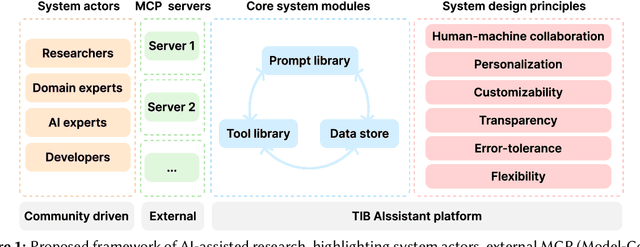
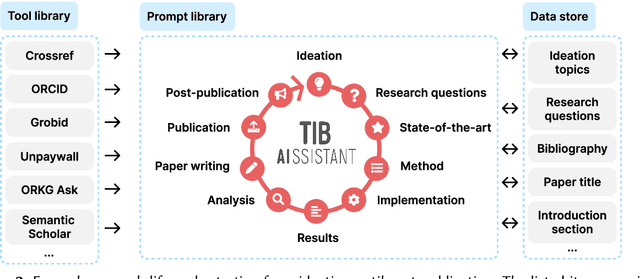
The rapid advancements in Generative AI and Large Language Models promise to transform the way research is conducted, potentially offering unprecedented opportunities to augment scholarly workflows. However, effectively integrating AI into research remains a challenge due to varying domain requirements, limited AI literacy, the complexity of coordinating tools and agents, and the unclear accuracy of Generative AI in research. We present the vision of the TIB AIssistant, a domain-agnostic human-machine collaborative platform designed to support researchers across disciplines in scientific discovery, with AI assistants supporting tasks across the research life cycle. The platform offers modular components - including prompt and tool libraries, a shared data store, and a flexible orchestration framework - that collectively facilitate ideation, literature analysis, methodology development, data analysis, and scholarly writing. We describe the conceptual framework, system architecture, and implementation of an early prototype that demonstrates the feasibility and potential impact of our approach.

Comparative Evaluation of Pretrained Transfer Learning Models on Automatic Short Answer Grading
Sep 02, 2020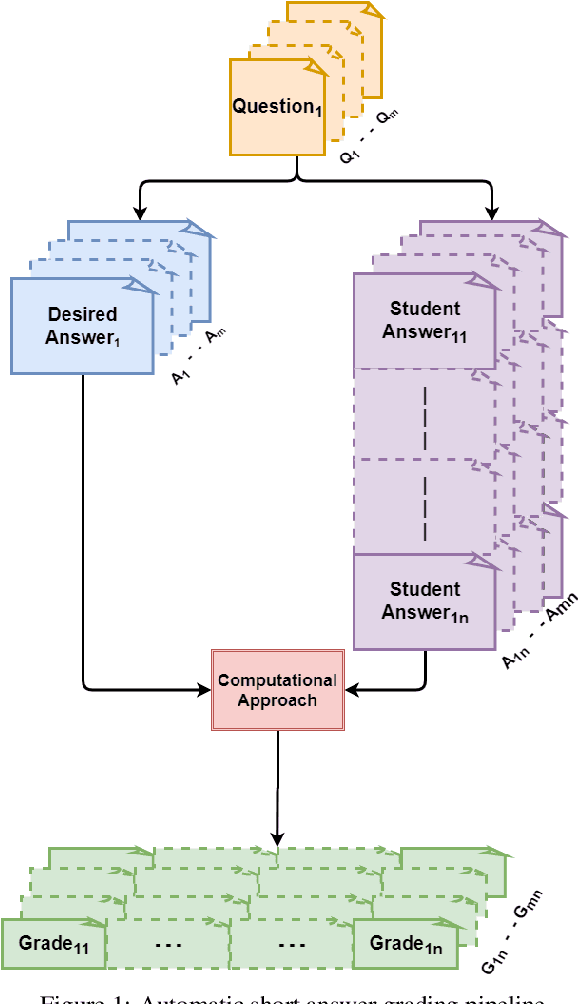
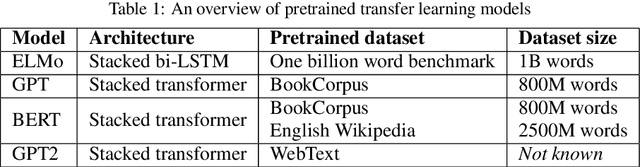
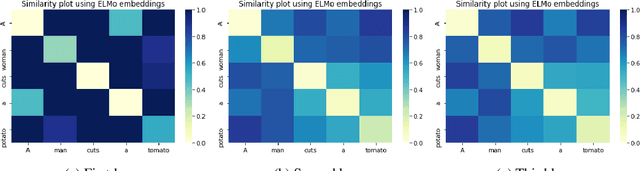
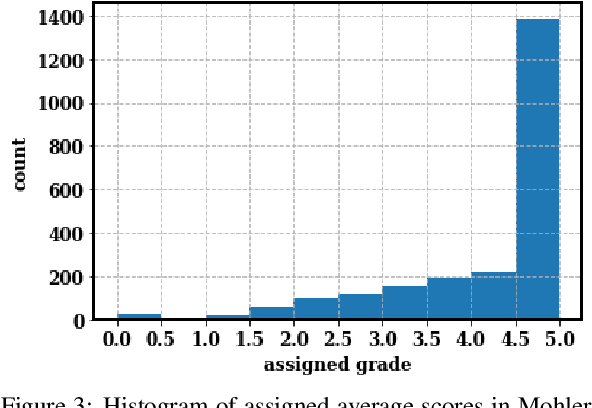
Automatic Short Answer Grading (ASAG) is the process of grading the student answers by computational approaches given a question and the desired answer. Previous works implemented the methods of concept mapping, facet mapping, and some used the conventional word embeddings for extracting semantic features. They extracted multiple features manually to train on the corresponding datasets. We use pretrained embeddings of the transfer learning models, ELMo, BERT, GPT, and GPT-2 to assess their efficiency on this task. We train with a single feature, cosine similarity, extracted from the embeddings of these models. We compare the RMSE scores and correlation measurements of the four models with previous works on Mohler dataset. Our work demonstrates that ELMo outperformed the other three models. We also, briefly describe the four transfer learning models and conclude with the possible causes of poor results of transfer learning models.