 Add to Chrome
 Add to Firefox
 Add to Edge
Non-partitioned e-detectors for nonparametric sequential change detection
Jul 30, 2026
We study the problem of sequential change detection over a general class of probability distributions ($\mathcal P$), where both the pre-change and post-change distributions are unknown and belong to $\mathcal P$. We do not assume a pre-specified partition of $\mathcal P$ into pre- and post-change families. We propose a general class of sequential change detectors obtained by aggregating point-null e-processes over possible changepoints and taking an infimum over candidate no-change distributions. The weights in the aggregation scheme determine whether they attain average run length (ARL) control and probability-of-false-alarm (PFA) control. Under suitable assumptions, we prove that our methods achieve first-order asymptotically optimal detection delay. Concrete examples include sub-Gaussian and bounded mean changes, Gaussian mean changes with unknown variance, as well as changes in Markov transition matrices.

Distribution-free changepoint localization after sequential change detection
May 31, 2026This paper introduces a distribution-free framework for constructing post-detection confidence sets for changepoints after stopping a sequential change detection procedure. It is well known that conformal test martingales can be used to sequentially detect changes in distribution, but by themselves provide no inference for the time at which a proclaimed change occurred. Past work on post-detection inference requires pre- and post-change classes of distributions to be known, but this paper accomplishes localization of the changepoint without any distributional assumptions. We establish finite-sample coverage guarantees (conditional on correct detection). We provide non-asymptotic bounds on the conditional expected size of the confidence sets. Under suitable asymptotic regimes, we proved that the conditional expected size of the confidence set remains uniformly bounded. and demonstrate strong empirical performance on simulated and real data. To the best of our knowledge, this is the first general distribution-free framework for sequential changepoint localization with a valid post-detection coverage guarantee.
Causal Inference with Categorical Unobserved Confounder via Mixture Learning
May 18, 2026Unobserved confounding is a fundamental challenge for estimating causal effects. To address unobserved confounding, recent literature has turned to two different approaches -- proxy variables and the use of multiple treatments. The first approach, commonly referred to as proximal causal inference, requires proxies to be assigned to specific asymmetric roles: treatment-inducing proxies (negative control exposures), variables that act as common causes of the treatment and outcome, and outcome-inducing proxies (negative control outcomes). In practice, however, identifying variables that satisfy these asymmetric roles can be difficult depending on the application domain. The second approach, commonly referred to as the ``Deconfounder," deals with multiple conditionally independent treatments. There has been limited progress towards developing a consistent estimation method for this setting. As the primary contribution of this work, we establish that causal effects are identifiable in both settings when the unobserved confounder is categorical under suitable conditions. Our approach builds on a mixture learning perspective: we show that the underlying confounding structure can be recovered by identifying the corresponding mixture distribution. We propose an estimation procedure based on tensor decomposition, which allows consistent recovery of the latent structure and comes with non-asymptotic guarantees. Simulation studies and real data experiments demonstrate that the proposed method performs well even with limited data.
Post-detection inference for sequential changepoint localization
Feb 10, 2025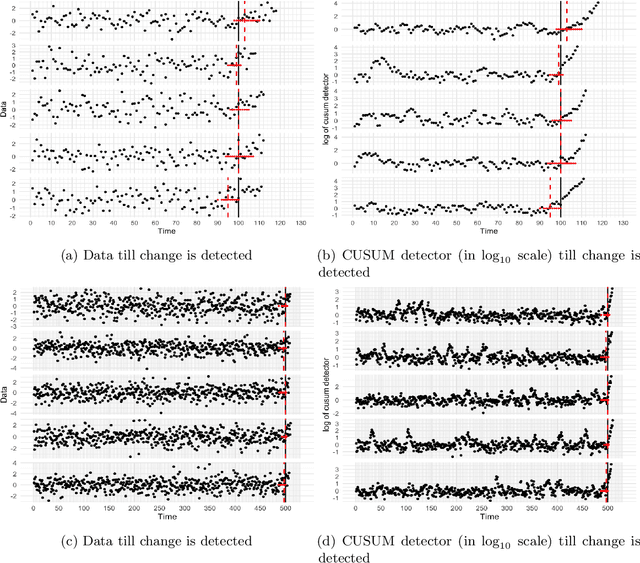



This paper addresses a fundamental but largely unexplored challenge in sequential changepoint analysis: conducting inference following a detected change. We study the problem of localizing the changepoint using only the data observed up to a data-dependent stopping time at which a sequential detection algorithm $\mathcal A$ declares a change. We first construct confidence sets for the unknown changepoint when pre- and post-change distributions are assumed to be known. We then extend our framework to composite pre- and post-change scenarios. We impose no conditions on the observation space or on $\mathcal A$ -- we only need to be able to run $\mathcal A$ on simulated data sequences. In summary, this work offers both theoretically sound and practically effective tools for sequential changepoint localization.
Group-Feature (Sensor) Selection With Controlled Redundancy Using Neural Networks
Oct 31, 2023In this paper, we present a novel embedded feature selection method based on a Multi-layer Perceptron (MLP) network and generalize it for group-feature or sensor selection problems, which can control the level of redundancy among the selected features or groups. Additionally, we have generalized the group lasso penalty for feature selection to encompass a mechanism for selecting valuable group features while simultaneously maintaining a control over redundancy. We establish the monotonicity and convergence of the proposed algorithm, with a smoothed version of the penalty terms, under suitable assumptions. Experimental results on several benchmark datasets demonstrate the promising performance of the proposed methodology for both feature selection and group feature selection over some state-of-the-art methods.
Robust Classification of High-Dimensional Data using Data-Adaptive Energy Distance
Jun 24, 2023Classification of high-dimensional low sample size (HDLSS) data poses a challenge in a variety of real-world situations, such as gene expression studies, cancer research, and medical imaging. This article presents the development and analysis of some classifiers that are specifically designed for HDLSS data. These classifiers are free of tuning parameters and are robust, in the sense that they are devoid of any moment conditions of the underlying data distributions. It is shown that they yield perfect classification in the HDLSS asymptotic regime, under some fairly general conditions. The comparative performance of the proposed classifiers is also investigated. Our theoretical results are supported by extensive simulation studies and real data analysis, which demonstrate promising advantages of the proposed classification techniques over several widely recognized methods.