 Add to Chrome
 Add to Firefox
 Add to Edge
High-Dimensional Change-Point Detection via Angular Kernel Statistics
May 25, 2026
We study change-point detection for high-dimensional data in regimes where inference must be performed from small batches of observations. Our primary focus is the high-dimensional, low sample size (HDLSS) regime, where the sequence length is fixed while the ambient dimension diverges. We propose a dimension-averaged angular kernel scan framework for detecting marginal distributional shifts. The statistic aggregates bounded one-dimensional angular discrepancies across coordinates, yielding a fully nonparametric, hyperparameter-free, and moment-agnostic estimator that remains well-defined without specifying, estimating, or assuming finite marginal moments, for example under heavy-tailed or contaminated distributions. For the offline single-change problem, we derive an exact population mean factorization into a universal deterministic shape function and a scalar signal factor, characterize the null covariance structure up to a scalar long-run variance factor, and establish an HDLSS multivariate central limit theorem under cross-coordinate mixing. These results lead to plug-in Gaussian calibration, asymptotic type-I error control, and power and localization guarantees, including a $d^{-1/2}$ local detection scale. We further extend the offline procedure to a fixed-window sequential monitoring procedure for high-dimensional streaming data, and obtain ARL calibration and worst-case EDD bounds. Simulation studies demonstrate that the proposed method can accurately detect and localize changes in challenging HDLSS and streaming settings where moment-based or hyperparameter-sensitive procedures may be unreliable.

Robust and Automatic Data Clustering: Dirichlet Process meets Median-of-Means
Nov 26, 2023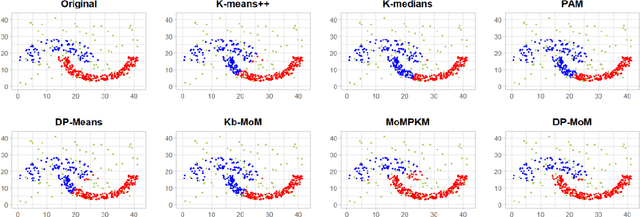
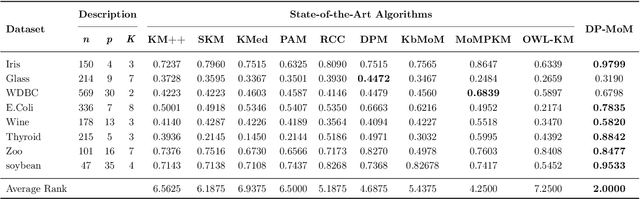
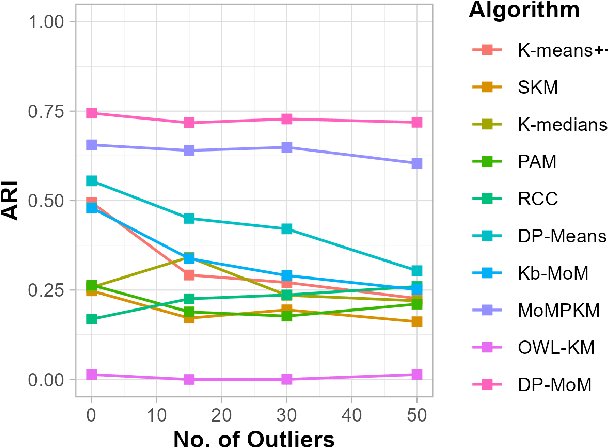
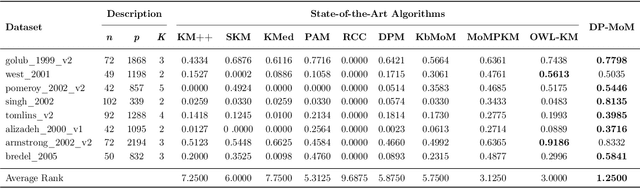
Clustering stands as one of the most prominent challenges within the realm of unsupervised machine learning. Among the array of centroid-based clustering algorithms, the classic $k$-means algorithm, rooted in Lloyd's heuristic, takes center stage as one of the extensively employed techniques in the literature. Nonetheless, both $k$-means and its variants grapple with noteworthy limitations. These encompass a heavy reliance on initial cluster centroids, susceptibility to converging into local minima of the objective function, and sensitivity to outliers and noise in the data. When confronted with data containing noisy or outlier-laden observations, the Median-of-Means (MoM) estimator emerges as a stabilizing force for any centroid-based clustering framework. On a different note, a prevalent constraint among existing clustering methodologies resides in the prerequisite knowledge of the number of clusters prior to analysis. Utilizing model-based methodologies, such as Bayesian nonparametric models, offers the advantage of infinite mixture models, thereby circumventing the need for such requirements. Motivated by these facts, in this article, we present an efficient and automatic clustering technique by integrating the principles of model-based and centroid-based methodologies that mitigates the effect of noise on the quality of clustering while ensuring that the number of clusters need not be specified in advance. Statistical guarantees on the upper bound of clustering error, and rigorous assessment through simulated and real datasets suggest the advantages of our proposed method over existing state-of-the-art clustering algorithms.
Robust Classification of High-Dimensional Data using Data-Adaptive Energy Distance
Jun 24, 2023Classification of high-dimensional low sample size (HDLSS) data poses a challenge in a variety of real-world situations, such as gene expression studies, cancer research, and medical imaging. This article presents the development and analysis of some classifiers that are specifically designed for HDLSS data. These classifiers are free of tuning parameters and are robust, in the sense that they are devoid of any moment conditions of the underlying data distributions. It is shown that they yield perfect classification in the HDLSS asymptotic regime, under some fairly general conditions. The comparative performance of the proposed classifiers is also investigated. Our theoretical results are supported by extensive simulation studies and real data analysis, which demonstrate promising advantages of the proposed classification techniques over several widely recognized methods.