 Add to Chrome
 Add to Firefox
 Add to Edge
Position Encoding with Random Float Sampling Enhances Length Generalization of Transformers
Feb 15, 2026
Length generalization is the ability of language models to maintain performance on inputs longer than those seen during pretraining. In this work, we introduce a simple yet powerful position encoding (PE) strategy, Random Float Sampling (RFS), that generalizes well to lengths unseen during pretraining or fine-tuning. In particular, instead of selecting position indices from a predefined discrete set, RFS uses randomly sampled continuous values, thereby avoiding out-of-distribution (OOD) issues on unseen lengths by exposing the model to diverse indices during training. Since assigning indices to tokens is a common and fundamental procedure in widely used PEs, the advantage of RFS can easily be incorporated into, for instance, the absolute sinusoidal encoding, RoPE, and ALiBi. Experiments corroborate its effectiveness by showing that RFS results in superior performance in length generalization tasks as well as zero-shot commonsense reasoning benchmarks.

Improved Active Learning via Dependent Leverage Score Sampling
Oct 08, 2023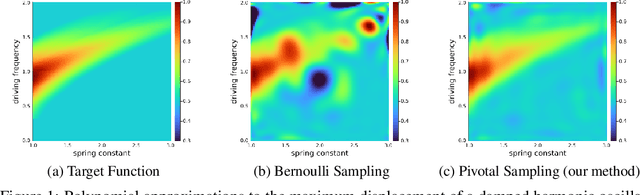
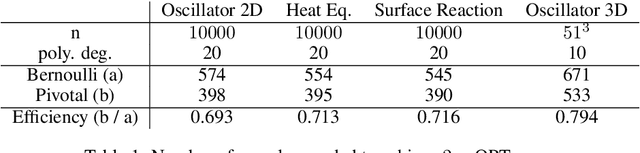
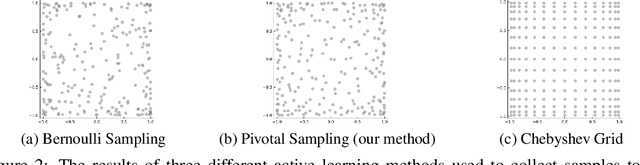
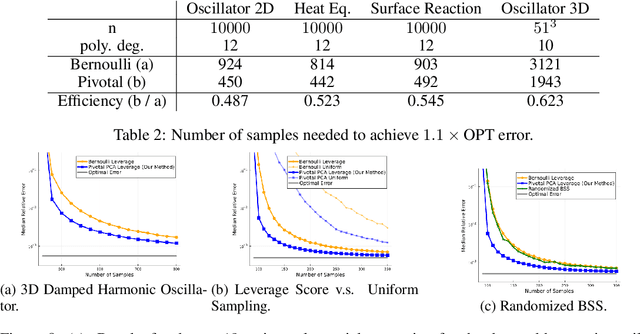
We show how to obtain improved active learning methods in the agnostic (adversarial noise) setting by combining marginal leverage score sampling with non-independent sampling strategies that promote spatial coverage. In particular, we propose an easily implemented method based on the pivotal sampling algorithm, which we test on problems motivated by learning-based methods for parametric PDEs and uncertainty quantification. In comparison to independent sampling, our method reduces the number of samples needed to reach a given target accuracy by up to $50\%$. We support our findings with two theoretical results. First, we show that any non-independent leverage score sampling method that obeys a weak one-sided $\ell_{\infty}$ independence condition (which includes pivotal sampling) can actively learn $d$ dimensional linear functions with $O(d\log d)$ samples, matching independent sampling. This result extends recent work on matrix Chernoff bounds under $\ell_{\infty}$ independence, and may be of interest for analyzing other sampling strategies beyond pivotal sampling. Second, we show that, for the important case of polynomial regression, our pivotal method obtains an improved bound of $O(d)$ samples.