 Add to Chrome
 Add to Firefox
 Add to Edge
Delocalization of bias in unadjusted Hamiltonian Monte Carlo and underdamped Langevin
Jul 16, 2026
Unadjusted samplers such as unadjusted Hamiltonian Monte Carlo and underdamped Langevin are well-known to be biased. Metropolis--Hastings adjustment has been conventionally incorporated into Hamiltonian Monte Carlo to eliminate the bias. However, this adjustment can significantly increase the iteration complexity due to the small step size required for reasonable Metropolis acceptance rates. In this work, we extend the \emph{delocalization of bias} phenomenon, previously established for the overdamped Langevin algorithm, to these two unadjusted algorithms. We show that to control the $W_2$ bias of any $K$-dimensional marginal of a high-dimensional distribution, $O(\sqrt{K})$ integration steps suffice up to $\log d$ terms, assuming either weak or sparse interactions among variables. The discrete-time integrators here introduce technical difficulties beyond those of the overdamped setting, which we address through a broadly applicable matrix-polynomial framework that characterizes their propagators. Our result for the underdamped Langevin algorithm is valid for all large friction parameters, implying that the Leimkuhler-Matthews integrator for the overdamped Langevin dynamics also exhibits delocalization of bias.

Convergence of Unadjusted Langevin in High Dimensions: Delocalization of Bias
Aug 20, 2024The unadjusted Langevin algorithm is commonly used to sample probability distributions in extremely high-dimensional settings. However, existing analyses of the algorithm for strongly log-concave distributions suggest that, as the dimension $d$ of the problem increases, the number of iterations required to ensure convergence within a desired error in the $W_2$ metric scales in proportion to $d$ or $\sqrt{d}$. In this paper, we argue that, despite this poor scaling of the $W_2$ error for the full set of variables, the behavior for a small number of variables can be significantly better: a number of iterations proportional to $K$, up to logarithmic terms in $d$, often suffices for the algorithm to converge to within a desired $W_2$ error for all $K$-marginals. We refer to this effect as delocalization of bias. We show that the delocalization effect does not hold universally and prove its validity for Gaussian distributions and strongly log-concave distributions with certain sparse interactions. Our analysis relies on a novel $W_{2,\ell^\infty}$ metric to measure convergence. A key technical challenge we address is the lack of a one-step contraction property in this metric. Finally, we use asymptotic arguments to explore potential generalizations of the delocalization effect beyond the Gaussian and sparse interactions setting.
The surprising efficiency of temporal difference learning for rare event prediction
May 27, 2024
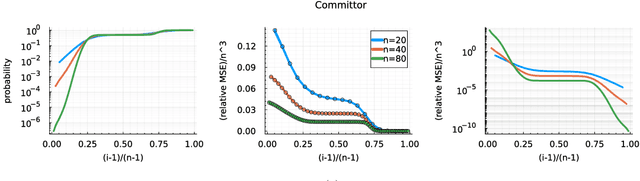


We quantify the efficiency of temporal difference (TD) learning over the direct, or Monte Carlo (MC), estimator for policy evaluation in reinforcement learning, with an emphasis on estimation of quantities related to rare events. Policy evaluation is complicated in the rare event setting by the long timescale of the event and by the need for \emph{relative accuracy} in estimates of very small values. Specifically, we focus on least-squares TD (LSTD) prediction for finite state Markov chains, and show that LSTD can achieve relative accuracy far more efficiently than MC. We prove a central limit theorem for the LSTD estimator and upper bound the \emph{relative asymptotic variance} by simple quantities characterizing the connectivity of states relative to the transition probabilities between them. Using this bound, we show that, even when both the timescale of the rare event and the relative accuracy of the MC estimator are exponentially large in the number of states, LSTD maintains a fixed level of relative accuracy with a total number of observed transitions of the Markov chain that is only \emph{polynomially} large in the number of states.
Improved Active Learning via Dependent Leverage Score Sampling
Oct 08, 2023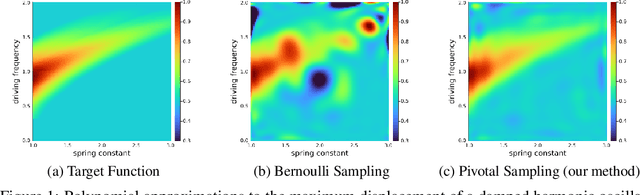
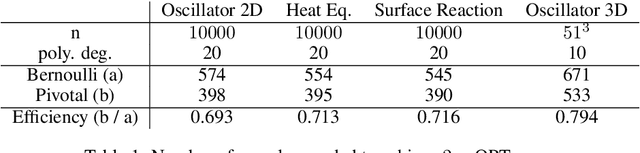
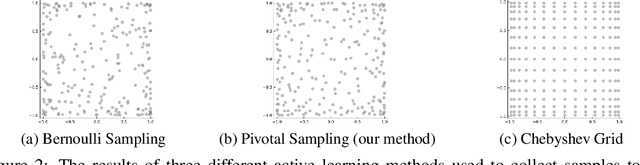
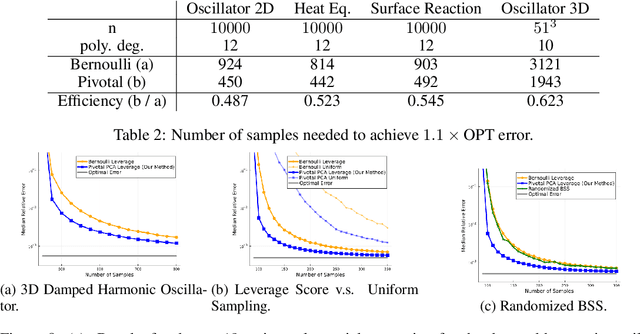
We show how to obtain improved active learning methods in the agnostic (adversarial noise) setting by combining marginal leverage score sampling with non-independent sampling strategies that promote spatial coverage. In particular, we propose an easily implemented method based on the pivotal sampling algorithm, which we test on problems motivated by learning-based methods for parametric PDEs and uncertainty quantification. In comparison to independent sampling, our method reduces the number of samples needed to reach a given target accuracy by up to $50\%$. We support our findings with two theoretical results. First, we show that any non-independent leverage score sampling method that obeys a weak one-sided $\ell_{\infty}$ independence condition (which includes pivotal sampling) can actively learn $d$ dimensional linear functions with $O(d\log d)$ samples, matching independent sampling. This result extends recent work on matrix Chernoff bounds under $\ell_{\infty}$ independence, and may be of interest for analyzing other sampling strategies beyond pivotal sampling. Second, we show that, for the important case of polynomial regression, our pivotal method obtains an improved bound of $O(d)$ samples.