 Add to Chrome
 Add to Firefox
 Add to Edge
Towards complete digital twins in cultural heritage with ART3mis 3D artifacts annotator
Feb 13, 2026
Archaeologists, as well as specialists and practitioners in cultural heritage, require applications with additional functions, such as the annotation and attachment of metadata to specific regions of the 3D digital artifacts, to go beyond the simplistic three-dimensional (3D) visualization. Different strategies addressed this issue, most of which are excellent in their particular area of application, but their capacity is limited to their design's purpose; they lack generalization and interoperability. This paper introduces ART3mis, a general-purpose, user-friendly, feature-rich, interactive web-based textual annotation tool for 3D objects. Moreover, it enables the communication, distribution, and reuse of information as it complies with the W3C Web Annotation Data Model. It is primarily designed to help cultural heritage conservators, restorers, and curators who lack technical expertise in 3D imaging and graphics, handle, segment, and annotate 3D digital replicas of artifacts with ease.

ART3mis: Ray-Based Textual Annotation on 3D Cultural Objects
Feb 13, 2026Beyond simplistic 3D visualisations, archaeologists, as well as cultural heritage experts and practitioners, need applications with advanced functionalities. Such as the annotation and attachment of metadata onto particular regions of the 3D digital objects. Various approaches have been presented to tackle this challenge, most of which achieve excellent results in the domain of their application. However, they are often confined to that specific domain and particular problem. In this paper, we present ART3mis - a general-purpose, user-friendly, interactive textual annotation tool for 3D objects. Primarily attuned to aid cultural heritage conservators, restorers and curators with no technical skills in 3D imaging and graphics, the tool allows for the easy handling, segmenting and annotating of 3D digital replicas of artefacts. ART3mis applies a user-driven, direct-on-surface approach. It can handle detailed 3D cultural objects in real-time and store textual annotations for multiple complex regions in JSON data format.
PReP: Efficient context-based shape retrieval for missing parts
Oct 18, 2024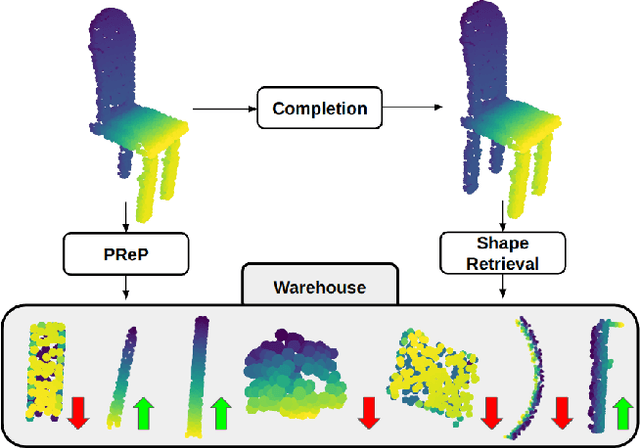
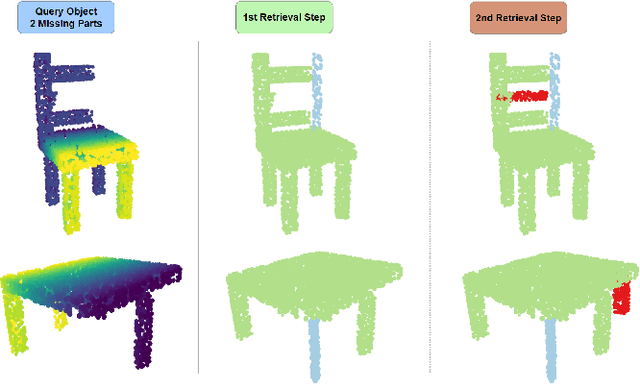
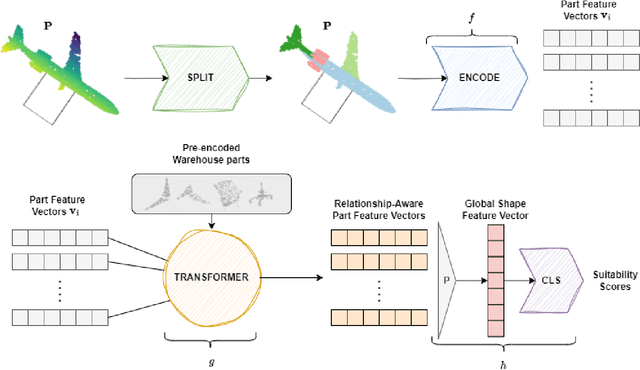
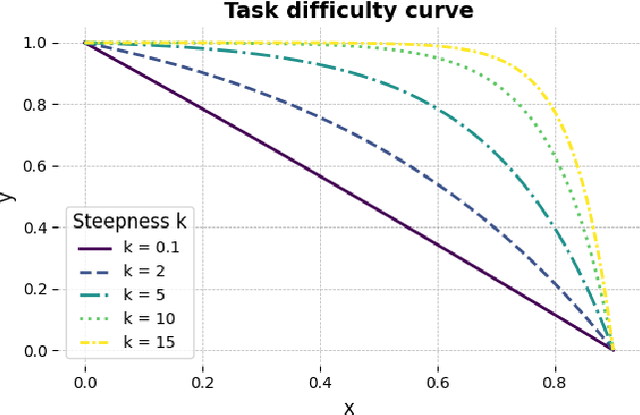
In this paper we study the problem of shape part retrieval in the point cloud domain. Shape retrieval methods in the literature rely on the presence of an existing query object, but what if the part we are looking for is not available? We present Part Retrieval Pipeline (PReP), a pipeline that creatively utilizes metric learning techniques along with a trained classification model to measure the suitability of potential replacement parts from a database, as part of an application scenario targeting circular economy. Through an innovative training procedure with increasing difficulty, it is able to learn to recognize suitable parts relying only on shape context. Thanks to its low parameter size and computational requirements, it can be used to sort through a warehouse of potentially tens of thousand of spare parts in just a few seconds. We also establish an alternative baseline approach to compare against, and extensively document the unique challenges associated with this task, as well as identify the design choices to solve them.
Efficient and Scalable Point Cloud Generation with Sparse Point-Voxel Diffusion Models
Aug 12, 2024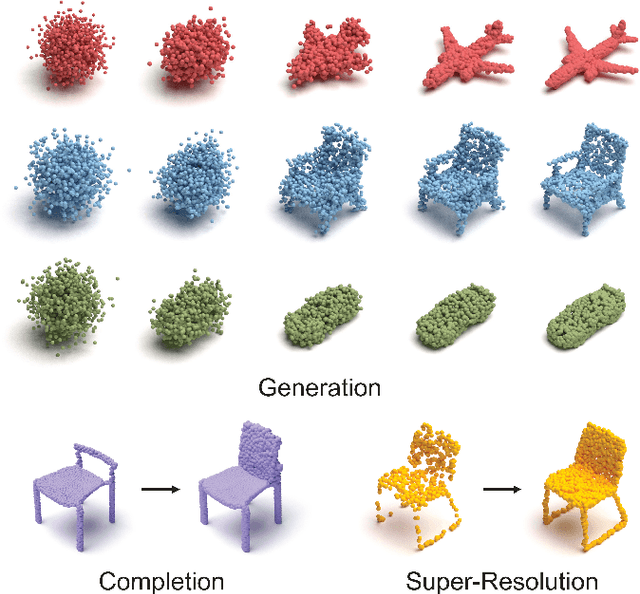
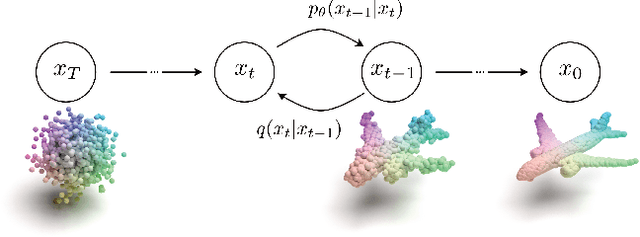
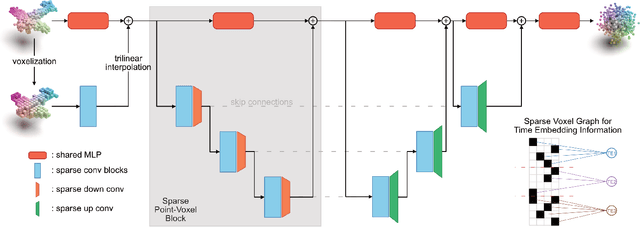
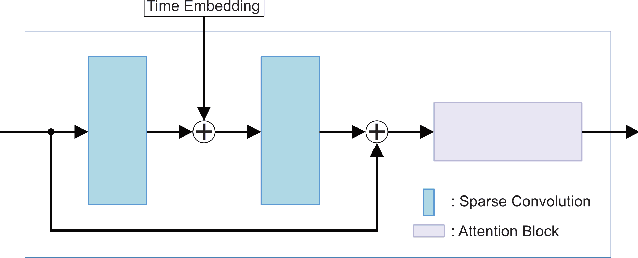
We propose a novel point cloud U-Net diffusion architecture for 3D generative modeling capable of generating high-quality and diverse 3D shapes while maintaining fast generation times. Our network employs a dual-branch architecture, combining the high-resolution representations of points with the computational efficiency of sparse voxels. Our fastest variant outperforms all non-diffusion generative approaches on unconditional shape generation, the most popular benchmark for evaluating point cloud generative models, while our largest model achieves state-of-the-art results among diffusion methods, with a runtime approximately 70% of the previously state-of-the-art PVD. Beyond unconditional generation, we perform extensive evaluations, including conditional generation on all categories of ShapeNet, demonstrating the scalability of our model to larger datasets, and implicit generation which allows our network to produce high quality point clouds on fewer timesteps, further decreasing the generation time. Finally, we evaluate the architecture's performance in point cloud completion and super-resolution. Our model excels in all tasks, establishing it as a state-of-the-art diffusion U-Net for point cloud generative modeling. The code is publicly available at https://github.com/JohnRomanelis/SPVD.git.