 Add to Chrome
 Add to Firefox
 Add to Edge
Towards complete digital twins in cultural heritage with ART3mis 3D artifacts annotator
Feb 13, 2026
Archaeologists, as well as specialists and practitioners in cultural heritage, require applications with additional functions, such as the annotation and attachment of metadata to specific regions of the 3D digital artifacts, to go beyond the simplistic three-dimensional (3D) visualization. Different strategies addressed this issue, most of which are excellent in their particular area of application, but their capacity is limited to their design's purpose; they lack generalization and interoperability. This paper introduces ART3mis, a general-purpose, user-friendly, feature-rich, interactive web-based textual annotation tool for 3D objects. Moreover, it enables the communication, distribution, and reuse of information as it complies with the W3C Web Annotation Data Model. It is primarily designed to help cultural heritage conservators, restorers, and curators who lack technical expertise in 3D imaging and graphics, handle, segment, and annotate 3D digital replicas of artifacts with ease.

ART3mis: Ray-Based Textual Annotation on 3D Cultural Objects
Feb 13, 2026Beyond simplistic 3D visualisations, archaeologists, as well as cultural heritage experts and practitioners, need applications with advanced functionalities. Such as the annotation and attachment of metadata onto particular regions of the 3D digital objects. Various approaches have been presented to tackle this challenge, most of which achieve excellent results in the domain of their application. However, they are often confined to that specific domain and particular problem. In this paper, we present ART3mis - a general-purpose, user-friendly, interactive textual annotation tool for 3D objects. Primarily attuned to aid cultural heritage conservators, restorers and curators with no technical skills in 3D imaging and graphics, the tool allows for the easy handling, segmenting and annotating of 3D digital replicas of artefacts. ART3mis applies a user-driven, direct-on-surface approach. It can handle detailed 3D cultural objects in real-time and store textual annotations for multiple complex regions in JSON data format.
Towards Resource-Efficient Federated Learning in Industrial IoT for Multivariate Time Series Analysis
Nov 06, 2024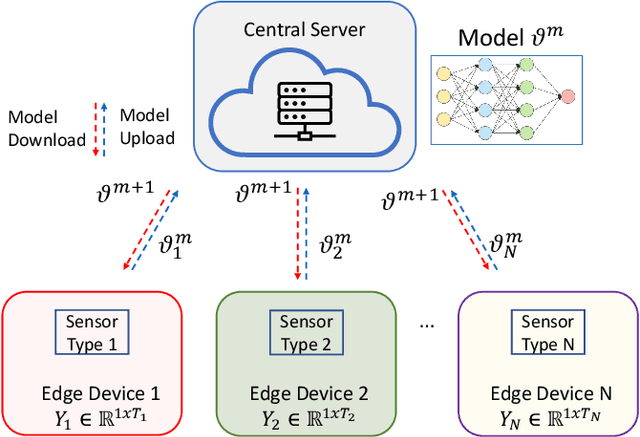
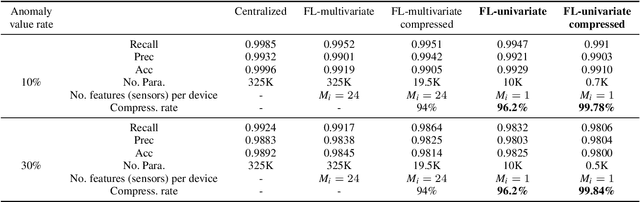
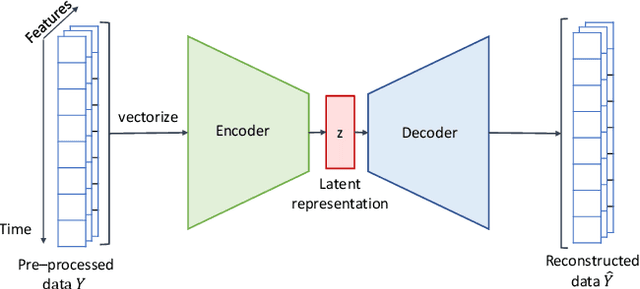
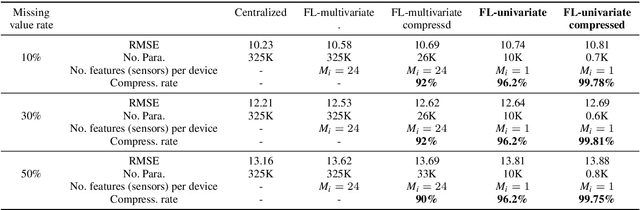
Anomaly and missing data constitute a thorny problem in industrial applications. In recent years, deep learning enabled anomaly detection has emerged as a critical direction, however the improved detection accuracy is achieved with the utilization of large neural networks, increasing their storage and computational cost. Moreover, the data collected in edge devices contain user privacy, introducing challenges that can be successfully addressed by the privacy-preserving distributed paradigm, known as federated learning (FL). This framework allows edge devices to train and exchange models increasing also the communication cost. Thus, to deal with the increased communication, processing and storage challenges of the FL based deep anomaly detection NN pruning is expected to have significant benefits towards reducing the processing, storage and communication complexity. With this focus, a novel compression-based optimization problem is proposed at the server-side of a FL paradigm that fusses the received local models broadcast and performs pruning generating a more compressed model. Experiments in the context of anomaly detection and missing value imputation demonstrate that the proposed FL scenario along with the proposed compressed-based method are able to achieve high compression rates (more than $99.7\%$) with negligible performance losses (less than $1.18\%$ ) as compared to the centralized solutions.