 Add to Chrome
 Add to Firefox
 Add to Edge
TabQL: In-Context Q-Learning with Tabular Foundation Models
May 18, 2026
We propose Tabular Q-Learning (TabQL), a reinforcement learning framework that replaces the conventional parametric Q-network in Deep Q-Learning (DQN) with a tabular foundation model endowed with in-context learning capabilities. The key idea is to represent Q-values through a sequence-to-sequence foundation model operating over a tabularized representation of state-action-Q-value tuples, enabling rapid adaptation from limited online interaction by conditioning on recent experience. TabQL departs from classical DQN by leveraging (i) zero- or few-shot Q-value inference via in-context updates, and (ii) a warm-up phase using standard DQN to bootstrap high-quality context. Particularly, to enhance the context quality, new transitions are generated by executing actions output by TabQL with predicted Q values from DQN. We formalize TabQL, analyze its convergence and sample complexity under mild assumptions, and show that TabQL interpolates between vanilla Q-learning and DQN with in-context learning. Our analysis demonstrates that TabQL achieves improved efficiency compared to DQN by amortizing Bellman updates through in-context learning. Extensive numerical experiments with several benchmarks showcase the effectiveness and efficacy of the proposed TabQL.

Vulnerability-Aware Instance Reweighting For Adversarial Training
Jul 14, 2023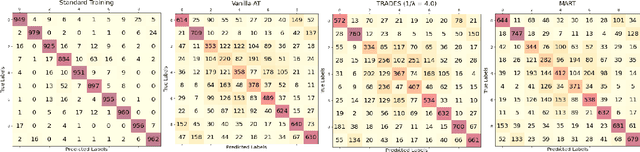

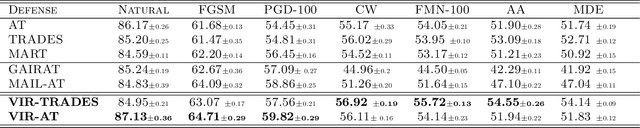
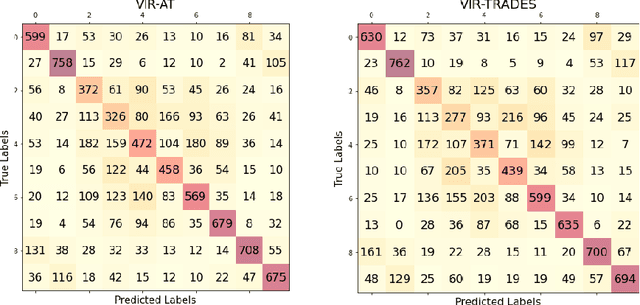
Adversarial Training (AT) has been found to substantially improve the robustness of deep learning classifiers against adversarial attacks. AT involves obtaining robustness by including adversarial examples in training a classifier. Most variants of AT algorithms treat every training example equally. However, recent works have shown that better performance is achievable by treating them unequally. In addition, it has been observed that AT exerts an uneven influence on different classes in a training set and unfairly hurts examples corresponding to classes that are inherently harder to classify. Consequently, various reweighting schemes have been proposed that assign unequal weights to robust losses of individual examples in a training set. In this work, we propose a novel instance-wise reweighting scheme. It considers the vulnerability of each natural example and the resulting information loss on its adversarial counterpart occasioned by adversarial attacks. Through extensive experiments, we show that our proposed method significantly improves over existing reweighting schemes, especially against strong white and black-box attacks.