 Add to Chrome
 Add to Firefox
 Add to Edge
Facial Demorphing via Identity Preserving Image Decomposition
Aug 20, 2024
A face morph is created by combining the face images usually pertaining to two distinct identities. The goal is to generate an image that can be matched with two identities thereby undermining the security of a face recognition system. To deal with this problem, several morph attack detection techniques have been developed. But these methods do not extract any information about the underlying bonafides used to create them. Demorphing addresses this limitation. However, current demorphing techniques are mostly reference-based, i.e, they need an image of one of the identities to recover the other. In this work, we treat demorphing as an ill-posed decomposition problem. We propose a novel method that is reference-free and recovers the bonafides with high accuracy. Our method decomposes the morph into several identity-preserving feature components. A merger network then weighs and combines these components to recover the bonafides. Our method is observed to reconstruct high-quality bonafides in terms of definition and fidelity. Experiments on the CASIA-WebFace, SMDD and AMSL datasets demonstrate the effectiveness of our method.

To Impute or Not: Recommendations for Multibiometric Fusion
Aug 15, 2024Combining match scores from different biometric systems via fusion is a well-established approach to improving recognition accuracy. However, missing scores can degrade performance as well as limit the possible fusion techniques that can be applied. Imputation is a promising technique in multibiometric systems for replacing missing data. In this paper, we evaluate various score imputation approaches on three multimodal biometric score datasets, viz. NIST BSSR1, BIOCOP2008, and MIT LL Trimodal, and investigate the factors which might influence the effectiveness of imputation. Our studies reveal three key observations: (1) Imputation is preferable over not imputing missing scores, even when the fusion rule does not require complete score data. (2) Balancing the classes in the training data is crucial to mitigate negative biases in the imputation technique towards the under-represented class, even if it involves dropping a substantial number of score vectors. (3) Multivariate imputation approaches seem to be beneficial when scores between modalities are correlated, while univariate approaches seem to benefit scenarios where scores between modalities are less correlated.
Detecting Near-Duplicate Face Images
Aug 14, 2024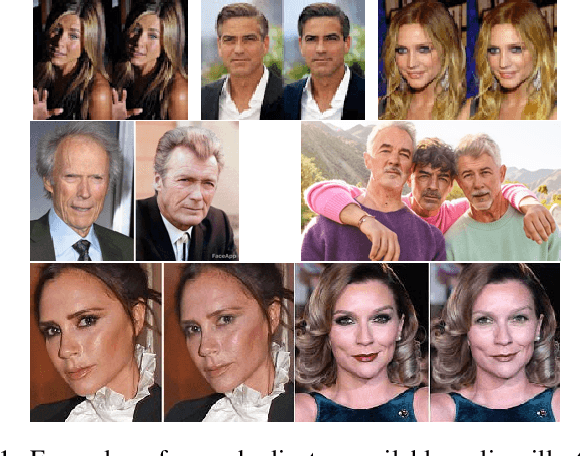



Near-duplicate images are often generated when applying repeated photometric and geometric transformations that produce imperceptible variants of the original image. Consequently, a deluge of near-duplicates can be circulated online posing copyright infringement concerns. The concerns are more severe when biometric data is altered through such nuanced transformations. In this work, we address the challenge of near-duplicate detection in face images by, firstly, identifying the original image from a set of near-duplicates and, secondly, deducing the relationship between the original image and the near-duplicates. We construct a tree-like structure, called an Image Phylogeny Tree (IPT) using a graph-theoretic approach to estimate the relationship, i.e., determine the sequence in which they have been generated. We further extend our method to create an ensemble of IPTs known as Image Phylogeny Forests (IPFs). We rigorously evaluate our method to demonstrate robustness across other modalities, unseen transformations by latest generative models and IPT configurations, thereby significantly advancing the state-of-the-art performance by 42% on IPF reconstruction accuracy.
ChatGPT Meets Iris Biometrics
Aug 09, 2024
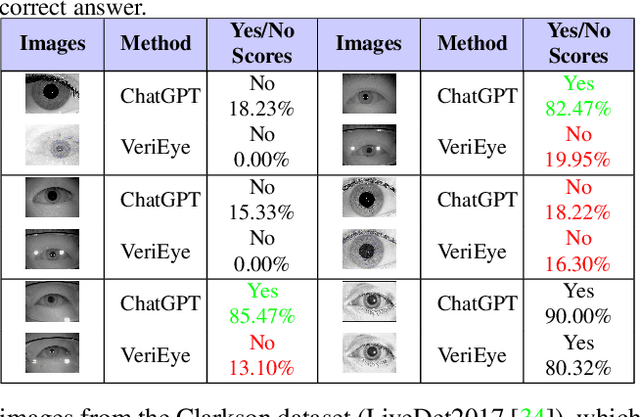
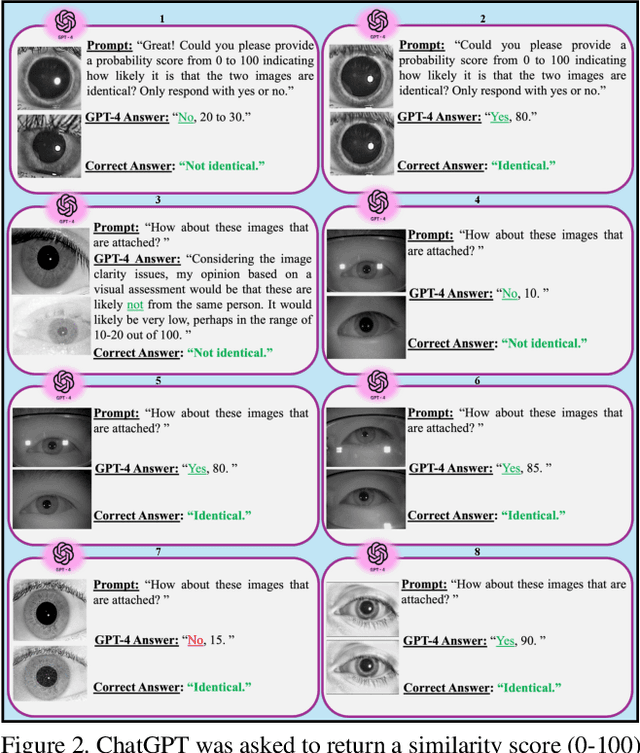
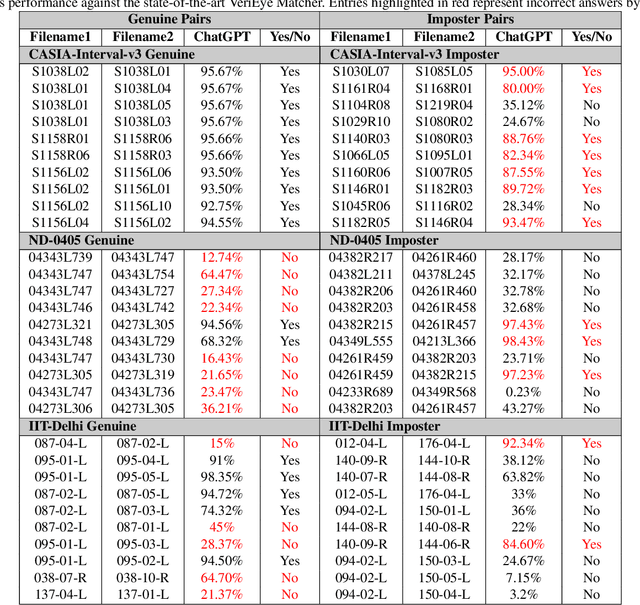
This study utilizes the advanced capabilities of the GPT-4 multimodal Large Language Model (LLM) to explore its potential in iris recognition - a field less common and more specialized than face recognition. By focusing on this niche yet crucial area, we investigate how well AI tools like ChatGPT can understand and analyze iris images. Through a series of meticulously designed experiments employing a zero-shot learning approach, the capabilities of ChatGPT-4 was assessed across various challenging conditions including diverse datasets, presentation attacks, occlusions such as glasses, and other real-world variations. The findings convey ChatGPT-4's remarkable adaptability and precision, revealing its proficiency in identifying distinctive iris features, while also detecting subtle effects like makeup on iris recognition. A comparative analysis with Gemini Advanced - Google's AI model - highlighted ChatGPT-4's better performance and user experience in complex iris analysis tasks. This research not only validates the use of LLMs for specialized biometric applications but also emphasizes the importance of nuanced query framing and interaction design in extracting significant insights from biometric data. Our findings suggest a promising path for future research and the development of more adaptable, efficient, robust and interactive biometric security solutions.
Synthesizing Iris Images using Generative Adversarial Networks: Survey and Comparative Analysis
Apr 26, 2024Biometric systems based on iris recognition are currently being used in border control applications and mobile devices. However, research in iris recognition is stymied by various factors such as limited datasets of bonafide irides and presentation attack instruments; restricted intra-class variations; and privacy concerns. Some of these issues can be mitigated by the use of synthetic iris data. In this paper, we present a comprehensive review of state-of-the-art GAN-based synthetic iris image generation techniques, evaluating their strengths and limitations in producing realistic and useful iris images that can be used for both training and testing iris recognition systems and presentation attack detectors. In this regard, we first survey the various methods that have been used for synthetic iris generation and specifically consider generators based on StyleGAN, RaSGAN, CIT-GAN, iWarpGAN, StarGAN, etc. We then analyze the images generated by these models for realism, uniqueness, and biometric utility. This comprehensive analysis highlights the pros and cons of various GANs in the context of developing robust iris matchers and presentation attack detectors.
Enhancing Privacy in Face Analytics Using Fully Homomorphic Encryption
Apr 24, 2024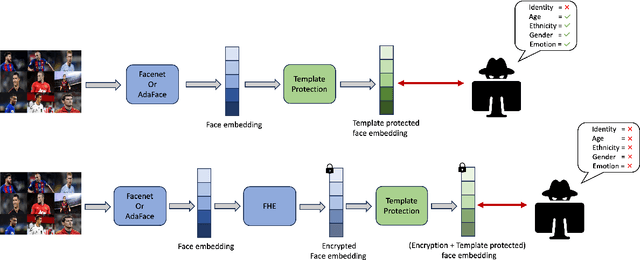
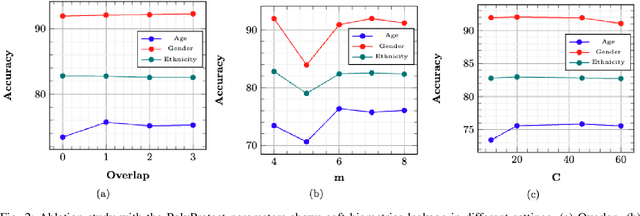
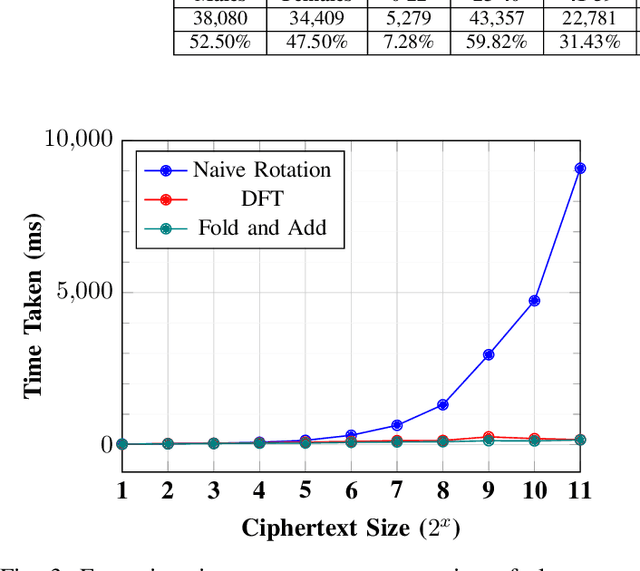
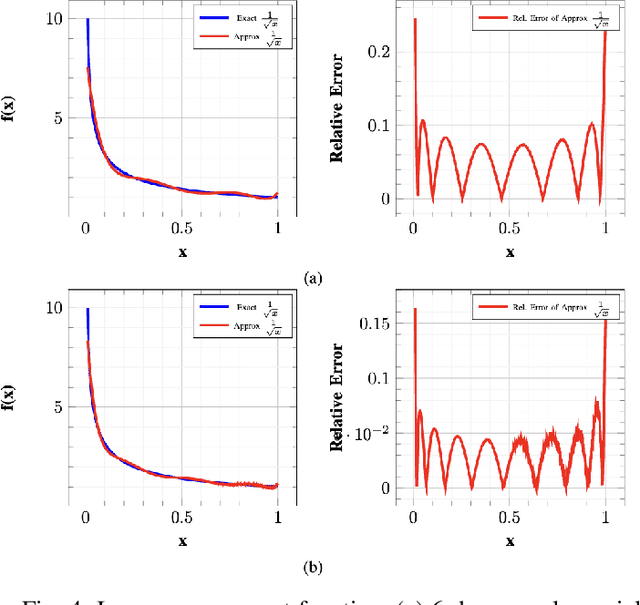
Modern face recognition systems utilize deep neural networks to extract salient features from a face. These features denote embeddings in latent space and are often stored as templates in a face recognition system. These embeddings are susceptible to data leakage and, in some cases, can even be used to reconstruct the original face image. To prevent compromising identities, template protection schemes are commonly employed. However, these schemes may still not prevent the leakage of soft biometric information such as age, gender and race. To alleviate this issue, we propose a novel technique that combines Fully Homomorphic Encryption (FHE) with an existing template protection scheme known as PolyProtect. We show that the embeddings can be compressed and encrypted using FHE and transformed into a secure PolyProtect template using polynomial transformation, for additional protection. We demonstrate the efficacy of the proposed approach through extensive experiments on multiple datasets. Our proposed approach ensures irreversibility and unlinkability, effectively preventing the leakage of soft biometric attributes from face embeddings without compromising recognition accuracy.
Iris-SAM: Iris Segmentation Using a Foundational Model
Feb 09, 2024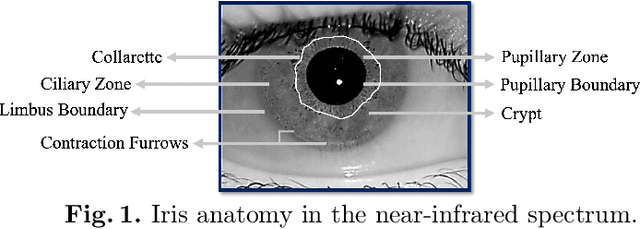
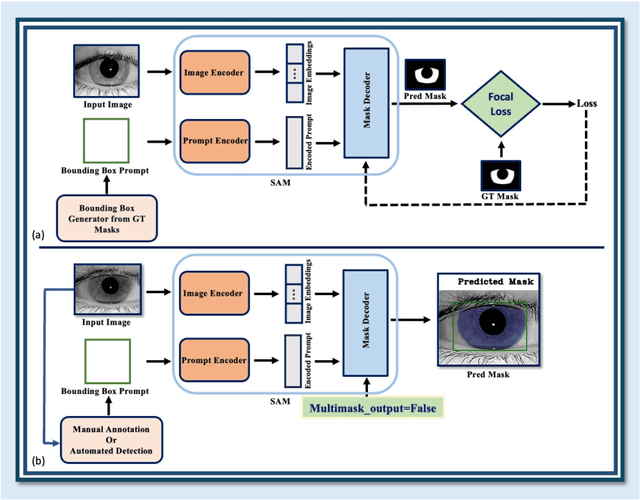
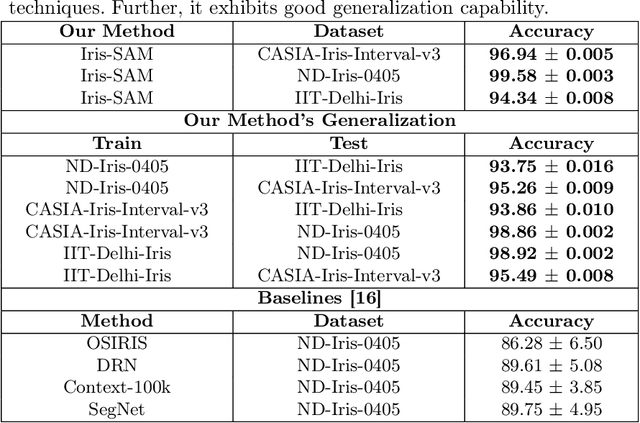
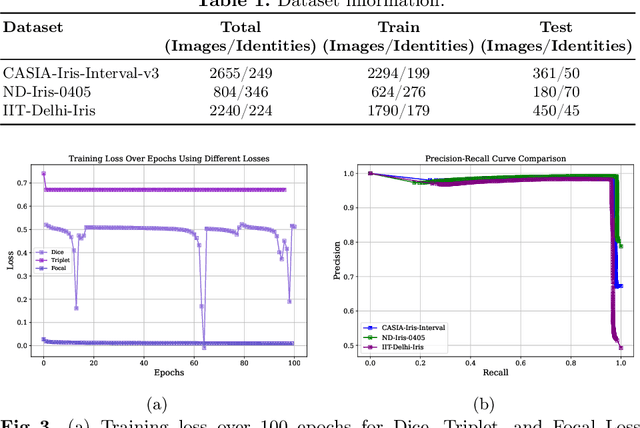
Iris segmentation is a critical component of an iris biometric system and it involves extracting the annular iris region from an ocular image. In this work, we develop a pixel-level iris segmentation model from a foundational model, viz., Segment Anything Model (SAM), that has been successfully used for segmenting arbitrary objects. The primary contribution of this work lies in the integration of different loss functions during the fine-tuning of SAM on ocular images. In particular, the importance of Focal Loss is borne out in the fine-tuning process since it strategically addresses the class imbalance problem (i.e., iris versus non-iris pixels). Experiments on ND-IRIS-0405, CASIA-Iris-Interval-v3, and IIT-Delhi-Iris datasets convey the efficacy of the trained model for the task of iris segmentation. For instance, on the ND-IRIS-0405 dataset, an average segmentation accuracy of 99.58% was achieved, compared to the best baseline performance of 89.75%.
A Linguistic Comparison between Human and ChatGPT-Generated Conversations
Feb 02, 2024This study explores linguistic differences between human and LLM-generated dialogues, using 19.5K dialogues generated by ChatGPT-3.5 as a companion to the EmpathicDialogues dataset. The research employs Linguistic Inquiry and Word Count (LIWC) analysis, comparing ChatGPT-generated conversations with human conversations across 118 linguistic categories. Results show greater variability and authenticity in human dialogues, but ChatGPT excels in categories such as social processes, analytical style, cognition, attentional focus, and positive emotional tone, reinforcing recent findings of LLMs being "more human than human." However, no significant difference was found in positive or negative affect between ChatGPT and human dialogues. Classifier analysis of dialogue embeddings indicates implicit coding of the valence of affect despite no explicit mention of affect in the conversations. The research also contributes a novel, companion ChatGPT-generated dataset of conversations between two independent chatbots, which were designed to replicate a corpus of human conversations available for open access and used widely in AI research on language modeling. Our findings increase understanding of ChatGPT's linguistic capabilities and inform ongoing efforts to distinguish between human and LLM-generated text, which is critical in detecting AI-generated fakes, misinformation, and disinformation.
Investigating Weight-Perturbed Deep Neural Networks With Application in Iris Presentation Attack Detection
Nov 22, 2023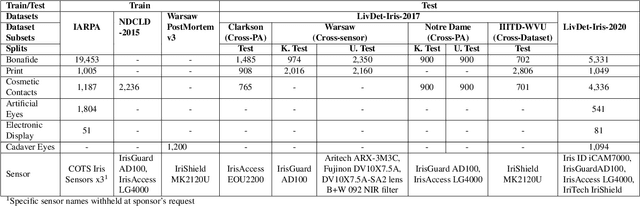
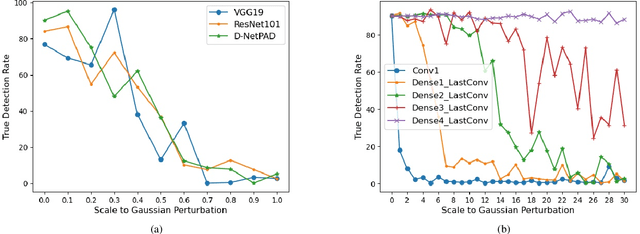
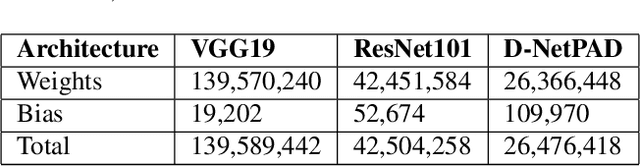
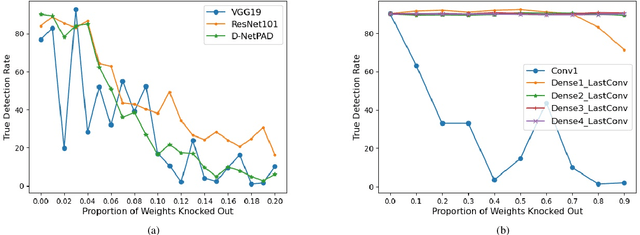
Deep neural networks (DNNs) exhibit superior performance in various machine learning tasks, e.g., image classification, speech recognition, biometric recognition, object detection, etc. However, it is essential to analyze their sensitivity to parameter perturbations before deploying them in real-world applications. In this work, we assess the sensitivity of DNNs against perturbations to their weight and bias parameters. The sensitivity analysis involves three DNN architectures (VGG, ResNet, and DenseNet), three types of parameter perturbations (Gaussian noise, weight zeroing, and weight scaling), and two settings (entire network and layer-wise). We perform experiments in the context of iris presentation attack detection and evaluate on two publicly available datasets: LivDet-Iris-2017 and LivDet-Iris-2020. Based on the sensitivity analysis, we propose improved models simply by perturbing parameters of the network without undergoing training. We further combine these perturbed models at the score-level and at the parameter-level to improve the performance over the original model. The ensemble at the parameter-level shows an average improvement of 43.58% on the LivDet-Iris-2017 dataset and 9.25% on the LivDet-Iris-2020 dataset. The source code is available at https://github.com/redwankarimsony/WeightPerturbation-MSU.
Iris Presentation Attack: Assessing the Impact of Combining Vanadium Dioxide Films with Artificial Eyes
Nov 21, 2023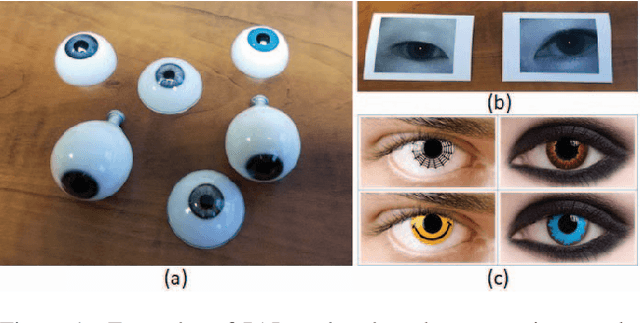
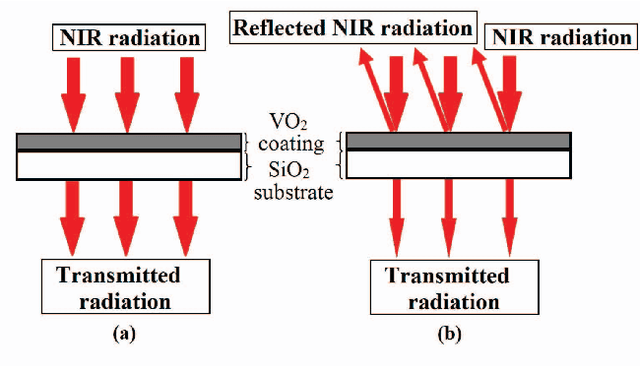
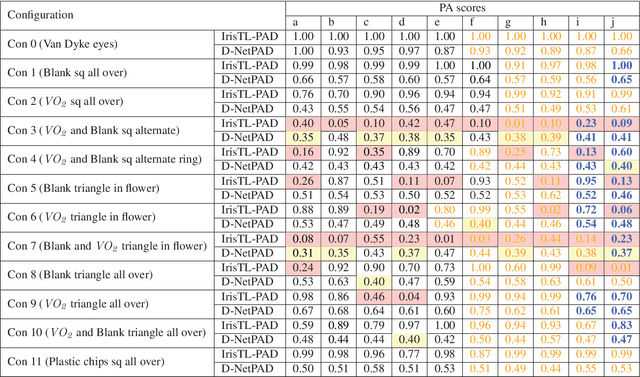
Iris recognition systems, operating in the near infrared spectrum (NIR), have demonstrated vulnerability to presentation attacks, where an adversary uses artifacts such as cosmetic contact lenses, artificial eyes or printed iris images in order to circumvent the system. At the same time, a number of effective presentation attack detection (PAD) methods have been developed. These methods have demonstrated success in detecting artificial eyes (e.g., fake Van Dyke eyes) as presentation attacks. In this work, we seek to alter the optical characteristics of artificial eyes by affixing Vanadium Dioxide (VO2) films on their surface in various spatial configurations. VO2 films can be used to selectively transmit NIR light and can, therefore, be used to regulate the amount of NIR light from the object that is captured by the iris sensor. We study the impact of such images produced by the sensor on two state-of-the-art iris PA detection methods. We observe that the addition of VO2 films on the surface of artificial eyes can cause the PA detection methods to misclassify them as bonafide eyes in some cases. This represents a vulnerability that must be systematically analyzed and effectively addressed.