 Add to Chrome
 Add to Firefox
 Add to Edge
End-to-End Context Compression at Scale
Jun 08, 2026
Long-context language model inference is bottlenecked by memory, as the KV cache grows with context length. Recent techniques to compress the KV cache fall short: they either degrade model quality substantially or require considerable time and compute to compress a single long prompt. Furthermore, many methods require the input to fit within the target model's context window, and are generally incompatible with modern production inference engines. Encoder-decoder compressors, which map a long token sequence to a shorter sequence of latent embeddings consumed by a decoder, are an appealing alternative in principle. However, existing approaches are not competitive with KV cache compression on the accuracy-efficiency frontier. In this work, we revisit encoder-decoder compression and close this gap. We first perform an architecture search, pre-training many variants from scratch to determine how best to design and train encoder-decoder compressors. Guided by our findings, we continually pre-train a family of 0.6B-encoder, 4B-decoder models on over 350B tokens each, at compression ratios of 1:4, 1:8, and 1:16. We introduce Latent Context Language Models (LCLMs), a family of compressors that improve the Pareto frontier across general-task performance, compression speed, and peak memory usage. We demonstrate that LCLMs serve as efficient backbones for long-horizon agents, letting the agent skim through a compressed long context and adaptively expand relevant segments on demand.

MAEB: Massive Audio Embedding Benchmark
Feb 17, 2026We introduce the Massive Audio Embedding Benchmark (MAEB), a large-scale benchmark covering 30 tasks across speech, music, environmental sounds, and cross-modal audio-text reasoning in 100+ languages. We evaluate 50+ models and find that no single model dominates across all tasks: contrastive audio-text models excel at environmental sound classification (e.g., ESC50) but score near random on multilingual speech tasks (e.g., SIB-FLEURS), while speech-pretrained models show the opposite pattern. Clustering remains challenging for all models, with even the best-performing model achieving only modest results. We observe that models excelling on acoustic understanding often perform poorly on linguistic tasks, and vice versa. We also show that the performance of audio encoders on MAEB correlates highly with their performance when used in audio large language models. MAEB is derived from MAEB+, a collection of 98 tasks. MAEB is designed to maintain task diversity while reducing evaluation cost, and it integrates into the MTEB ecosystem for unified evaluation across text, image, and audio modalities. We release MAEB and all 98 tasks along with code and a leaderboard at https://github.com/embeddings-benchmark/mteb.
Discrete Feynman-Kac Correctors
Jan 15, 2026Discrete diffusion models have recently emerged as a promising alternative to the autoregressive approach for generating discrete sequences. Sample generation via gradual denoising or demasking processes allows them to capture hierarchical non-sequential interdependencies in the data. These custom processes, however, do not assume a flexible control over the distribution of generated samples. We propose Discrete Feynman-Kac Correctors, a framework that allows for controlling the generated distribution of discrete masked diffusion models at inference time. We derive Sequential Monte Carlo (SMC) algorithms that, given a trained discrete diffusion model, control the temperature of the sampled distribution (i.e. perform annealing), sample from the product of marginals of several diffusion processes (e.g. differently conditioned processes), and sample from the product of the marginal with an external reward function, producing likely samples from the target distribution that also have high reward. Notably, our framework does not require any training of additional models or fine-tuning of the original model. We illustrate the utility of our framework in several applications including: efficient sampling from the annealed Boltzmann distribution of the Ising model, improving the performance of language models for code generation and amortized learning, as well as reward-tilted protein sequence generation.
FALCON: Few-step Accurate Likelihoods for Continuous Flows
Dec 10, 2025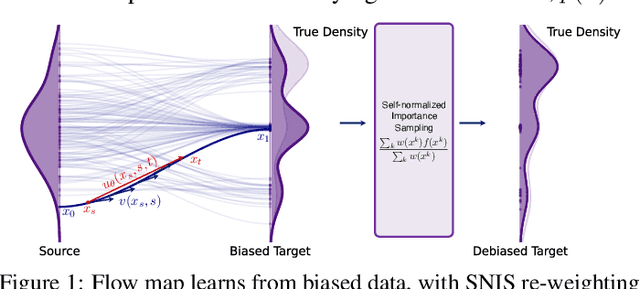
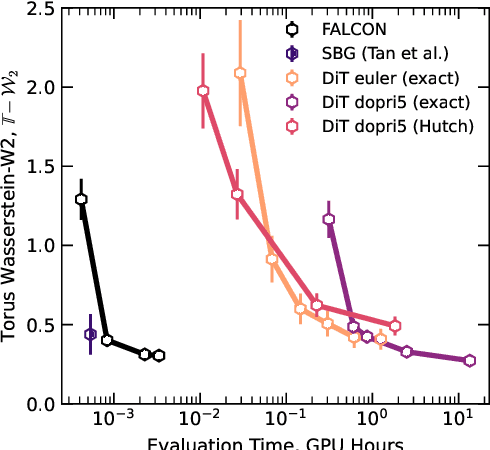
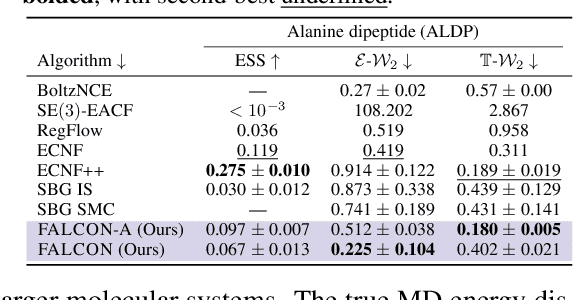
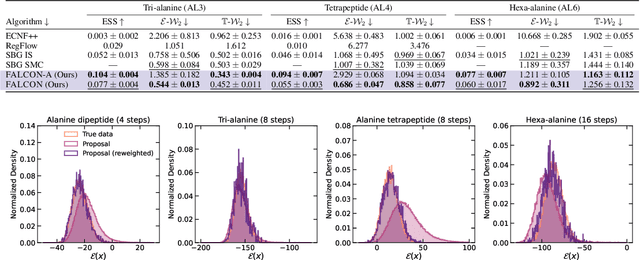
Scalable sampling of molecular states in thermodynamic equilibrium is a long-standing challenge in statistical physics. Boltzmann Generators tackle this problem by pairing a generative model, capable of exact likelihood computation, with importance sampling to obtain consistent samples under the target distribution. Current Boltzmann Generators primarily use continuous normalizing flows (CNFs) trained with flow matching for efficient training of powerful models. However, likelihood calculation for these models is extremely costly, requiring thousands of function evaluations per sample, severely limiting their adoption. In this work, we propose Few-step Accurate Likelihoods for Continuous Flows (FALCON), a method which allows for few-step sampling with a likelihood accurate enough for importance sampling applications by introducing a hybrid training objective that encourages invertibility. We show FALCON outperforms state-of-the-art normalizing flow models for molecular Boltzmann sampling and is two orders of magnitude faster than the equivalently performing CNF model.