 Add to Chrome
 Add to Firefox
 Add to Edge
MedSAM2-Anatomy: Training-Free Inference-Time Optimization for Musculoskeletal Segmentation
Jul 31, 2026
High-resolution 3D segmentation of hip and shoulder anatomy from CT and MRI is essential for surgical planning, yet frozen segmentation models often fail under domain shift. CNN-based expert models are fully automatic but lack adaptability, whereas promptable foundation models generalize better but require manual prompting. We present MedSAM2-Anatomy, a training-free inference-time optimization framework that improves frozen segmentation models without retraining or human interaction. A frozen expert model generates anatomical priors that are automatically converted into multiple prompt hypotheses for a frozen 3D foundation model. Candidate masks are fused while anatomically implausible priors are rejected. No model weights are updated and no manual prompts are required. TotalSegmentator and MedSAM2 are used as representative expert and foundation models, allowing the contribution of the inference policy to be isolated. Evaluation on the independent Balgrist-V0 CT and MRI cohorts shows that inference-time optimization increases median Dice from 0.71 to 0.92 on hip MRI and from 0.89 to 0.92 on shoulder CT, while reducing median HD95 on hip MRI from 22.0 mm to 5.0 mm. On public TotalSegmentator benchmarks, the expert model remains strongest, indicating that the optimal fusion strategy depends on the reliability of the expert prior. These results demonstrate that training-free inference-time optimization provides a practical strategy for improving frozen segmentation models without manual prompting.

Conditional Generative Data Augmentation for Clinical Audio Datasets
Mar 22, 2022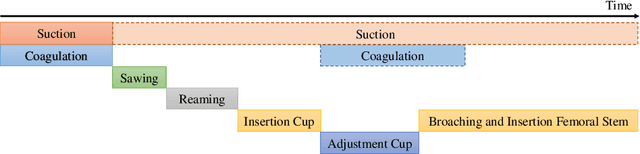
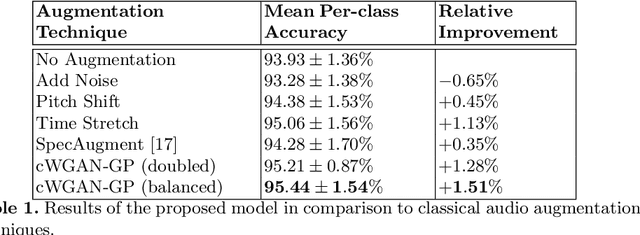
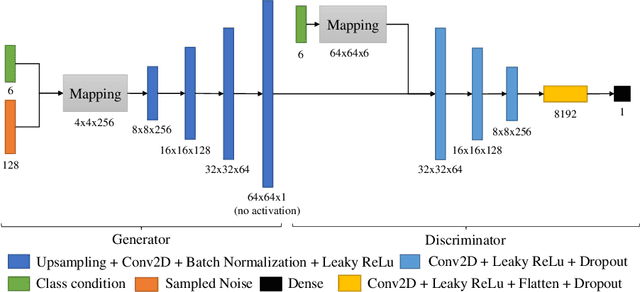
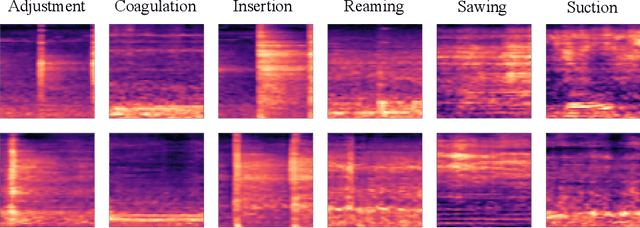
In this work, we propose a novel data augmentation method for clinical audio datasets based on a conditional Wasserstein Generative Adversarial Network with Gradient Penalty (cWGAN-GP), operating on log-mel spectrograms. To validate our method, we created a clinical audio dataset which was recorded in a real-world operating room during Total Hip Arthroplasty (THA) procedures and contains typical sounds which resemble the different phases of the intervention. We demonstrate the capability of the proposed method to generate realistic class-conditioned samples from the dataset distribution and show that training with the generated augmented samples outperforms classical audio augmentation methods in terms of classification accuracy. The performance was evaluated using a ResNet-18 classifier which shows a mean per-class accuracy improvement of 1.51% in a 5-fold cross validation experiment using the proposed augmentation method. Because clinical data is often expensive to acquire, the development of realistic and high-quality data augmentation methods is crucial to improve the robustness and generalization capabilities of learning-based algorithms which is especially important for safety-critical medical applications. Therefore, the proposed data augmentation method is an important step towards improving the data bottleneck for clinical audio-based machine learning systems. The code and dataset will be published upon acceptance.