 Add to Chrome
 Add to Firefox
 Add to Edge
PSIRNet: Deep Learning-based Free-breathing Rapid Acquisition Late Enhancement Imaging
Apr 09, 2026
Purpose: To develop and evaluate a deep learning (DL) method for free-breathing phase-sensitive inversion recovery (PSIR) late gadolinium enhancement (LGE) cardiac MRI that produces diagnostic-quality images from a single acquisition over two heartbeats, eliminating the need for 8 to 24 motion-corrected (MOCO) signal averages. Materials and Methods: Raw data comprising 800,653 slices from 55,917 patients, acquired on 1.5T and 3T scanners across multiple sites from 2016 to 2024, were used in this retrospective study. Data were split by patient: 640,000 slices (42,822 patients) for training and the remainder for validation and testing, without overlap. The training and testing data were from different institutions. PSIRNet, a physics-guided DL network with 845 million parameters, was trained end-to-end to reconstruct PSIR images with surface coil correction from a single interleaved IR/PD acquisition over two heartbeats. Reconstruction quality was evaluated using SSIM, PSNR, and NRMSE against MOCO PSIR references. Two expert cardiologists performed an independent qualitative assessment, scoring image quality on a 5-point Likert scale across bright blood, dark blood, and wideband LGE variants. Paired superiority and equivalence (margin = 0.25 Likert points) were tested using exact Wilcoxon signed-rank tests at a significance level of 0.05 using R version 4.5.2. Results: Both readers rated single-average PSIRNet reconstructions superior to MOCO PSIR for dark blood LGE (conservative P = .002); for bright blood and wideband, one reader rated it superior and the other confirmed equivalence (all P < .001). Inference required approximately 100 msec per slice versus more than 5 sec for MOCO PSIR. Conclusion: PSIRNet produces diagnostic-quality free-breathing PSIR LGE images from a single acquisition, enabling 8- to 24-fold reduction in acquisition time.

Reliable Extraction of Semantic Information and Rate of Innovation Estimation for Graph Signals
Nov 10, 2022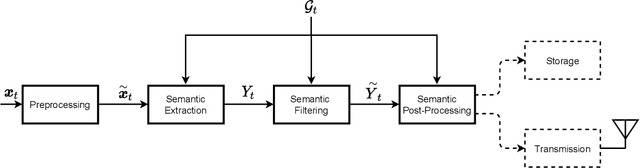

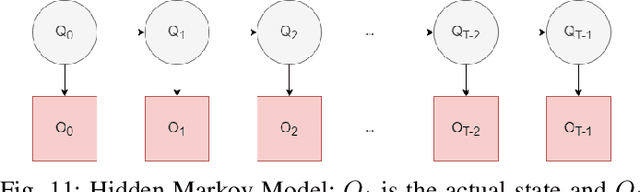

Semantic signal processing and communications are poised to play a central part in developing the next generation of sensor devices and networks. A crucial component of a semantic system is the extraction of semantic signals from the raw input signals, which has become increasingly tractable with the recent advances in machine learning (ML) and artificial intelligence (AI) techniques. The accurate extraction of semantic signals using the aforementioned ML and AI methods, and the detection of semantic innovation for scheduling transmission and/or storage events are critical tasks for reliable semantic signal processing and communications. In this work, we propose a reliable semantic information extraction framework based on our previous work on semantic signal representations in a hierarchical graph-based structure. The proposed framework includes a time integration method to increase fidelity of ML outputs in a class-aware manner, a graph-edit-distance based metric to detect innovation events at the graph-level and filter out sporadic errors, and a Hidden Markov Model (HMM) to produce smooth and reliable graph signals. The proposed methods within the framework are demonstrated individually and collectively through simulations and case studies based on real-world computer vision examples.
Towards Goal-Oriented Semantic Signal Processing: Applications and Future Challenges
Sep 24, 2021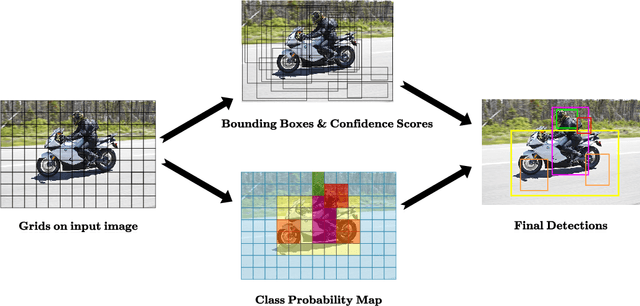
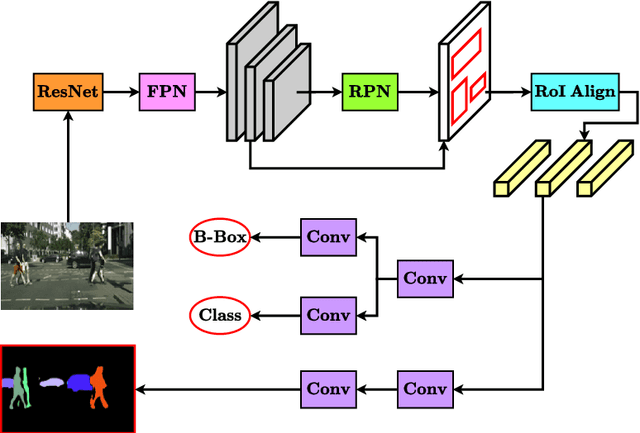

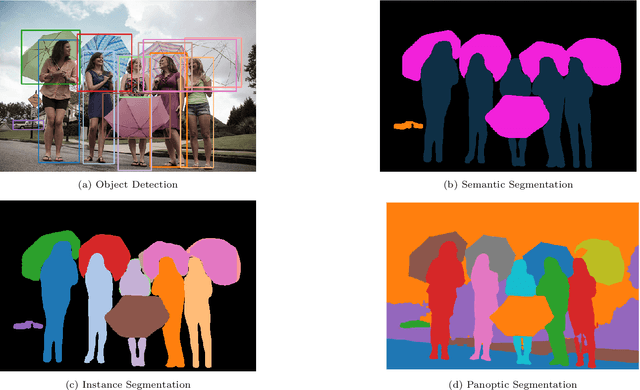
Advances in machine learning technology have enabled real-time extraction of semantic information in signals which can revolutionize signal processing techniques and improve their performance significantly for the next generation of applications. With the objective of a concrete representation and efficient processing of the semantic information, we propose and demonstrate a formal graph-based semantic language and a goal filtering method that enables goal-oriented signal processing. The proposed semantic signal processing framework can easily be tailored for specific applications and goals in a diverse range of signal processing applications. To illustrate its wide range of applicability, we investigate several use cases and provide details on how the proposed goal-oriented semantic signal processing framework can be customized. We also investigate and propose techniques for communications where sensor data is semantically processed and semantic information is exchanged across a sensor network.
* 44 pages, 29 figures, 3 tables. This preprint will be published in the Digital Signal Processing Journal's 30th anniversary issue on Future Signal Processing
Entropy of the Conditional Expectation under Gaussian Noise
Jun 08, 2021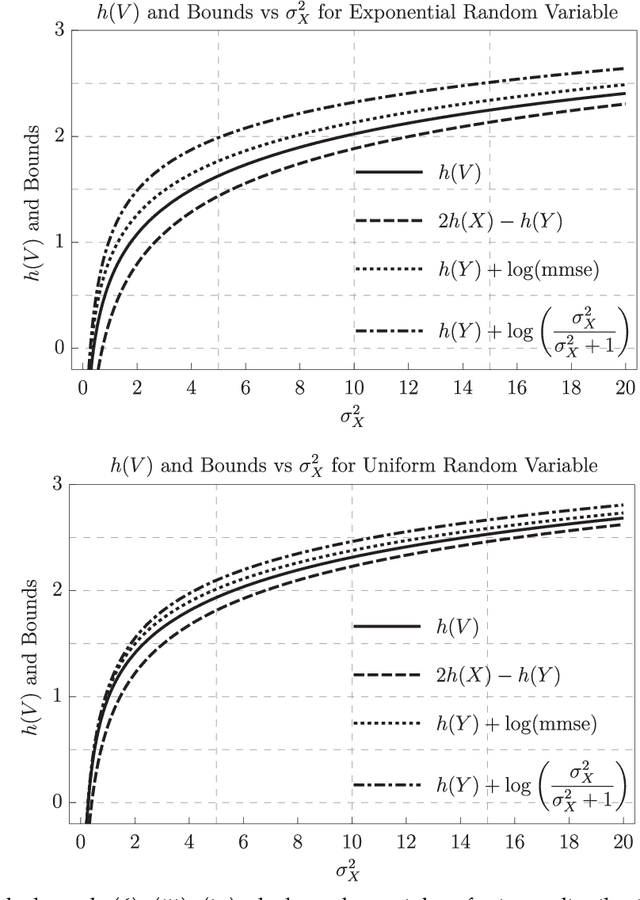
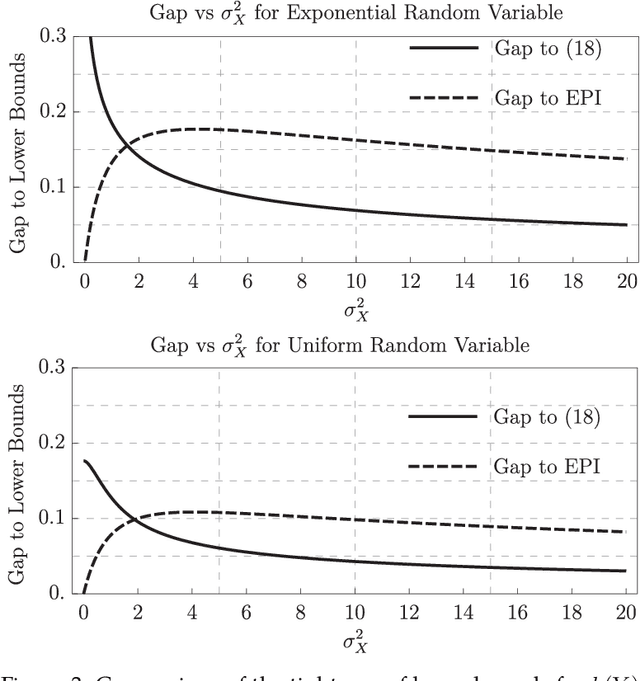
This paper considers an additive Gaussian noise channel with arbitrarily distributed finite variance input signals. It studies the differential entropy of the minimum mean-square error (MMSE) estimator and provides a new lower bound which connects the entropy of the input, output, and conditional mean. That is, the sum of entropies of the conditional mean and output is always greater than or equal to twice the input entropy. Various other properties such as upper bounds, asymptotics, Taylor series expansion, and connection to Fisher Information are obtained. An application of the lower bound in the remote-source coding problem is discussed, and extensions of the lower and upper bounds to the vector Gaussian channel are given.