 Add to Chrome
 Add to Firefox
 Add to Edge
Cluster-Aware Over-the-Air Federated Learning with Energy-Harvesting Devices: From Global Training to Model Personalization
Aug 02, 2026
Federated learning (FL) enables distributed optimization and learning across decentralized edge devices while preserving data privacy, but its performance is fundamentally constrained by heterogeneous data distributions, limited communication resources, and energy availability. In practical wireless networks, mobile devices (MDs) often exhibit diverse data and learning objectives, naturally forming clusters of users with jointly trainable models. When devices rely on energy harvesting (EH), stochastic energy arrivals further complicate participation and scheduling under communication constraints. In this work, we study over-the-air (OTA) FL with EH MDs under heterogeneous data distributions, and investigate two closely related learning objectives within a unified framework: one aiming for a more representative global model by reducing data bias, and the other learning more personalized cluster-specific models by exploiting this bias. In the global training mode, cluster information guides energy- and diversity-aware scheduling, ensuring that the scheduled active users provide a more representative aggregate update. In the personalization mode, the same cluster structure defines cluster-level learning objectives and OTA recovery targets, enabling the parameter server to train multiple cluster-specific models through simultaneous transmissions over the wireless multiple-access channel. Numerical results demonstrate that the proposed unified framework improves fairness or personalization, depending on the operating mode, while reducing communication overhead.

Update Estimation and Scheduling for Over-the-Air Federated Learning with Energy Harvesting Devices
Jan 30, 2025We study over-the-air (OTA) federated learning (FL) for energy harvesting devices with heterogeneous data distribution over wireless fading multiple access channel (MAC). To address the impact of low energy arrivals and data heterogeneity on global learning, we propose user scheduling strategies. Specifically, we develop two approaches: 1) entropy-based scheduling for known data distributions and 2) least-squares-based user representation estimation for scheduling with unknown data distributions at the parameter server. Both methods aim to select diverse users, mitigating bias and enhancing convergence. Numerical and analytical results demonstrate improved learning performance by reducing redundancy and conserving energy.
Over-the-Air Multi-Sensor Inference with Neural Networks Using Memristor-Based Analog Computing
Jan 17, 2025Deep neural networks provide reliable solutions for many classification and regression tasks; however, their application in real-time wireless systems with simple sensor networks is limited due to high energy consumption and significant bandwidth needs. This study proposes a multi-sensor wireless inference system with memristor-based analog computing. Given the sensors' limited computational capabilities, the features from the network's front end are transmitted to a central device where an $L_p$-norm inspired approximation of the maximum operation is employed to achieve transformation-invariant features, enabling efficient over-the-air transmission. We also introduce a trainable over-the-air sensor fusion method based on $L_p$-norm inspired combining function that customizes sensor fusion to match the network and sensor distribution characteristics, enhancing adaptability. To address the energy constraints of sensors, we utilize memristors, known for their energy-efficient in-memory computing, enabling analog-domain computations that reduce energy use and computational overhead in edge computing. This dual approach of memristors and $L_p$-norm inspired sensor fusion fosters energy-efficient computational and transmission paradigms and serves as a practical energy-efficient solution with minimal performance loss.
Towards Goal-Oriented Semantic Signal Processing: Applications and Future Challenges
Sep 24, 2021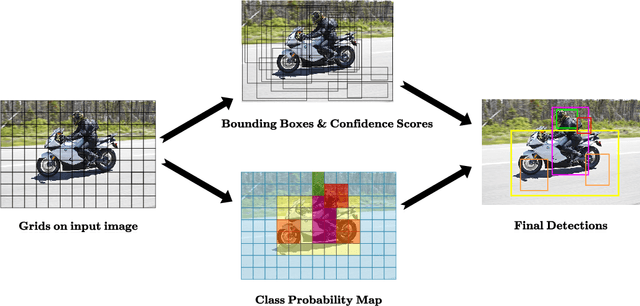
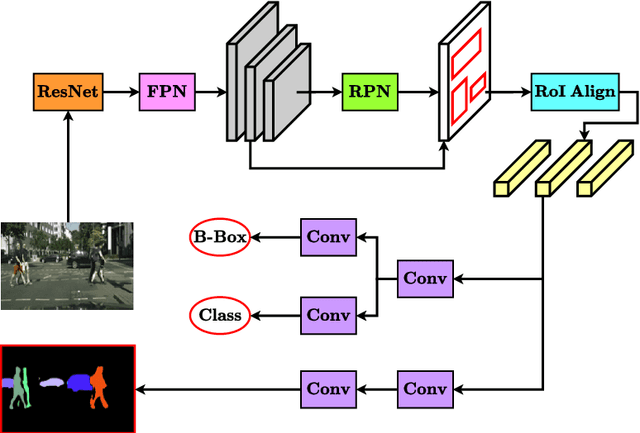

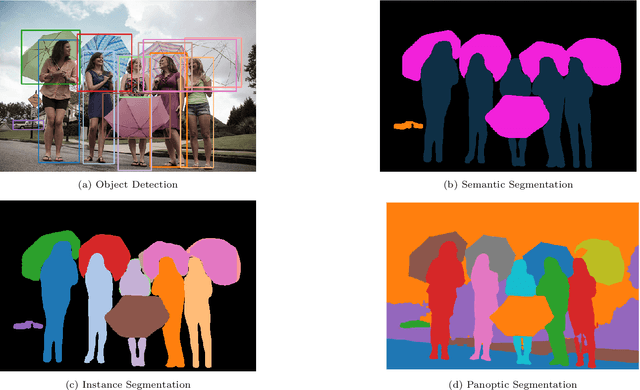
Advances in machine learning technology have enabled real-time extraction of semantic information in signals which can revolutionize signal processing techniques and improve their performance significantly for the next generation of applications. With the objective of a concrete representation and efficient processing of the semantic information, we propose and demonstrate a formal graph-based semantic language and a goal filtering method that enables goal-oriented signal processing. The proposed semantic signal processing framework can easily be tailored for specific applications and goals in a diverse range of signal processing applications. To illustrate its wide range of applicability, we investigate several use cases and provide details on how the proposed goal-oriented semantic signal processing framework can be customized. We also investigate and propose techniques for communications where sensor data is semantically processed and semantic information is exchanged across a sensor network.
* 44 pages, 29 figures, 3 tables. This preprint will be published in the Digital Signal Processing Journal's 30th anniversary issue on Future Signal Processing
Machine Learning at Wireless Edge with OFDM and Low Resolution ADC and DAC
Oct 01, 2020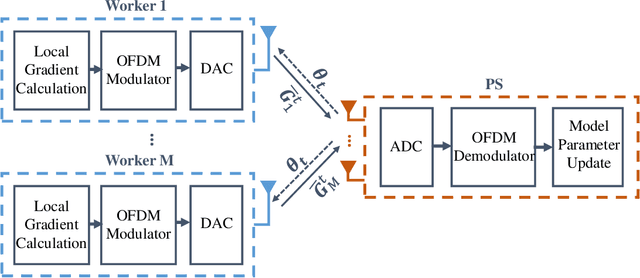
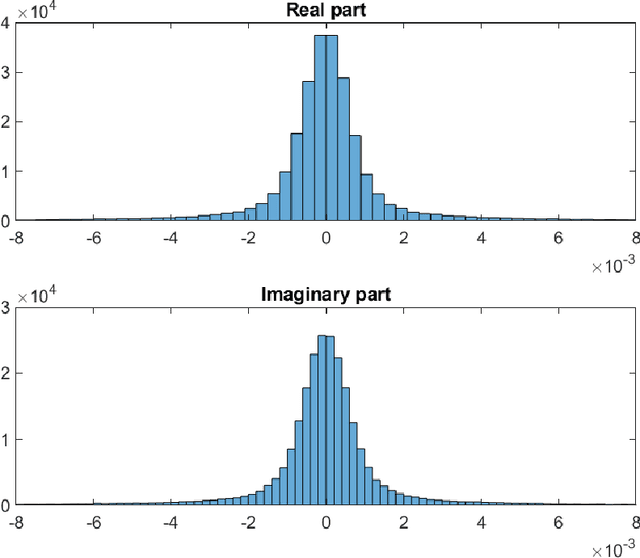
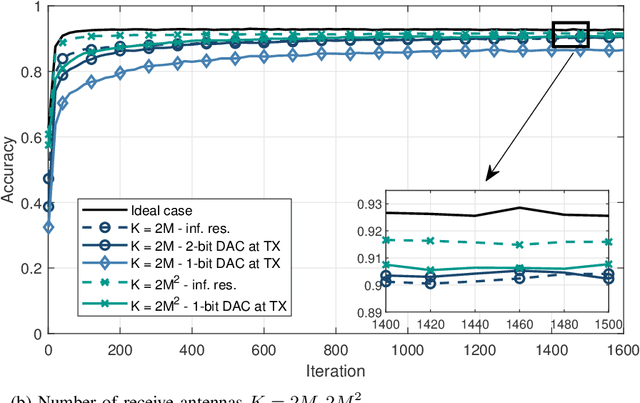
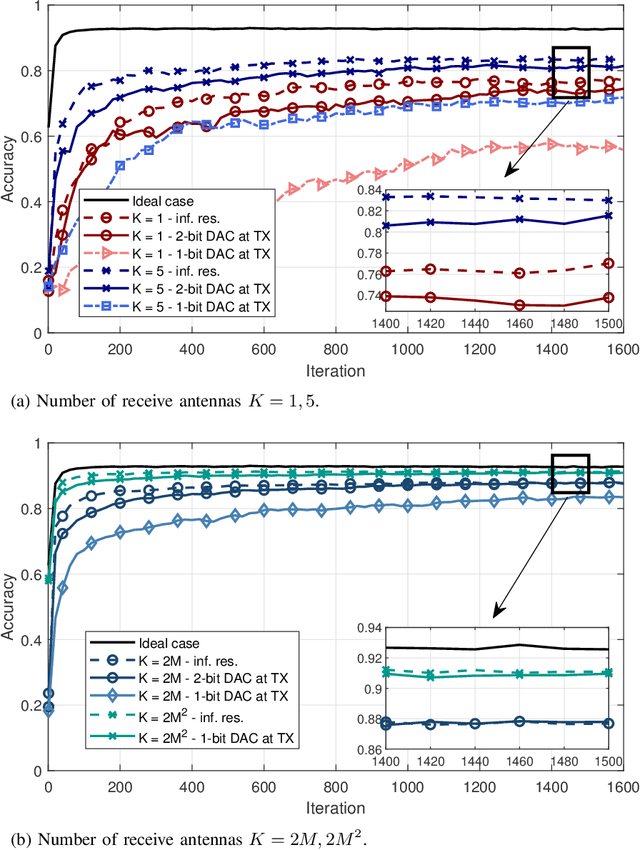
We study collaborative machine learning (ML) systems where a massive dataset is distributed across independent workers which compute their local gradient estimates based on their own datasets. Workers send their estimates through a multipath fading multiple access channel (MAC) with orthogonal frequency division multiplexing (OFDM) to mitigate the frequency selectivity of the channel. We assume that the parameter server (PS) employs multiple antennas to align the received signals with no channel state information (CSI) at the workers. To reduce the power consumption and the hardware costs, we employ complex-valued low resolution digital to analog converters (DACs) and analog to digital converters (ADCs), respectively, at the transmitter and the receiver sides to study the effects of practical low cost DACs and ADCs on the learning performance of the system. Our theoretical analysis shows that the impairments caused by low-resolution DACs and ADCs, including the extreme case of one-bit DACs and ADCs, do not prevent the convergence of the learning algorithm, and the multipath channel effects vanish when a sufficient number of antennas are used at the PS. We also validate our theoretical results via simulations, and demonstrate that using low-resolution, even one-bit, DACs and ADCs causes only a slight decrease in the learning accuracy.