 Add to Chrome
 Add to Firefox
 Add to Edge
GUI agent: Guided Exploration of User-Sensitive Screens
Jun 24, 2026
LLM agents are increasingly being used to automate tasks for users within an open GUI environment. They inevitably encounter screens containing user-sensitive information, for which takeover of task execution by the user is highly desirable or even necessary. State-of-the-art LLM-driven agents are usually fine-tuned to complete tasks regardless of the safety implications of their actions. This makes their real-world deployment difficult and adversely affects the reliability. Therefore, it is crucial to identify and categorize user-sensitive states and define user-sensitive queries. This dataset would be to engineers to recognize and request handover to the user in critical scenarios. This short paper develops an explorer agent that systematically explores the query space starting from one demonstrated task to identify queries that, if executed, would lead to user-sensitive states in a GUI environment.

A Solution to Adaptive Mobile Manipulator Throwing
Aug 03, 2022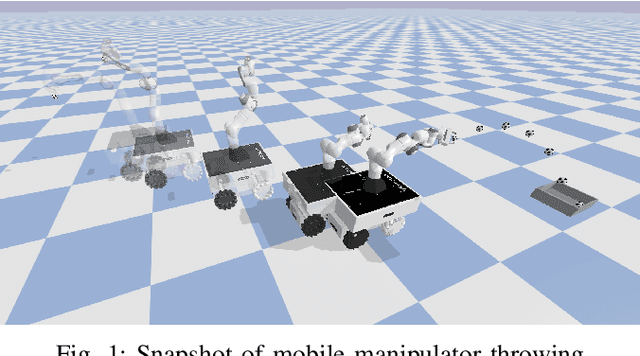
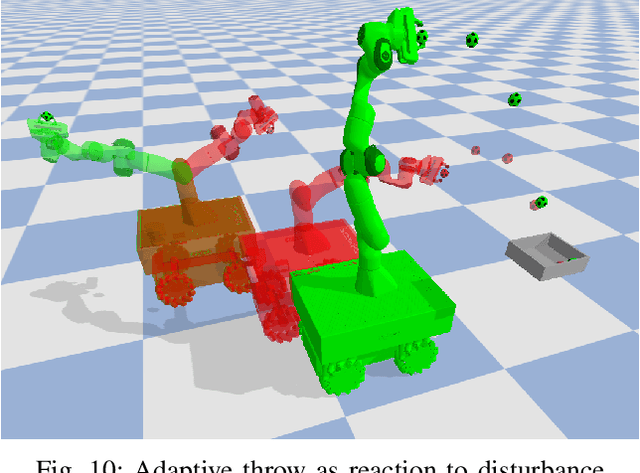
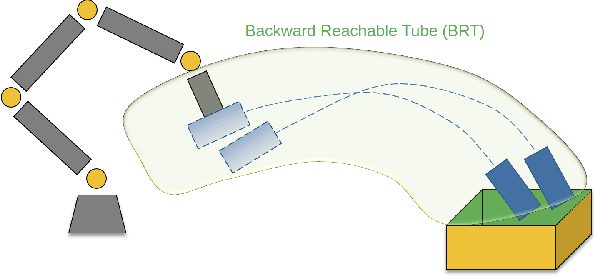
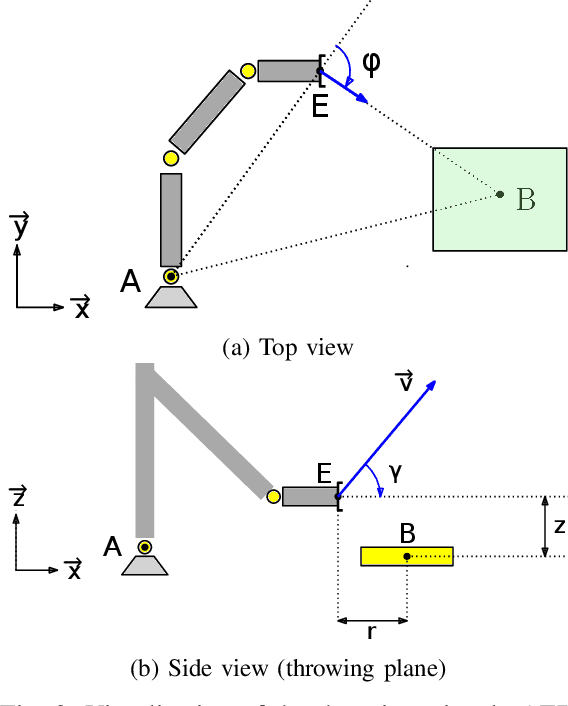
Mobile manipulator throwing is a promising method to increase the flexibility and efficiency of dynamic manipulation in factories. Its major challenge is to efficiently plan a feasible throw under a wide set of task specifications. We show that the mobile manipulator throwing problem can be simplified to a planar problem, hence greatly reducing the computational costs. Using machine learning approaches, we build a model of the object's inverted flying dynamics and the robot's kinematic feasibility, which enables throwing motion generation within 1 ms for given query of target position. Thanks to the computational efficiency of our method, we show that the system is adaptive under disturbance, via replanning on the fly for alternative solutions, instead of sticking to the original throwing plan.
Learning High Dimensional Demonstrations Using Laplacian Eigenmaps
Jul 18, 2022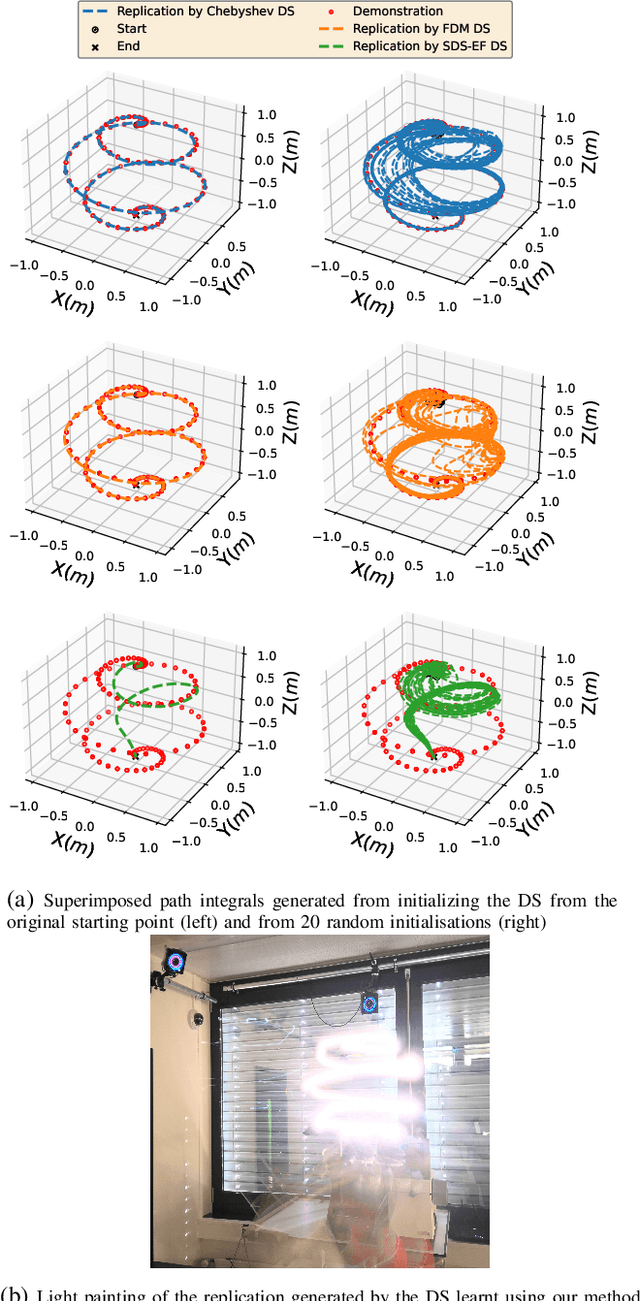
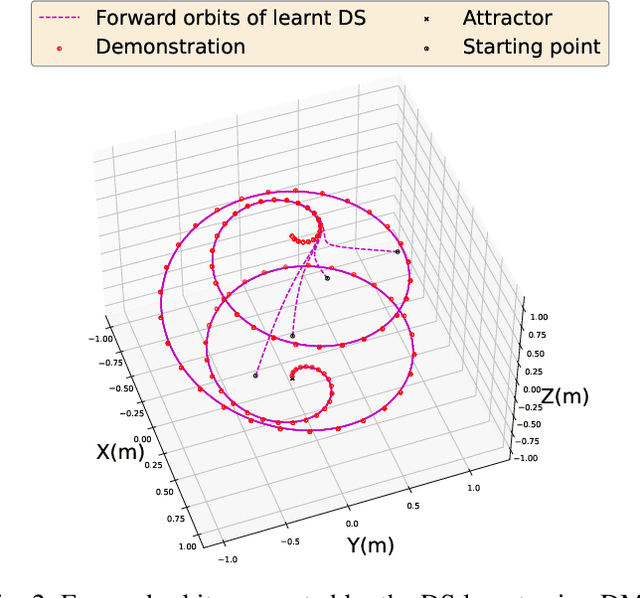
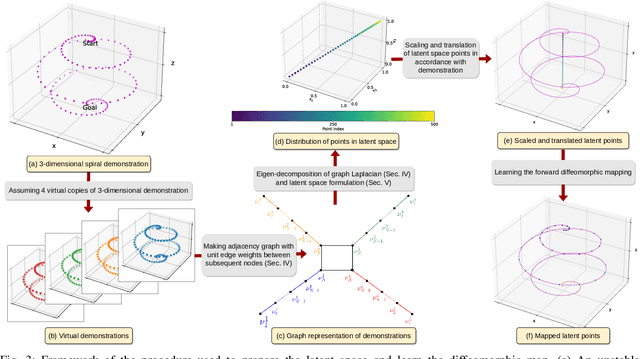
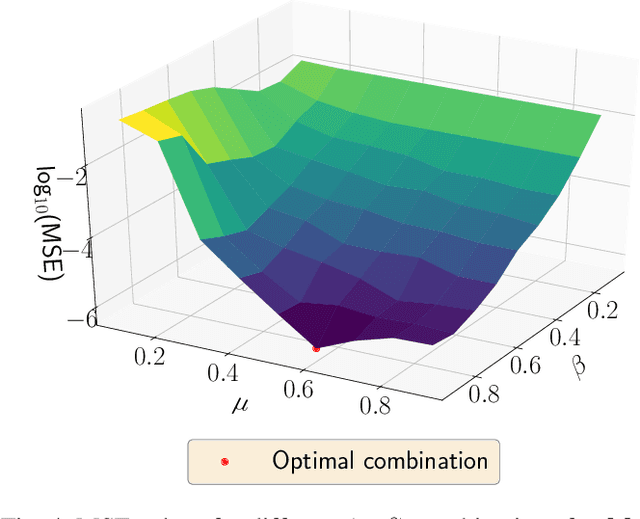
This article proposes a novel methodology to learn a stable robot control law driven by dynamical systems. The methodology requires a single demonstration and can deduce a stable dynamics in arbitrary high dimensions. The method relies on the idea that there exists a latent space in which the nonlinear dynamics appears quasi linear. The original nonlinear dynamics is mapped into a stable linear DS, by leveraging on the properties of graph embeddings. We show that the eigendecomposition of the Graph Laplacian results in linear embeddings in two dimensions and quasi-linear in higher dimensions. The nonlinear terms vanish, exponentially as the number of datapoints increase, and for large density of points, the embedding appears linear. We show that this new embedding enables to model highly nonlinear dynamics in high dimension and overcomes alternative techniques in both precision of reconstruction and number of parameters required for the embedding. We demonstrate its applicability to control real robot tasked to perform complex free motion in space.