 Add to Chrome
 Add to Firefox
 Add to Edge
Hierarchical Multi-Modal Planning for Fixed-Altitude Sparse Target Search and Sampling
Mar 09, 2026
Efficient monitoring of sparse benthic phenomena, such as coral colonies, presents a great challenge for Autonomous Underwater Vehicles. Traditional exhaustive coverage strategies are energy-inefficient, while recent adaptive sampling approaches rely on costly vertical maneuvers. To address these limitations, we propose HIMoS (Hierarchical Informative Multi-Modal Search), a fixed-altitude framework for sparse coral search-and-sample missions. The system integrates a heterogeneous sensor suite within a two-layer planning architecture. At the strategic level, a Global Planner optimizes topological routes to maximize potential discovery. At the tactical level, a receding-horizon Local Planner leverages differentiable belief propagation to generate kinematically feasible trajectories that balance acoustic substrate exploration, visual coral search, and close-range sampling. Validated in high-fidelity simulations derived from real-world coral reef benthic surveys, our approach demonstrates superior mission efficiency compared to state-of-the-art baselines.

AquaticVision: Benchmarking Visual SLAM in Underwater Environment with Events and Frames
May 06, 2025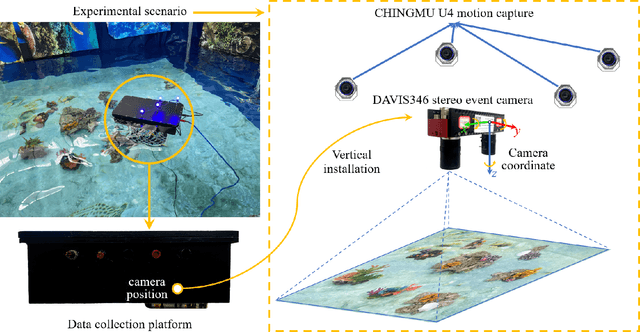
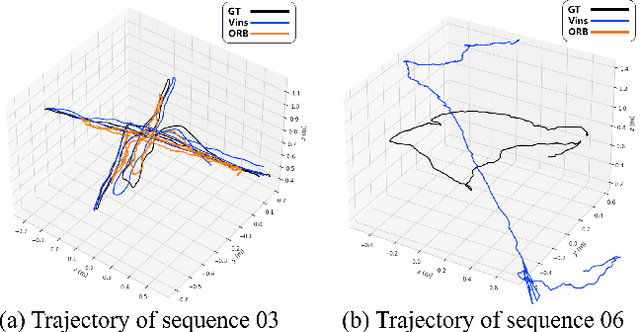
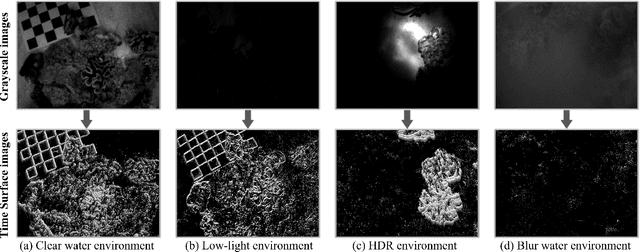
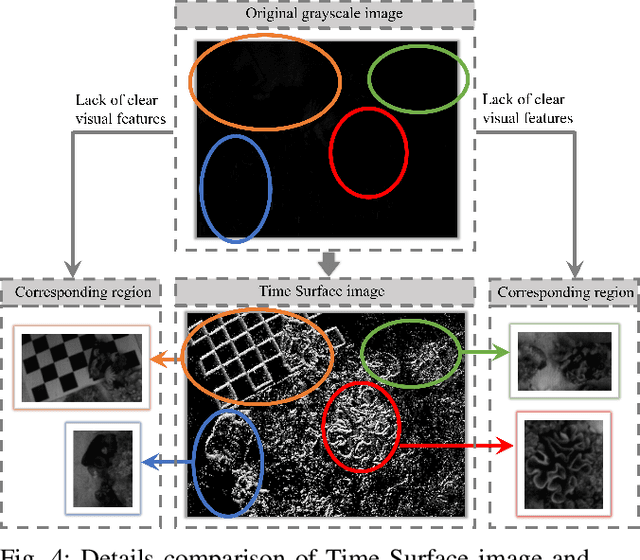
Many underwater applications, such as offshore asset inspections, rely on visual inspection and detailed 3D reconstruction. Recent advancements in underwater visual SLAM systems for aquatic environments have garnered significant attention in marine robotics research. However, existing underwater visual SLAM datasets often lack groundtruth trajectory data, making it difficult to objectively compare the performance of different SLAM algorithms based solely on qualitative results or COLMAP reconstruction. In this paper, we present a novel underwater dataset that includes ground truth trajectory data obtained using a motion capture system. Additionally, for the first time, we release visual data that includes both events and frames for benchmarking underwater visual positioning. By providing event camera data, we aim to facilitate the development of more robust and advanced underwater visual SLAM algorithms. The use of event cameras can help mitigate challenges posed by extremely low light or hazy underwater conditions. The webpage of our dataset is https://sites.google.com/view/aquaticvision-lias.