 Add to Chrome
 Add to Firefox
 Add to Edge
To Move or Not to Move: Constraint-based Planning Enables Zero-Shot Generalization for Interactive Navigation
Feb 23, 2026
Visual navigation typically assumes the existence of at least one obstacle-free path between start and goal, which must be discovered/planned by the robot. However, in real-world scenarios, such as home environments and warehouses, clutter can block all routes. Targeted at such cases, we introduce the Lifelong Interactive Navigation problem, where a mobile robot with manipulation abilities can move clutter to forge its own path to complete sequential object- placement tasks - each involving placing an given object (eg. Alarm clock, Pillow) onto a target object (eg. Dining table, Desk, Bed). To address this lifelong setting - where effects of environment changes accumulate and have long-term effects - we propose an LLM-driven, constraint-based planning framework with active perception. Our framework allows the LLM to reason over a structured scene graph of discovered objects and obstacles, deciding which object to move, where to place it, and where to look next to discover task-relevant information. This coupling of reasoning and active perception allows the agent to explore the regions expected to contribute to task completion rather than exhaustively mapping the environment. A standard motion planner then executes the corresponding navigate-pick-place, or detour sequence, ensuring reliable low-level control. Evaluated in physics-enabled ProcTHOR-10k simulator, our approach outperforms non-learning and learning-based baselines. We further demonstrate our approach qualitatively on real-world hardware.

Deep Reinforcement Learning with Dynamic Graphs for Adaptive Informative Path Planning
Feb 07, 2024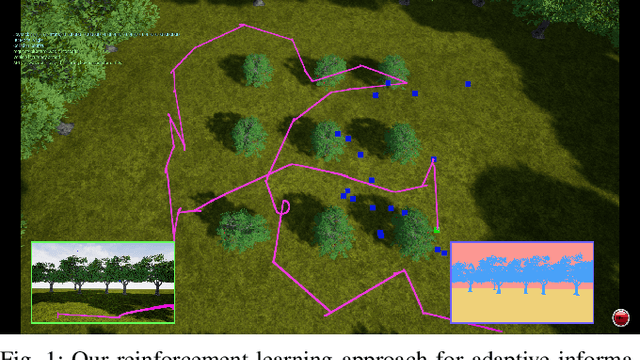
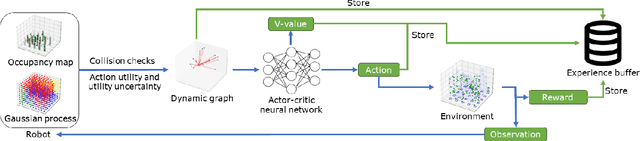
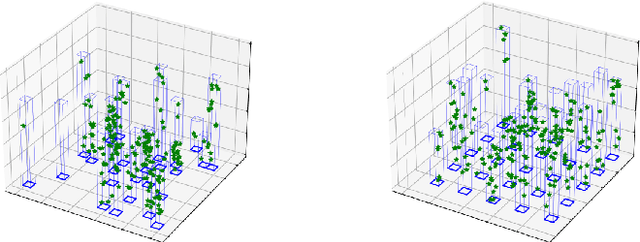
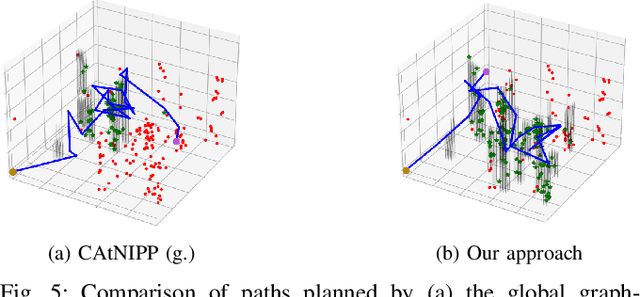
Autonomous robots are often employed for data collection due to their efficiency and low labour costs. A key task in robotic data acquisition is planning paths through an initially unknown environment to collect observations given platform-specific resource constraints, such as limited battery life. Adaptive online path planning in 3D environments is challenging due to the large set of valid actions and the presence of unknown occlusions. To address these issues, we propose a novel deep reinforcement learning approach for adaptively replanning robot paths to map targets of interest in unknown 3D environments. A key aspect of our approach is a dynamically constructed graph that restricts planning actions local to the robot, allowing us to quickly react to newly discovered obstacles and targets of interest. For replanning, we propose a new reward function that balances between exploring the unknown environment and exploiting online-collected data about the targets of interest. Our experiments show that our method enables more efficient target detection compared to state-of-the-art learning and non-learning baselines. We also show the applicability of our approach for orchard monitoring using an unmanned aerial vehicle in a photorealistic simulator.