 Add to Chrome
 Add to Firefox
 Add to Edge
Mixed-Integer Programming for Change-point Detection
Feb 12, 2026
We present a new mixed-integer programming (MIP) approach for offline multiple change-point detection by casting the problem as a globally optimal piecewise linear (PWL) fitting problem. Our main contribution is a family of strengthened MIP formulations whose linear programming (LP) relaxations admit integral projections onto the segment assignment variables, which encode the segment membership of each data point. This property yields provably tighter relaxations than existing formulations for offline multiple change-point detection. We further extend the framework to two settings of active research interest: (i) multidimensional PWL models with shared change-points, and (ii) sparse change-point detection, where only a subset of dimensions undergo structural change. Extensive computational experiments on benchmark real-world datasets demonstrate that the proposed formulations achieve reductions in solution times under both $\ell_1$ and $\ell_2$ loss functions in comparison to the state-of-the-art.

Comparing skill of historical rainfall data based monsoon rainfall prediction in India with NCEP-NWP forecasts
Feb 12, 2024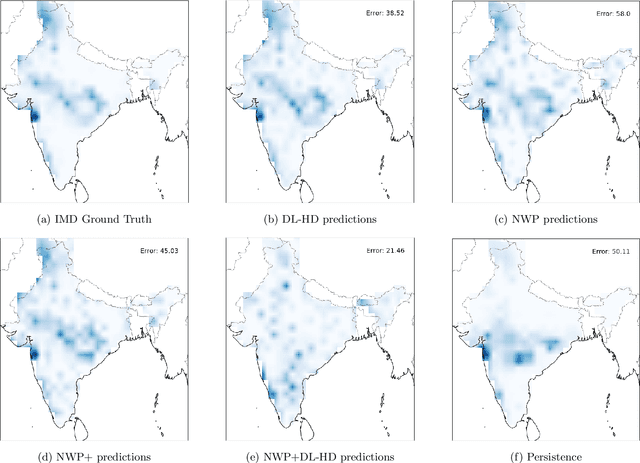
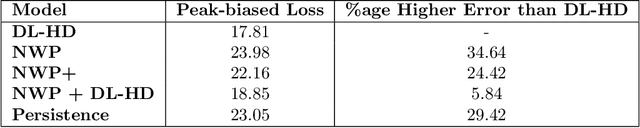
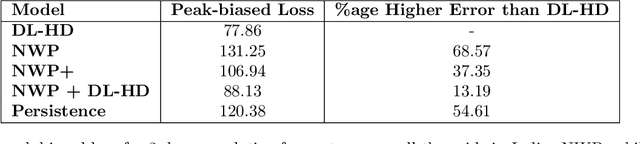
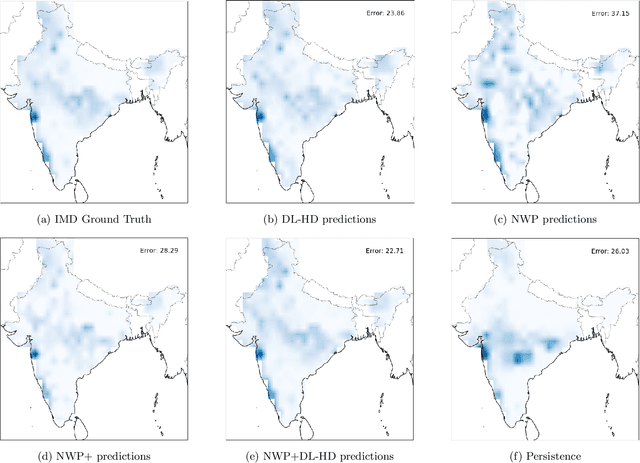
In this draft we consider the problem of forecasting rainfall across India during the four monsoon months, one day as well as three days in advance. We train neural networks using historical daily gridded precipitation data for India obtained from IMD for the time period $1901- 2022$, at a spatial resolution of $1^{\circ} \times 1^{\circ}$. This is compared with the numerical weather prediction (NWP) forecasts obtained from NCEP (National Centre for Environmental Prediction) available for the period 2011-2022. We conduct a detailed country wide analysis and separately analyze some of the most populated cities in India. Our conclusion is that forecasts obtained by applying deep learning to historical rainfall data are more accurate compared to NWP forecasts as well as predictions based on persistence. On average, compared to our predictions, forecasts from NCEP-NWP model have about 34% higher error for a single day prediction, and over 68% higher error for a three day prediction. Similarly, persistence estimates report a 29% higher error in a single day forecast, and over 54% error in a three day forecast. We further observe that data up to 20 days in the past is useful in reducing errors of one and three day forecasts, when a transformer based learning architecture, and to a lesser extent when an LSTM is used. A key conclusion suggested by our preliminary analysis is that NWP forecasts can be substantially improved upon through more and diverse data relevant to monsoon prediction combined with carefully selected neural network architecture.