 Add to Chrome
 Add to Firefox
 Add to Edge
From EEG Cleaning to Decoding: The Role of Artifact Rejection in MI-based BCIs
May 12, 2026
Motor imagery (MI) BCIs are sensitive to EEG artifacts, yet the practical impact of automated artifact rejection on downstream MI decoding performance remains unclear. While most work focuses on decoder design, the contribution of data curation, particularly automated rejection policies, has received comparatively less attention, despite its importance for robust ML pipelines. Here, we propose Fast Automatic Artifact Rejection (FAAR), a lightweight method that computes a compact set of artifact-sensitive features, derives an epoch-level Signal Quality Index, adaptively selects rejection thresholds, and automatically rejects contaminated epochs without requiring prior knowledge of artifact types or manual threshold tuning. We evaluate FAAR on 13 publicly available MI datasets and compare it to a no-rejection baseline, AutoReject, and Isolation Forest. We show rejection effects are strongly subject- and regime-dependent, with the largest gains in low-baseline/low-SNR conditions, so it should be used adaptively. FAAR reduces inter-subject performance variability, an important property for MI-BCI reliability and BCI-illiteracy, without aggressive data removal. Finally, FAAR's lightweight and fully automated thresholding yields consistent rejection behavior across offline curation, training, and online filtering, and supports real-time BCI constraints.

Geodesic Optimization for Predictive Shift Adaptation on EEG data
Jul 04, 2024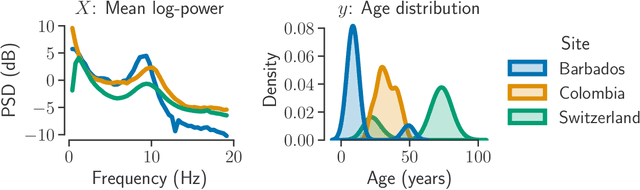
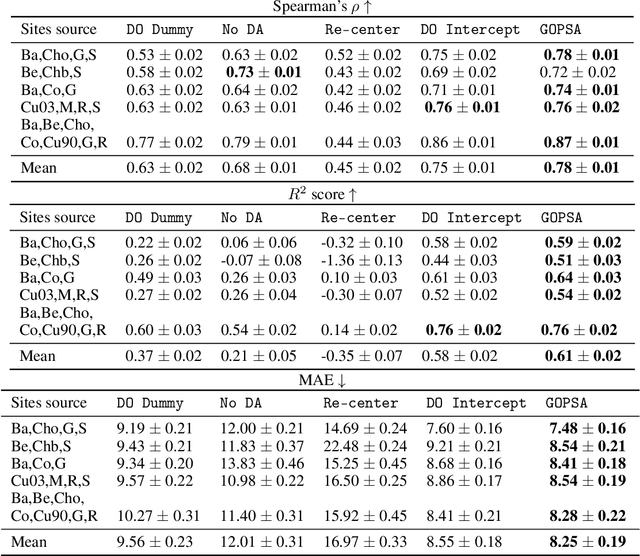
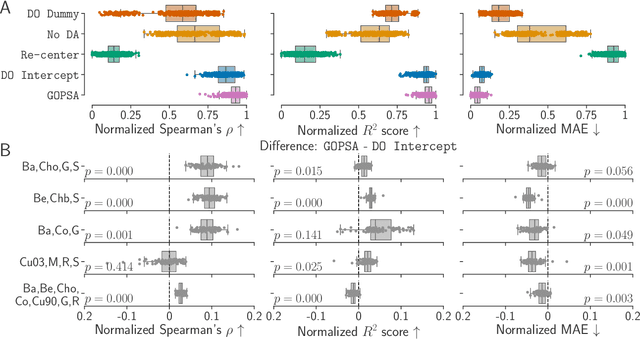
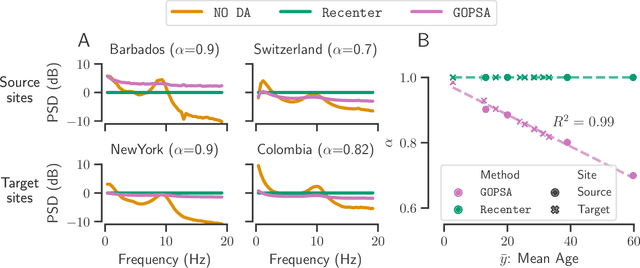
Electroencephalography (EEG) data is often collected from diverse contexts involving different populations and EEG devices. This variability can induce distribution shifts in the data $X$ and in the biomedical variables of interest $y$, thus limiting the application of supervised machine learning (ML) algorithms. While domain adaptation (DA) methods have been developed to mitigate the impact of these shifts, such methods struggle when distribution shifts occur simultaneously in $X$ and $y$. As state-of-the-art ML models for EEG represent the data by spatial covariance matrices, which lie on the Riemannian manifold of Symmetric Positive Definite (SPD) matrices, it is appealing to study DA techniques operating on the SPD manifold. This paper proposes a novel method termed Geodesic Optimization for Predictive Shift Adaptation (GOPSA) to address test-time multi-source DA for situations in which source domains have distinct $y$ distributions. GOPSA exploits the geodesic structure of the Riemannian manifold to jointly learn a domain-specific re-centering operator representing site-specific intercepts and the regression model. We performed empirical benchmarks on the cross-site generalization of age-prediction models with resting-state EEG data from a large multi-national dataset (HarMNqEEG), which included $14$ recording sites and more than $1500$ human participants. Compared to state-of-the-art methods, our results showed that GOPSA achieved significantly higher performance on three regression metrics ($R^2$, MAE, and Spearman's $\rho$) for several source-target site combinations, highlighting its effectiveness in tackling multi-source DA with predictive shifts in EEG data analysis. Our method has the potential to combine the advantages of mixed-effects modeling with machine learning for biomedical applications of EEG, such as multicenter clinical trials.