 Add to Chrome
 Add to Firefox
 Add to Edge
From EEG Cleaning to Decoding: The Role of Artifact Rejection in MI-based BCIs
May 12, 2026
Motor imagery (MI) BCIs are sensitive to EEG artifacts, yet the practical impact of automated artifact rejection on downstream MI decoding performance remains unclear. While most work focuses on decoder design, the contribution of data curation, particularly automated rejection policies, has received comparatively less attention, despite its importance for robust ML pipelines. Here, we propose Fast Automatic Artifact Rejection (FAAR), a lightweight method that computes a compact set of artifact-sensitive features, derives an epoch-level Signal Quality Index, adaptively selects rejection thresholds, and automatically rejects contaminated epochs without requiring prior knowledge of artifact types or manual threshold tuning. We evaluate FAAR on 13 publicly available MI datasets and compare it to a no-rejection baseline, AutoReject, and Isolation Forest. We show rejection effects are strongly subject- and regime-dependent, with the largest gains in low-baseline/low-SNR conditions, so it should be used adaptively. FAAR reduces inter-subject performance variability, an important property for MI-BCI reliability and BCI-illiteracy, without aggressive data removal. Finally, FAAR's lightweight and fully automated thresholding yields consistent rejection behavior across offline curation, training, and online filtering, and supports real-time BCI constraints.

Improved Riemannian potato field: an Automatic Artifact Rejection Method for EEG
Sep 11, 2025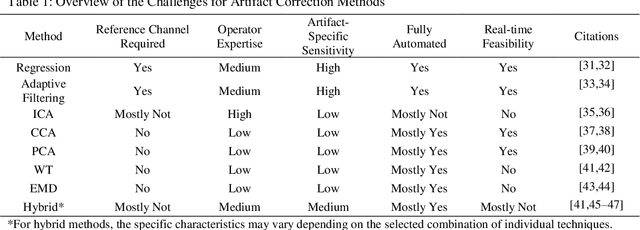
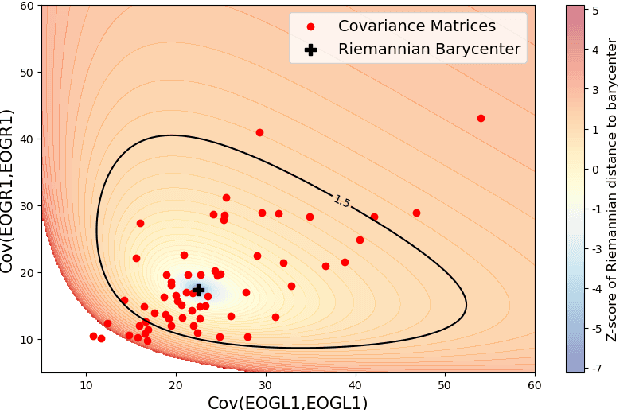
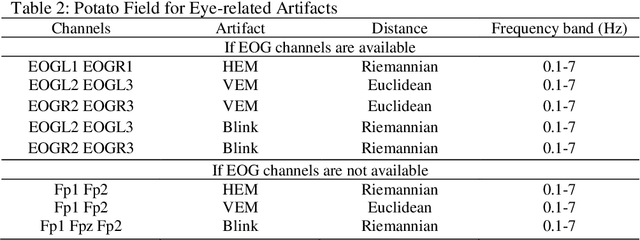

Electroencephalography (EEG) signal cleaning has long been a critical challenge in the research community. The presence of artifacts can significantly degrade EEG data quality, complicating analysis and potentially leading to erroneous interpretations. While various artifact rejection methods have been proposed, the gold standard remains manual visual inspection by human experts-a process that is time-consuming, subjective, and impractical for large-scale EEG studies. Existing techniques are often hindered by a strong reliance on manual hyperparameter tuning, sensitivity to outliers, and high computational costs. In this paper, we introduce the improved Riemannian Potato Field (iRPF), a fast and fully automated method for EEG artifact rejection that addresses key limitations of current approaches. We evaluate iRPF against several state-of-the-art artifact rejection methods, using two publicly available EEG databases, labeled for various artifact types, comprising 226 EEG recordings. Our results demonstrate that iRPF outperforms all competitors across multiple metrics, with gains of up to 22% in recall, 102% in specificity, 54% in precision, and 24% in F1-score, compared to Isolation Forest, Autoreject, Riemannian Potato, and Riemannian Potato Field, respectively. Statistical analysis confirmed the significance of these improvements (p < 0.001) with large effect sizes (Cohen's d > 0.8) in most comparisons. Additionally, on a typical EEG recording iRPF performs artifact cleaning in under 8 milliseconds per epoch using a standard laptop, highlighting its efficiency for large-scale EEG data processing and real-time applications. iRPF offers a robust and data-driven artifact rejection solution for high-quality EEG pre-processing in brain-computer interfaces and clinical neuroimaging applications.