 Add to Chrome
 Add to Firefox
 Add to Edge
From EEG Cleaning to Decoding: The Role of Artifact Rejection in MI-based BCIs
May 12, 2026
Motor imagery (MI) BCIs are sensitive to EEG artifacts, yet the practical impact of automated artifact rejection on downstream MI decoding performance remains unclear. While most work focuses on decoder design, the contribution of data curation, particularly automated rejection policies, has received comparatively less attention, despite its importance for robust ML pipelines. Here, we propose Fast Automatic Artifact Rejection (FAAR), a lightweight method that computes a compact set of artifact-sensitive features, derives an epoch-level Signal Quality Index, adaptively selects rejection thresholds, and automatically rejects contaminated epochs without requiring prior knowledge of artifact types or manual threshold tuning. We evaluate FAAR on 13 publicly available MI datasets and compare it to a no-rejection baseline, AutoReject, and Isolation Forest. We show rejection effects are strongly subject- and regime-dependent, with the largest gains in low-baseline/low-SNR conditions, so it should be used adaptively. FAAR reduces inter-subject performance variability, an important property for MI-BCI reliability and BCI-illiteracy, without aggressive data removal. Finally, FAAR's lightweight and fully automated thresholding yields consistent rejection behavior across offline curation, training, and online filtering, and supports real-time BCI constraints.

Channel Adaptation for EEG Foundation Models: A Systematic Benchmark Across Architectures, Tasks, and Training Regimes
Apr 25, 2026Scaling EEG foundation models requires pooling data across heterogeneous electrode montages, a prerequisite both for larger pretraining corpora and for downstream deployment. We present the first systematic comparison of four channel adaptation methods (Conv1d projection, spherical spline interpolation (SSI), source-space decomposition, and Riemannian re-centering) across five pretrained EEG foundation models (5M--157M parameters), five downstream tasks, and two training regimes with 10--15 random seeds each. We find that rigid-montage models (BENDR, Neuro-GPT) require external adaptation, while flexible models (EEGPT, CBraMod) match or exceed it natively when fine-tuned but benefit from external methods under frozen-encoder deployment. A probe-SFT asymmetry exists: external adaptation can cause severe negative transfer during fine-tuning of flexible models. The optimal method is architecture-dependent (Conv1d for BENDR, SSI/Riemannian for Neuro-GPT, source-space decomposition for depression detection), and 5M-parameter CBraMod outperforms models up to 31$\times$ larger on 4/5 datasets, consistent with independent findings that compact EEG-specific architectures can match larger models.
ENIGMA: EEG-to-Image in 15 Minutes Using Less Than 1% of the Parameters
Feb 10, 2026To be practical for real-life applications, models for brain-computer interfaces must be easily and quickly deployable on new subjects, effective on affordable scanning hardware, and small enough to run locally on accessible computing resources. To directly address these current limitations, we introduce ENIGMA, a multi-subject electroencephalography (EEG)-to-Image decoding model that reconstructs seen images from EEG recordings and achieves state-of-the-art (SOTA) performance on the research-grade THINGS-EEG2 and consumer-grade AllJoined-1.6M benchmarks, while fine-tuning effectively on new subjects with as little as 15 minutes of data. ENIGMA boasts a simpler architecture and requires less than 1% of the trainable parameters necessary for previous approaches. Our approach integrates a subject-unified spatio-temporal backbone along with a set of multi-subject latent alignment layers and an MLP projector to map raw EEG signals to a rich visual latent space. We evaluate our approach using a broad suite of image reconstruction metrics that have been standardized in the adjacent field of fMRI-to-Image research, and we describe the first EEG-to-Image study to conduct extensive behavioral evaluations of our reconstructions using human raters. Our simple and robust architecture provides a significant performance boost across both research-grade and consumer-grade EEG hardware, and a substantial improvement in fine-tuning efficiency and inference cost. Finally, we provide extensive ablations to determine the architectural choices most responsible for our performance gains in both single and multi-subject cases across multiple benchmark datasets. Collectively, our work provides a substantial step towards the development of practical brain-computer interface applications.
EEG Foundation Challenge: From Cross-Task to Cross-Subject EEG Decoding
Jun 23, 2025Current electroencephalogram (EEG) decoding models are typically trained on small numbers of subjects performing a single task. Here, we introduce a large-scale, code-submission-based competition comprising two challenges. First, the Transfer Challenge asks participants to build and test a model that can zero-shot decode new tasks and new subjects from their EEG data. Second, the Psychopathology factor prediction Challenge asks participants to infer subject measures of mental health from EEG data. For this, we use an unprecedented, multi-terabyte dataset of high-density EEG signals (128 channels) recorded from over 3,000 child to young adult subjects engaged in multiple active and passive tasks. We provide several tunable neural network baselines for each of these two challenges, including a simple network and demographic-based regression models. Developing models that generalise across tasks and individuals will pave the way for ML network architectures capable of adapting to EEG data collected from diverse tasks and individuals. Similarly, predicting mental health-relevant personality trait values from EEG might identify objective biomarkers useful for clinical diagnosis and design of personalised treatment for psychological conditions. Ultimately, the advances spurred by this challenge could contribute to the development of computational psychiatry and useful neurotechnology, and contribute to breakthroughs in both fundamental neuroscience and applied clinical research.
* Approved at Neurips Competition track. webpage: https://eeg2025.github.io/
Quantifying Data Requirements for EEG Independent Component Analysis Using AMICA
Jun 11, 2025
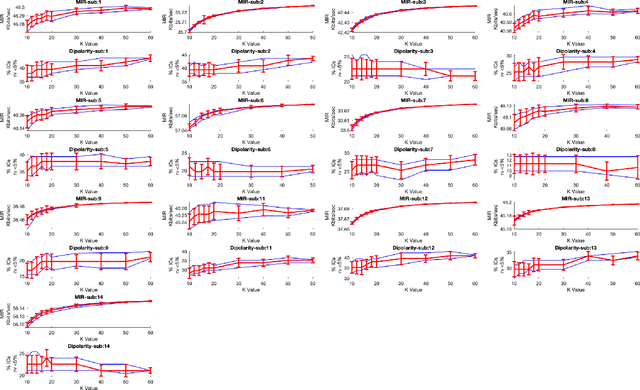
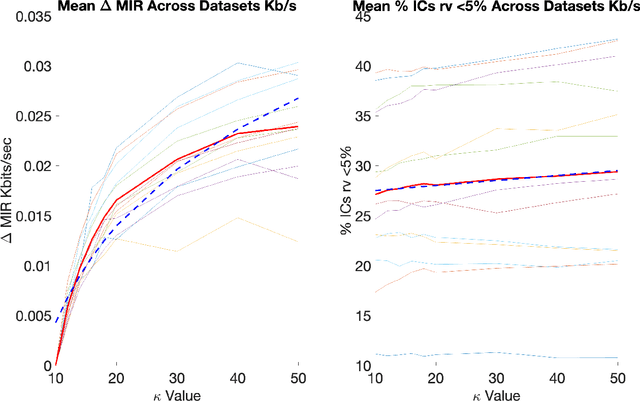

Independent Component Analysis (ICA) is an important step in EEG processing for a wide-ranging set of applications. However, ICA requires well-designed studies and data collection practices to yield optimal results. Past studies have focused on quantitative evaluation of the differences in quality produced by different ICA algorithms as well as different configurations of parameters for AMICA, a multimodal ICA algorithm that is considered the benchmark against which other algorithms are measured. Here, the effect of the data quantity versus the number of channels on decomposition quality is explored. AMICA decompositions were run on a 71 channel dataset with 13 subjects while randomly subsampling data to correspond to specific ratios of the number of frames in a dataset to the channel count. Decomposition quality was evaluated for the varying quantities of data using measures of mutual information reduction (MIR) and the near dipolarity of components. We also note that an asymptotic trend can be seen in the increase of MIR and a general increasing trend in near dipolarity with increasing data, but no definitive plateau in these metrics was observed, suggesting that the benefits of collecting additional EEG data may extend beyond common heuristic thresholds and continue to enhance decomposition quality.
Automatic EEG Independent Component Classification Using ICLabel in Python
Nov 20, 2024ICLabel is an important plug-in function in EEGLAB, the most widely used software for EEG data processing. A powerful approach to automated processing of EEG data involves decomposing the data by Independent Component Analysis (ICA) and then classifying the resulting independent components (ICs) using ICLabel. While EEGLAB pipelines support high-performance computing (HPC) platforms running the open-source Octave interpreter, the ICLabel plug-in is incompatible with Octave because of its specialized neural network architecture. To enhance cross-platform compatibility, we developed a Python version of ICLabel that uses standard EEGLAB data structures. We compared ICLabel MATLAB and Python implementations to data from 14 subjects. ICLabel returns the likelihood of classification in 7 classes of components for each ICA component. The returned IC classifications were virtually identical between Python and MATLAB, with differences in classification percentage below 0.001%.
Deep learning applied to EEG data with different montages using spatial attention
Oct 16, 2023The ability of Deep Learning to process and extract relevant information in complex brain dynamics from raw EEG data has been demonstrated in various recent works. Deep learning models, however, have also been shown to perform best on large corpora of data. When processing EEG, a natural approach is to combine EEG datasets from different experiments to train large deep-learning models. However, most EEG experiments use custom channel montages, requiring the data to be transformed into a common space. Previous methods have used the raw EEG signal to extract features of interest and focused on using a common feature space across EEG datasets. While this is a sensible approach, it underexploits the potential richness of EEG raw data. Here, we explore using spatial attention applied to EEG electrode coordinates to perform channel harmonization of raw EEG data, allowing us to train deep learning on EEG data using different montages. We test this model on a gender classification task. We first show that spatial attention increases model performance. Then, we show that a deep learning model trained on data using different channel montages performs significantly better than deep learning models trained on fixed 23- and 128-channel data montages.
An Exploration of Optimal Parameters for Efficient Blind Source Separation of EEG Recordings Using AMICA
Sep 27, 2023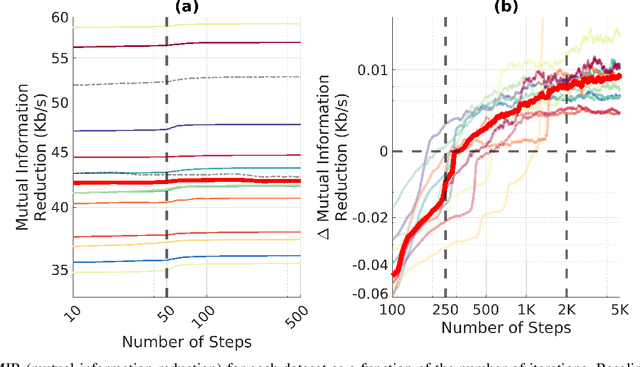
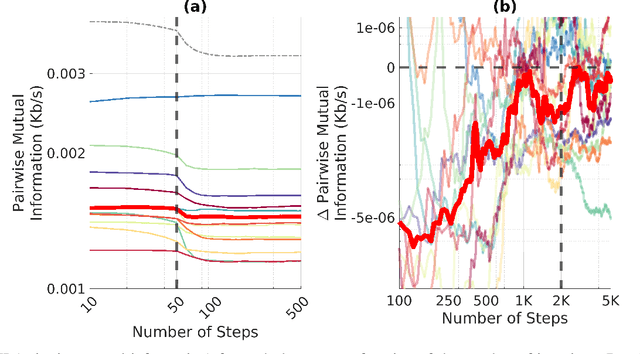
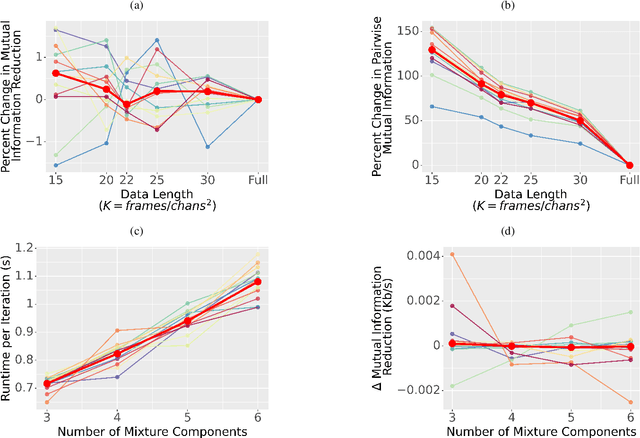
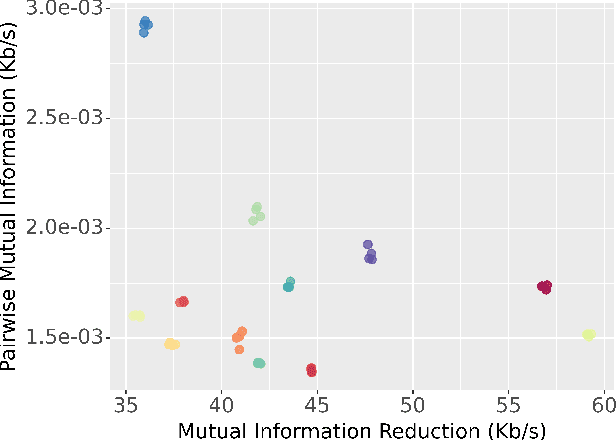
EEG continues to find a multitude of uses in both neuroscience research and medical practice, and independent component analysis (ICA) continues to be an important tool for analyzing EEG. A multitude of ICA algorithms for EEG decomposition exist, and in the past, their relative effectiveness has been studied. AMICA is considered the benchmark against which to compare the performance of other ICA algorithms for EEG decomposition. AMICA exposes many parameters to the user to allow for precise control of the decomposition. However, several of the parameters currently tend to be set according to "rules of thumb" shared in the EEG community. Here, AMICA decompositions are run on data from a collection of subjects while varying certain key parameters. The running time and quality of decompositions are analyzed based on two metrics: Pairwise Mutual Information (PMI) and Mutual Information Reduction (MIR). Recommendations for selecting starting values for parameters are presented.
A Framework to Evaluate Independent Component Analysis applied to EEG signal: testing on the Picard algorithm
Oct 16, 2022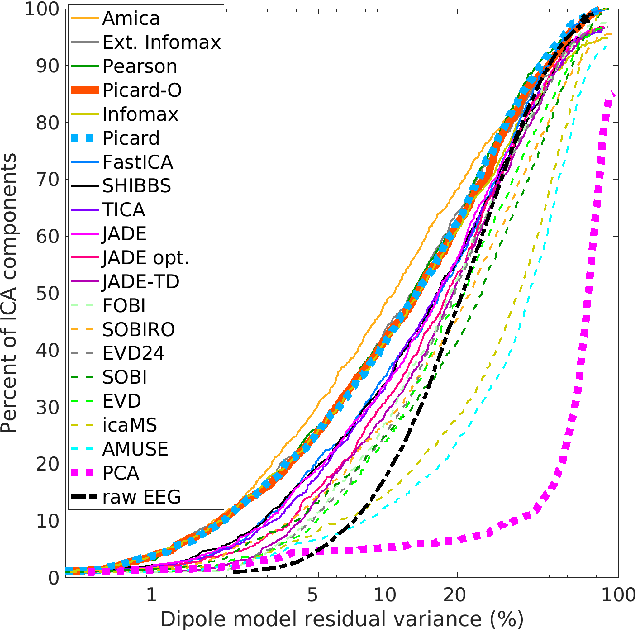
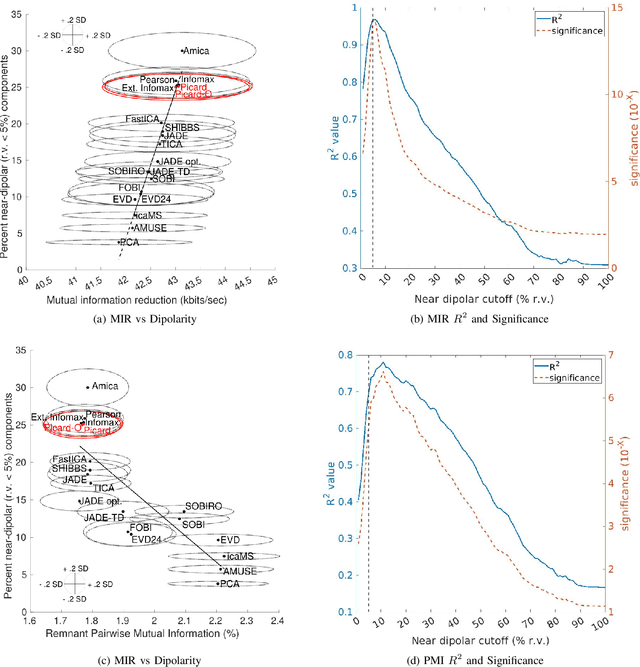
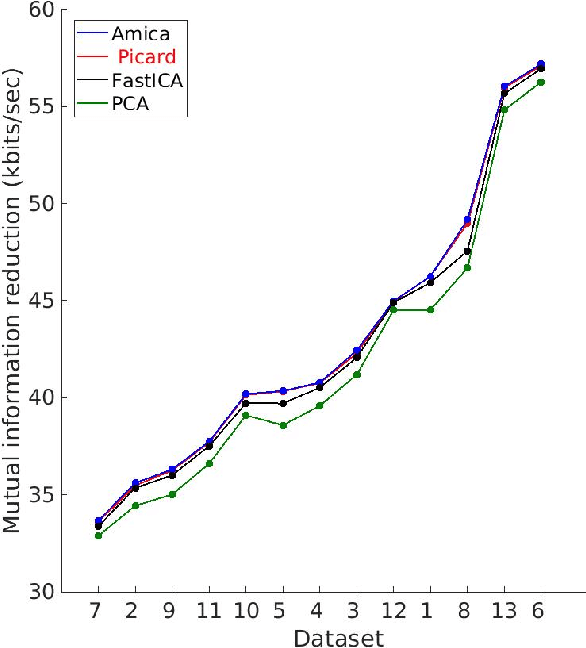
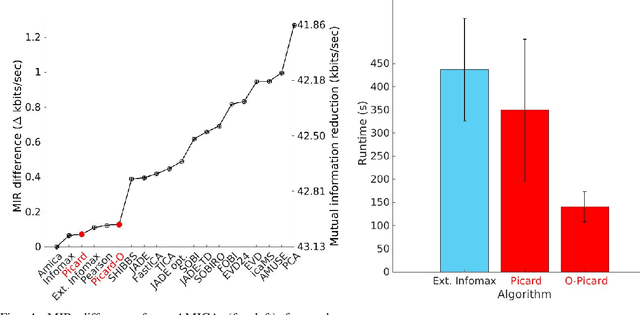
Independent component analysis (ICA), is a blind source separation method that is becoming increasingly used to separate brain and non-brain related activities in electroencephalographic (EEG) and other electrophysiological recordings. It can be used to extract effective brain source activities and estimate their cortical source areas, and is commonly used in machine learning applications to classify EEG artifacts. Previously, we compared results of decomposing 13 71-channel scalp EEG datasets using 22 ICA and other blind source separation (BSS) algorithms. We are now making this framework available to the scientific community and, in the process of its release are testing a recent ICA algorithm (Picard) not included in the previous assay. Our test framework uses three main metrics to assess BSS performance: Pairwise Mutual Information (PMI) between scalp channel pairs; PMI remaining between component pairs after decomposition; and, the complete (not pairwise) Mutual Information Reduction (MIR) produced by each algorithm. We also measure the "dipolarity" of the scalp projection maps for the decomposed component, defined by the number of components whose scalp projection maps nearly match the projection of a single equivalent dipole. Within this framework, Picard performed similarly to Infomax ICA. This is not surprising since Picard is a type of Infomax algorithm that uses the L-BFGS method for faster convergence, in contrast to Infomax and Extended Infomax (runica) which use gradient descent. Our results show that Picard performs similarly to Infomax and, likewise, better than other BSS algorithms, excepting the more computationally complex AMICA. We have released the source code of our framework and the test data through GitHub.
A streamable large-scale clinical EEG dataset for Deep Learning
Apr 13, 2022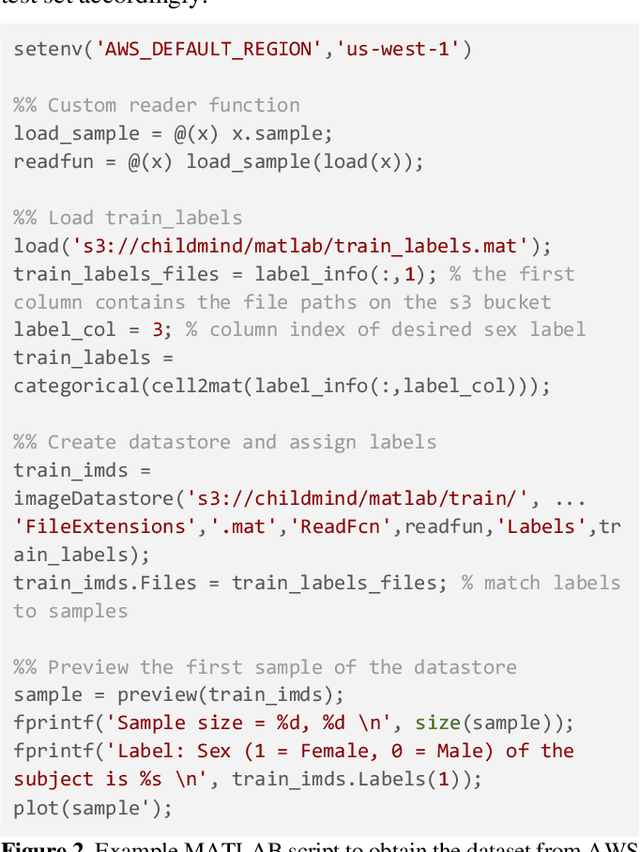
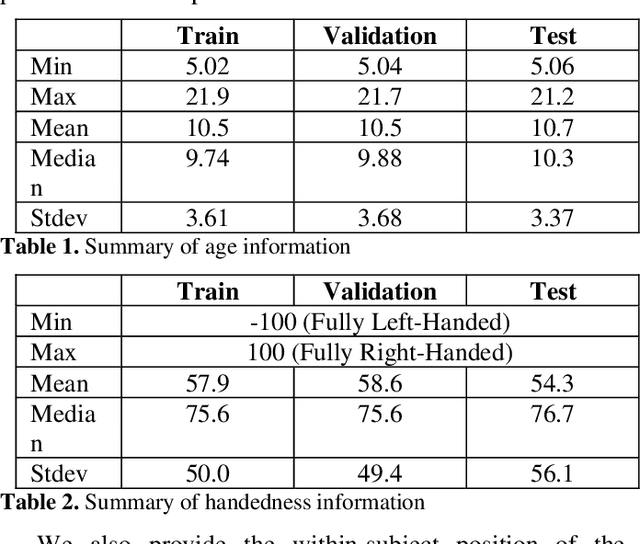
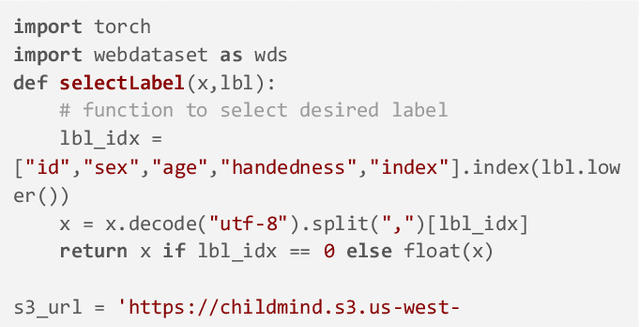
Deep Learning has revolutionized various fields, including Computer Vision, Natural Language Processing, as well as Biomedical research. Within the field of neuroscience, specifically in electrophysiological neuroimaging, researchers are starting to explore leveraging deep learning to make predictions on their data without extensive feature engineering. The availability of large-scale datasets is a crucial aspect of allowing the experimentation of Deep Learning models. We are publishing the first large-scale clinical EEG dataset that simplifies data access and management for Deep Learning. This dataset contains eyes-closed EEG data prepared from a collection of 1,574 juvenile participants from the Healthy Brain Network. We demonstrate a use case integrating this framework, and discuss why providing such neuroinformatics infrastructure to the community is critical for future scientific discoveries.