 Add to Chrome
 Add to Firefox
 Add to Edge
Model-Free Co-Optimization of Manufacturable Sensor Layouts and Deformation Proprioception
Mar 09, 2026
Flexible sensors are increasingly employed in soft robotics and wearable devices to provide proprioception of freeform deformations.Although supervised learning can train shape predictors from sensor signals, prediction accuracy strongly depends on sensor layout, which is typically determined heuristically or through trial-and-error. This work introduces a model-free, data-driven computational pipeline that jointly optimizes the number, length, and placement of flexible length-measurement sensors together with the parameters of a shape prediction network for large freeform deformations. Unlike model-based approaches, the proposed method relies solely on datasets of deformed shapes, without requiring physical simulation models, and is therefore broadly applicable to diverse robotic sensing tasks. The pipeline incorporates differentiable loss functions that account for both prediction accuracy and manufacturability constraints. By co-optimizing sensor layouts and network parameters, the method significantly improves deformation prediction accuracy over unoptimized layouts while ensuring practical feasibility. The effectiveness and generality of the approach are validated through numerical and physical experiments on multiple soft robotic and wearable systems.

Accelerate Neural Subspace-Based Reduced-Order Solver of Deformable Simulation by Lipschitz Optimization
Sep 05, 2024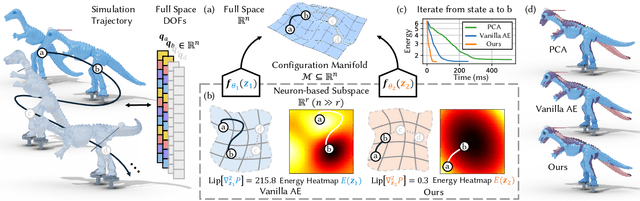
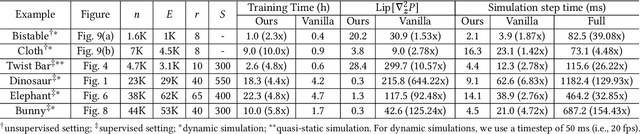
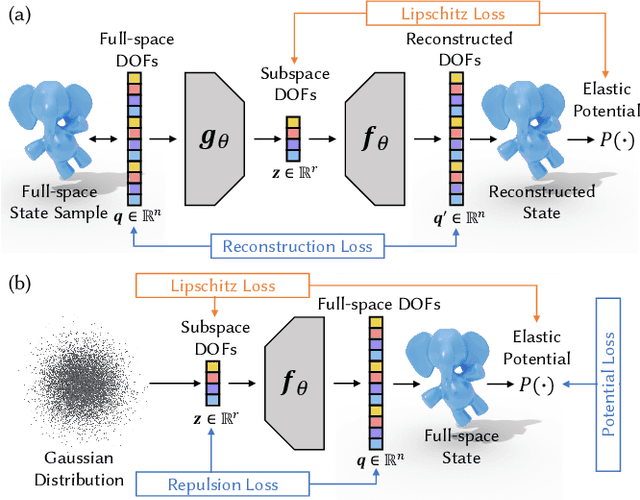
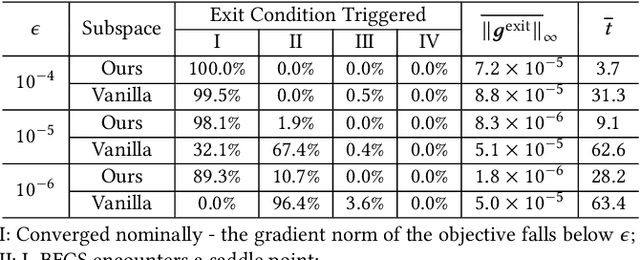
Reduced-order simulation is an emerging method for accelerating physical simulations with high DOFs, and recently developed neural-network-based methods with nonlinear subspaces have been proven effective in diverse applications as more concise subspaces can be detected. However, the complexity and landscape of simulation objectives within the subspace have not been optimized, which leaves room for enhancement of the convergence speed. This work focuses on this point by proposing a general method for finding optimized subspace mappings, enabling further acceleration of neural reduced-order simulations while capturing comprehensive representations of the configuration manifolds. We achieve this by optimizing the Lipschitz energy of the elasticity term in the simulation objective, and incorporating the cubature approximation into the training process to manage the high memory and time demands associated with optimizing the newly introduced energy. Our method is versatile and applicable to both supervised and unsupervised settings for optimizing the parameterizations of the configuration manifolds. We demonstrate the effectiveness of our approach through general cases in both quasi-static and dynamics simulations. Our method achieves acceleration factors of up to 6.83 while consistently preserving comparable simulation accuracy in various cases, including large twisting, bending, and rotational deformations with collision handling. This novel approach offers significant potential for accelerating physical simulations, and can be a good add-on to existing neural-network-based solutions in modeling complex deformable objects.