 Add to Chrome
 Add to Firefox
 Add to Edge
X+Slides: Benchmarking Audience-Conditioned Slide Generation
Jun 17, 2026
Automatically generating slide decks from source documents is an important application of large language models (LLMs). Existing benchmarks primarily assess slide completeness and technical depth, while overlooking the target audience as a critical real-world factor. For instance, specialists demand rigorous proofs, whereas decision-makers prioritize actionable conclusions. To bridge this gap, we introduce X+Slides, a benchmark specifically designed for audience-conditioned slide generation. Built on a diverse corpus spanning 113 topics and seven presentation scenes, X+Slides employs a dynamic evaluation framework constructed from 8,133 deduplicated, source-grounded probes. By assigning audience-specific utility weights to the same source-grounded probes, X+Slides reports four complementary metrics: Audience Coverage measures how much audience-essential information is conveyed, Domain-wise Coverage shows which information types are covered, Efficiency measures delivered utility per unit of attention cost, and Correctness verifies whether slide claims are supported by the source. Experiments on DeepPresenter, SlideTailor, and NotebookLM show that current systems can recover a substantial but still incomplete part of audience-essential information: at $τ_A=0.7$, DeepPresenter reaches a best Audience Coverage of 0.714, SlideTailor reaches 0.594, and the NotebookLM ablation reaches 0.853 while showing clear grounding differences. These results indicate that visual quality and broad topic coverage should not be treated as evidence support without source-grounded evaluation.

Solving Challenging Math Word Problems Using GPT-4 Code Interpreter with Code-based Self-Verification
Aug 15, 2023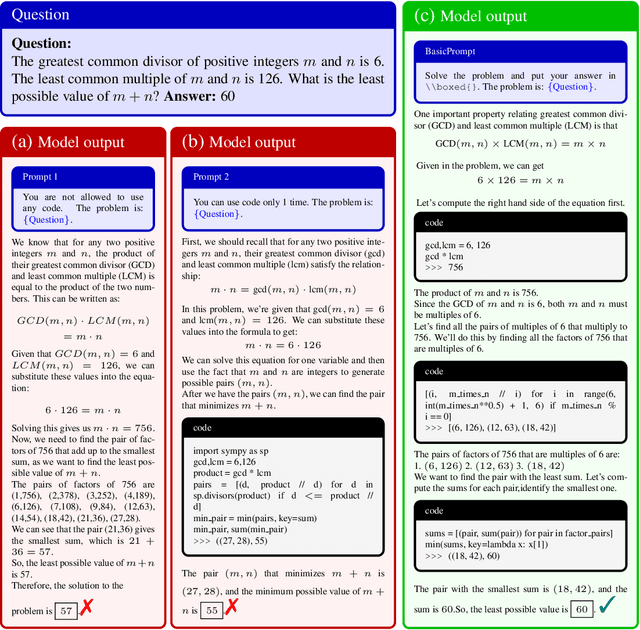
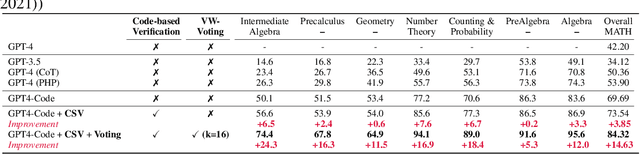
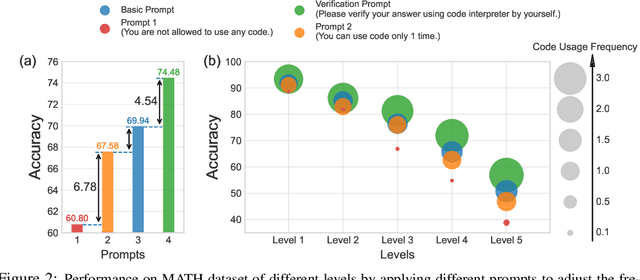
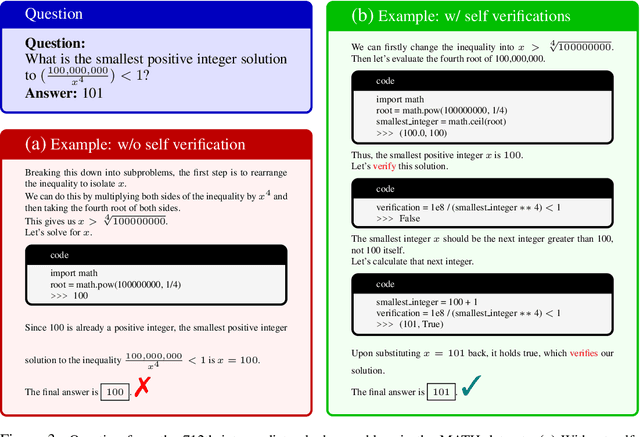
Recent progress in large language models (LLMs) like GPT-4 and PaLM-2 has brought significant advancements in addressing math reasoning problems. In particular, OpenAI's latest version of GPT-4, known as GPT-4 Code Interpreter, shows remarkable performance on challenging math datasets. In this paper, we explore the effect of code on enhancing LLMs' reasoning capability by introducing different constraints on the \textit{Code Usage Frequency} of GPT-4 Code Interpreter. We found that its success can be largely attributed to its powerful skills in generating and executing code, evaluating the output of code execution, and rectifying its solution when receiving unreasonable outputs. Based on this insight, we propose a novel and effective prompting method, explicit \uline{c}ode-based \uline{s}elf-\uline{v}erification~(CSV), to further boost the mathematical reasoning potential of GPT-4 Code Interpreter. This method employs a zero-shot prompt on GPT-4 Code Interpreter to encourage it to use code to self-verify its answers. In instances where the verification state registers as ``False'', the model shall automatically amend its solution, analogous to our approach of rectifying errors during a mathematics examination. Furthermore, we recognize that the states of the verification result indicate the confidence of a solution, which can improve the effectiveness of majority voting. With GPT-4 Code Interpreter and CSV, we achieve an impressive zero-shot accuracy on MATH dataset \textbf{(53.9\% $\to$ 84.3\%)}.