 Add to Chrome
 Add to Firefox
 Add to Edge
$TCP_α$: Margin-Controlled Confidence estimation for reliable Music Information Retrieval
Aug 20, 2026
Deep neural networks are often overconfident, assigning high confidence even to incorrect predictions. Consequently, users lack a reliable signal for deciding when a prediction can be trusted. Post-hoc confidence estimation addresses this by training a lightweight auxiliary head over a frozen classifier. Existing targets, however, suffer from inherent ambiguity: they assign overlapping confidence values to correct and incorrect predictions, while errors near the decision boundary receive confidence scores indistinguishable from correct predictions. In this work, we propose $TCP_α$, a novel confidence target that resolves these limitations by introducing a margin-controlled penalty for misclassified samples. We prove that $TCP_α$ guarantees complete separation between the target values of correct and incorrect predictions, with a separation margin that is independent of the number of classes and increases monotonically with the penalty parameter. Since accurate classifiers naturally produce very few errors, learning these targets results in a severely imbalanced regression problem. We therefore present a systematic study of training strategies for learning under this imbalance and identify an effective training configuration through extensive ablation studies. We evaluate the proposed approach on rāga identification, investigate its robustness under domain shift, and further validate it on frame-wise ornamentation detection without modifying the selected configuration. Across all settings, $TCP_α$ consistently outperforms existing confidence targets for failure prediction. Rejecting only the least-confident 8\% of predictions improves the base model's macro-F1 from 0.89 to 0.98, while fine-tuning the confidence head with only 5\% labeled samples from a new corpus effectively restores performance under domain shift.

How Good is Zero-Shot MT Evaluation for Low Resource Indian Languages?
Jun 06, 2024While machine translation evaluation has been studied primarily for high-resource languages, there has been a recent interest in evaluation for low-resource languages due to the increasing availability of data and models. In this paper, we focus on a zero-shot evaluation setting focusing on low-resource Indian languages, namely Assamese, Kannada, Maithili, and Punjabi. We collect sufficient Multi-Dimensional Quality Metrics (MQM) and Direct Assessment (DA) annotations to create test sets and meta-evaluate a plethora of automatic evaluation metrics. We observe that even for learned metrics, which are known to exhibit zero-shot performance, the Kendall Tau and Pearson correlations with human annotations are only as high as 0.32 and 0.45. Synthetic data approaches show mixed results and overall do not help close the gap by much for these languages. This indicates that there is still a long way to go for low-resource evaluation.
Numerical Claim Detection in Finance: A New Financial Dataset, Weak-Supervision Model, and Market Analysis
Feb 18, 2024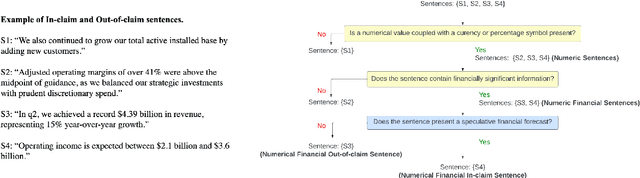
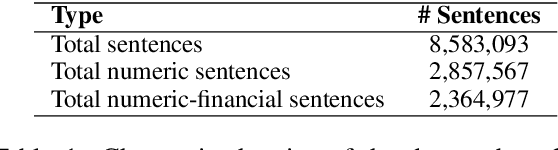
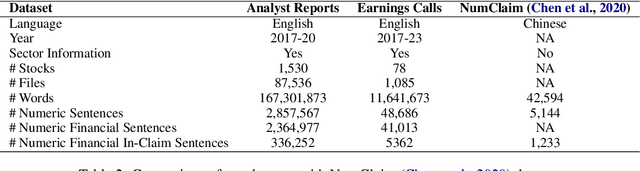
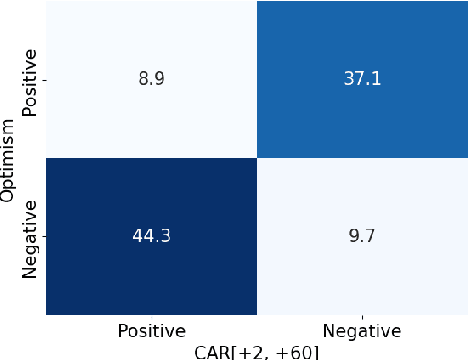
In this paper, we investigate the influence of claims in analyst reports and earnings calls on financial market returns, considering them as significant quarterly events for publicly traded companies. To facilitate a comprehensive analysis, we construct a new financial dataset for the claim detection task in the financial domain. We benchmark various language models on this dataset and propose a novel weak-supervision model that incorporates the knowledge of subject matter experts (SMEs) in the aggregation function, outperforming existing approaches. Furthermore, we demonstrate the practical utility of our proposed model by constructing a novel measure ``optimism". Furthermore, we observed the dependence of earnings surprise and return on our optimism measure. Our dataset, models, and code will be made publicly (under CC BY 4.0 license) available on GitHub and Hugging Face.