 Add to Chrome
 Add to Firefox
 Add to Edge
Credit Cards, Confusion, Computation, and Consequences: What Can We Uncover About Language Model Reasoning?
Jul 29, 2026
We introduce CreditCardQA, the first financial literacy benchmark for numerical reasoning derived from real credit card agreements. The dataset contains 1,800 questions, including first-person variants that reflect how consumers naturally ask about fees, interest, and payments. We evaluate a range of large language and reasoning models under Chain-of-Thought (CoT) and Program-of-Thought (PoT) prompting. Overall, PoT yields consistent performance gains, particularly for models with weaker baseline reasoning, and narrows gaps between open- and closed-source systems. Through error analysis, we show that failures arise less from arithmetic and more from misapplied financial rules, missed conditions, and misunderstandings of contractual terms. We further analyze question difficulty and find that comparisons, conditional logic, and monetary constraints are especially challenging. We also find that errors often arise in edge cases such as late-payment penalties or small-balance scenarios that are more likely to affect lower-income or financially vulnerable individuals.

IPO-Mine: A Toolkit and Dataset for Section-Structured Analysis of Long, Multimodal IPO Documents
May 27, 2026An Initial Public Offering (IPO) filing is a document released when a private firm goes public, allowing individual (retail) investors to purchase its shares. These filings describe a firm's business, financials, and risks and are long, multimodal documents with narrative text and images. Despite their importance to financial markets, there is no large-scale, standardized dataset or benchmark for studying IPO filings with modern language and multimodal models. These documents pose significant challenges: filings frequently exceed 500,000 tokens and lack consistent structural organization. We introduce the IPO-Toolkit, an open-source framework for downloading and parsing IPO filings into standardized section-structured text and extracted images. The toolkit segments filings, extracts embedded images, and produces structured outputs that enable large-scale, reproducible analysis workflows over long, multimodal documents. Using this infrastructure, we construct the IPO-Dataset, a large, section-structured, multimodal dataset covering more than 109,000 IPO filings and amendments from 1994 to 2026 and containing over 76,000 images. We establish structured evaluation tasks over extracted financial charts, including chart quality and misleadingness assessment. Our experiments show that state-of-the-art multimodal models often diverge from expert human judgments on these tasks, exposing alignment challenges in multimodal reasoning over long, real-world regulatory documents. Beyond benchmarking, the IPO-Dataset enables large-scale analysis of section-level textual variation and cross-industry differences in visual and textual disclosure practices. Our code, dataset, and website are publicly available under CC-BY-4.0.
CoCoHD: Congress Committee Hearing Dataset
Oct 04, 2024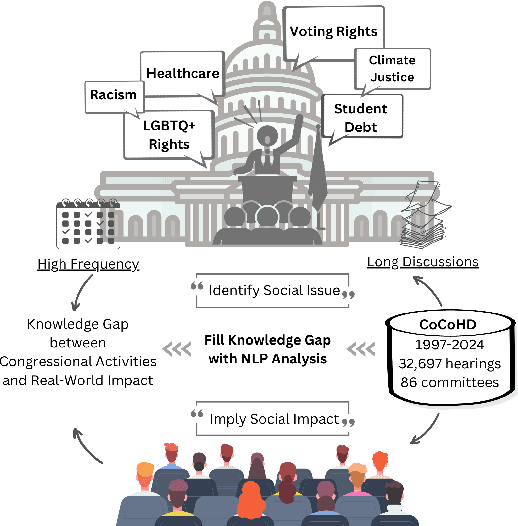
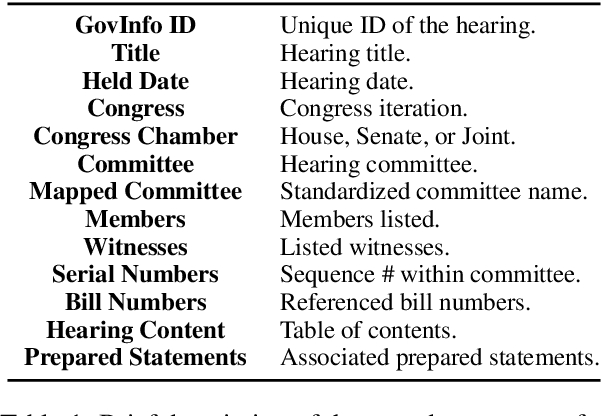
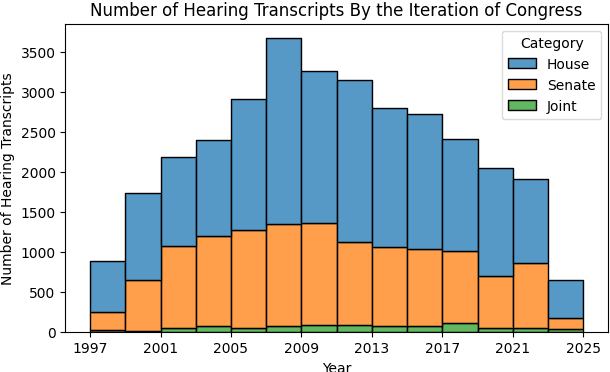
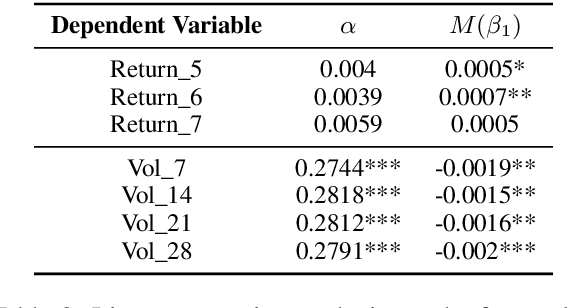
U.S. congressional hearings significantly influence the national economy and social fabric, impacting individual lives. Despite their importance, there is a lack of comprehensive datasets for analyzing these discourses. To address this, we propose the Congress Committee Hearing Dataset (CoCoHD), covering hearings from 1997 to 2024 across 86 committees, with 32,697 records. This dataset enables researchers to study policy language on critical issues like healthcare, LGBTQ+ rights, and climate justice. We demonstrate its potential with a case study on 1,000 energy-related sentences, analyzing the Energy and Commerce Committee's stance on fossil fuel consumption. By fine-tuning pre-trained language models, we create energy-relevant measures for each hearing. Our market analysis shows that natural language analysis using CoCoHD can predict and highlight trends in the energy sector.
Numerical Claim Detection in Finance: A New Financial Dataset, Weak-Supervision Model, and Market Analysis
Feb 18, 2024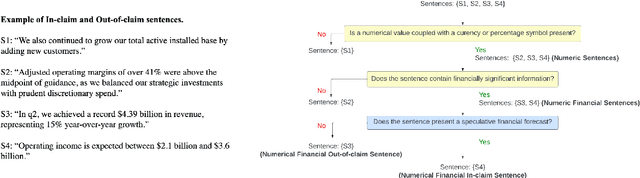
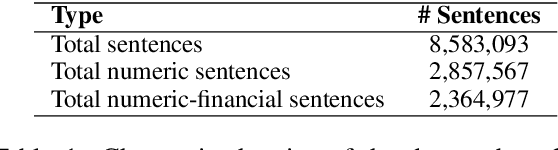
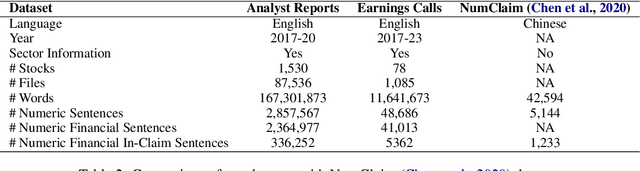
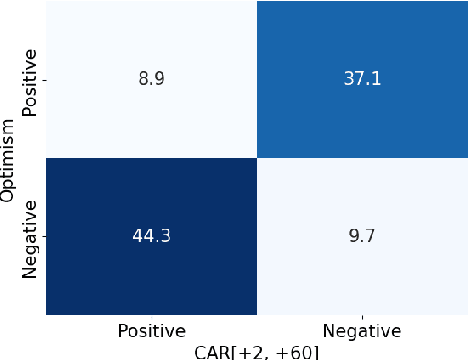
In this paper, we investigate the influence of claims in analyst reports and earnings calls on financial market returns, considering them as significant quarterly events for publicly traded companies. To facilitate a comprehensive analysis, we construct a new financial dataset for the claim detection task in the financial domain. We benchmark various language models on this dataset and propose a novel weak-supervision model that incorporates the knowledge of subject matter experts (SMEs) in the aggregation function, outperforming existing approaches. Furthermore, we demonstrate the practical utility of our proposed model by constructing a novel measure ``optimism". Furthermore, we observed the dependence of earnings surprise and return on our optimism measure. Our dataset, models, and code will be made publicly (under CC BY 4.0 license) available on GitHub and Hugging Face.