 Add to Chrome
 Add to Firefox
 Add to Edge
PerturbCellRL: Verifier-Guided Reinforcement Learning for Single-Cell Perturbation Prediction
Jun 26, 2026
Single-cell perturbation models can reduce costly wet-lab screening by predicting how cells respond transcriptionally to interventions. While recent generative models improve population-level prediction, individual generated cells are not explicitly checked for biological consistency. We introduce PerturbCellRL, a reinforcement learning (RL) framework that post-trains a pretrained single-cell transcriptomic generator using a suite of cell-level verifiers as rewards. These verifiers define four rewards: Pearson top-k similarity, RMSE top-k proximity, DE Spearman, and Pathway activity. The Pathway activity verifier rewards cells whose pathway responses match known perturbation biology. We evaluate PerturbCellRL on multiple genetic and chemical perturbation benchmarks. Across these benchmarks, PerturbCellRL improves over the pretrained flow-matching generator on reward-aligned evaluation metrics and a held-out evaluation metric. Moreover, PerturbCellRL remains competitive with state-of-the-art methods on population-level metrics. Together, these results frame trustworthy single-cell prediction as verifier-guided generative alignment, moving beyond matching expression distributions toward predictions whose single-cell perturbation effects are explicitly checked for biological consistency.

CoVA: Context-aware Visual Attention for Webpage Information Extraction
Oct 24, 2021
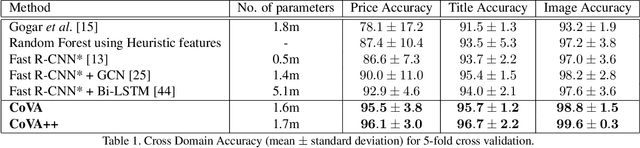

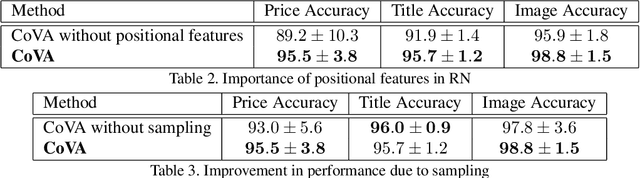
Webpage information extraction (WIE) is an important step to create knowledge bases. For this, classical WIE methods leverage the Document Object Model (DOM) tree of a website. However, use of the DOM tree poses significant challenges as context and appearance are encoded in an abstract manner. To address this challenge we propose to reformulate WIE as a context-aware Webpage Object Detection task. Specifically, we develop a Context-aware Visual Attention-based (CoVA) detection pipeline which combines appearance features with syntactical structure from the DOM tree. To study the approach we collect a new large-scale dataset of e-commerce websites for which we manually annotate every web element with four labels: product price, product title, product image and background. On this dataset we show that the proposed CoVA approach is a new challenging baseline which improves upon prior state-of-the-art methods.