 Add to Chrome
 Add to Firefox
 Add to Edge
Smooth Reparameterizations of Functions on Simplicial Product Spaces: Applications to Probabilistic Tensor Decomposition and Functional Data Registration
Aug 03, 2026
We consider optimization problems defined on product spaces of simplices. Examples of this class of problems include learning low-rank discrete multivariate probability distributions via simplex constrained tensor decomposition and performing functional data registration under the Square Root Velocity Function (SRVF) representation. In this work, we demonstrate the feasibility of replacing the product simplex with a smooth, elementwise strictly convex reparameterization, resulting in an unconstrained optimization problem on a manifold. We show that performing such a reparameterization results in the second order Karush-Kuhn-Tucker (KKT) points on the smooth manifold being mapped to the weak second order KKT points on the product simplex. This leads to a Riemannian Gradient Descent (RGD) algorithm for solving the reparameterized problem, which outperforms Projected Gradient Descent (PGD), and provides a more faithful representation of the original function shapes while performing curve registration.

TreeSRNF: Square-Root Normal Fields for Generative Modelling of the Geometric and Structural Variability in Tree-like 3D Objects
Jul 15, 2026We introduce a novel mathematical framework for analyzing and generating complex tree-shaped 3D objects, such as botanical trees and plants, which deform both in their 3D geometry and branching structure. Unlike previous works, which either consider only the skeletal structure of tree-like objects or approximate their 3D geometry using branch thickness, the proposed framework accurately models both the 3D geometry of the tree branches and the way they are interconnected. In this paper, we first generalize the Square Root Normal Fields (SRNF) representation, originally proposed for the statistical analysis of genus-0 surfaces, to tree-shaped 3D objects. We then treat tree-shaped 3D objects as points on a novel Riemannian tree-shape space equipped with a novel Riemannian metric that measures the amount of surface bending and stretching, and structural changes one needs to apply to one 3D tree-shape to align it with another. This way, deformations become trajectories in this novel tree-shape space. We analyze the theoretical properties of this novel tree-shape space and the corresponding metric and develop algorithms for computing point-wise and branch-wise correspondences and geodesic paths between complex 3D trees. We finally show how to use these building blocks for (1) computing statistical summaries, \ie means and modes of variation, of collections of tree-shaped 3D objects, and (2) synthesizing novel tree-shaped 3D objects by sampling from probability distributions fitted to a population of tree-shaped 3D objects. We demonstrate the performance and utility of the proposed framework on real and synthetic plants and botanical trees and show that it significantly outperforms the state-of-the-art.
Bayesian In Vivo Tracking of Synapses using Joint Poisson Deconvolution and Diffeomorphic Registration
May 13, 2026Synapses are densely packed submicron structures that dynamically reorganize during learning and memory formation. Longitudinal \textit{in vivo} imaging of fluorescently tagged synaptic receptors offers a promising opportunity to study large-scale synaptic dynamics and how these processes are disrupted in neurological disease. However, in vivo imaging with 2-photon microscopy uses low laser power and therefore suffers from low signal-to-noise ratio (SNR) and high shot noise, nonlinear tissue motion between days, nonstationary fluctuations in synaptic fluorescence, and significant blur induced by the microscope point spread function (PSF). Together, these factors make it challenging to detect and track synapses, especially in regions with high synaptic density. This paper presents a novel template-based framework for modeling synapses as varying luminance point sources that move under a nonlinear tissue deformation. Taking a unified Bayesian approach, we apply this model to microscopy data by deriving a posterior that incorporates a diffeomorphic mapping for domain warping, a Gaussian point spread function for the imaging process, and a Poisson observation model for raw photon counts. The Bayesian solution simultaneously: (1) Constructs a probabilistic template of synapse locations, (2) denoises and deconvolves the image data, (3) infers fluorescence intensities, (4) performs diffeomorphic image registration to correct for tissue motion, and (5) provides confidence regions for these parameter estimates. We demonstrate the framework on both a 2D+t simulated dataset and a 3D+t longitudinal \textit{in vivo} microscopy dataset of fluorescent synapses imaged in a mouse over two weeks.
An Elastic Shape Variational Autoencoder for Skeleton Pose Trajectories
May 10, 2026Deep generative models provide flexible frameworks for modeling complex, structured data such as images, videos, 3D objects, and texts. However, when applied to sequences of human skeletons, standard variational autoencoders (VAEs) often allocate substantial capacity to nuisance factors-such as camera orientation, subject scale, viewpoint, and execution speed-rather than the intrinsic geometry of shapes and their motion. We propose the Elastic Shape - Variational Autoencoder (ES-VAE), a geometry-aware generative model for skeletal trajectories that leverages the transported square-root velocity field (TSRVF) representation on Kendall's shape manifold. This representation inherently removes rigid translations, rotations, and global scaling of shapes, and temporal rate variability of sequences, isolating the underlying shape dynamics. The ES-VAE encoder maps skeletal sequences to a low-dimensional latent space incorporating the Riemannian logarithm map, while the decoder reconstructs sequences using the corresponding exponential map. We demonstrate the effectiveness of ES-VAE on two datasets. First, we analyze skeletal gait cycles to predict clinical mobility scores and classify subjects into healthy and post-stroke groups. Second, we evaluate action recognition on the NTU RGB+D dataset. Across both settings, ES-VAE consistently outperforms standard VAEs and a range of sequence modeling baselines, including temporal convolutional networks, transformers, and graph convolutional networks. More broadly, ES-VAE provides a principled framework for learning generative models of longitudinal data on pose shape manifolds, offering improved latent representation and downstream performance compared to existing deep learning approaches.
Geometry Preserving Loss Functions Promote Improved Adaptation of Blackbox Generative Model
Apr 26, 2026Adaptation of blackbox generative models has been widely studied recently through the exploration of several methods including generator fine-tuning, latent space searches, leveraging singular value decomposition, and so on. However, adapting large-scale generative AI tools to specific use cases continues to be challenging, as many of these industry-grade models are not made widely available. The traditional approach of fine-tuning certain layers of a generative network is not feasible due to the expense of storing and fine-tuning generative models, as well as the restricted access to weights and gradients. Recognizing these challenges, we propose a novel end-to-end pipeline aimed at domain adaptation by leveraging geometry-preserving loss functions in conjunction to pre-trained generative adversarial networks (GANs). Our method rethinks the problem of adaptation by re-contextualizing the role of GAN inversion in obtaining accurate latent space representations. Extending the ability of existing state-of-the-art inverters, we preserve pair-wise distances between tangent spaces to successfully train a latent generative model to produce samples from the target distribution. We evaluate our proposed pipeline on StyleGANs with real distribution shifts and demonstrate that the introduction of the geometry preserving loss function lends to improved adaptation of generative models compared to other traditional loss functions.
Graph Network Modeling Techniques for Visualizing Human Mobility Patterns
Apr 04, 2025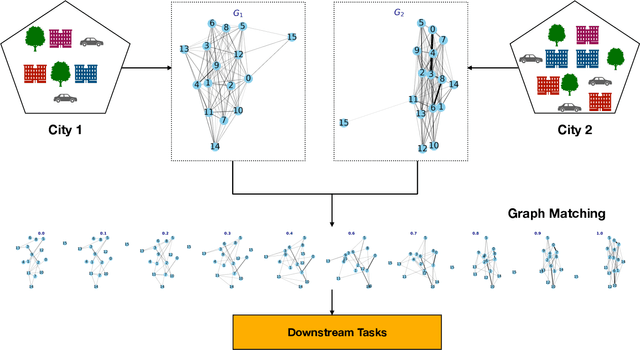
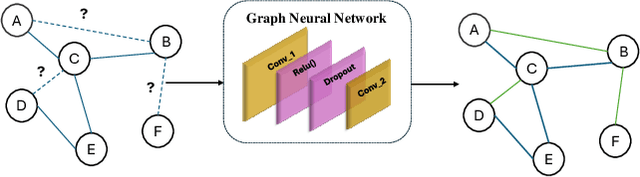
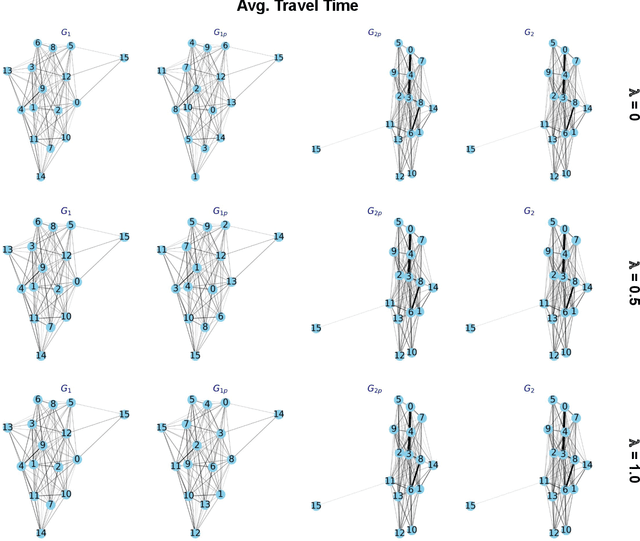

Human mobility analysis at urban-scale requires models to represent the complex nature of human movements, which in turn are affected by accessibility to nearby points of interest, underlying socioeconomic factors of a place, and local transport choices for people living in a geographic region. In this work, we represent human mobility and the associated flow of movements as a grapyh. Graph-based approaches for mobility analysis are still in their early stages of adoption and are actively being researched. The challenges of graph-based mobility analysis are multifaceted - the lack of sufficiently high-quality data to represent flows at high spatial and teporal resolution whereas, limited computational resources to translate large voluments of mobility data into a network structure, and scaling issues inherent in graph models etc. The current study develops a methodology by embedding graphs into a continuous space, which alleviates issues related to fast graph matching, graph time-series modeling, and visualization of mobility dynamics. Through experiments, we demonstrate how mobility data collected from taxicab trajectories could be transformed into network structures and patterns of mobility flow changes, and can be used for downstream tasks reporting approx 40% decrease in error on average in matched graphs vs unmatched ones.
Investigating Image Manifolds of 3D Objects: Learning, Shape Analysis, and Comparisons
Mar 09, 2025Despite high-dimensionality of images, the sets of images of 3D objects have long been hypothesized to form low-dimensional manifolds. What is the nature of such manifolds? How do they differ across objects and object classes? Answering these questions can provide key insights in explaining and advancing success of machine learning algorithms in computer vision. This paper investigates dual tasks -- learning and analyzing shapes of image manifolds -- by revisiting a classical problem of manifold learning but from a novel geometrical perspective. It uses geometry-preserving transformations to map the pose image manifolds, sets of images formed by rotating 3D objects, to low-dimensional latent spaces. The pose manifolds of different objects in latent spaces are found to be nonlinear, smooth manifolds. The paper then compares shapes of these manifolds for different objects using Kendall's shape analysis, modulo rigid motions and global scaling, and clusters objects according to these shape metrics. Interestingly, pose manifolds for objects from the same classes are frequently clustered together. The geometries of image manifolds can be exploited to simplify vision and image processing tasks, to predict performances, and to provide insights into learning methods.
Dynamic Neural Surfaces for Elastic 4D Shape Representation and Analysis
Mar 05, 2025We propose a novel framework for the statistical analysis of genus-zero 4D surfaces, i.e., 3D surfaces that deform and evolve over time. This problem is particularly challenging due to the arbitrary parameterizations of these surfaces and their varying deformation speeds, necessitating effective spatiotemporal registration. Traditionally, 4D surfaces are discretized, in space and time, before computing their spatiotemporal registrations, geodesics, and statistics. However, this approach may result in suboptimal solutions and, as we demonstrate in this paper, is not necessary. In contrast, we treat 4D surfaces as continuous functions in both space and time. We introduce Dynamic Spherical Neural Surfaces (D-SNS), an efficient smooth and continuous spatiotemporal representation for genus-0 4D surfaces. We then demonstrate how to perform core 4D shape analysis tasks such as spatiotemporal registration, geodesics computation, and mean 4D shape estimation, directly on these continuous representations without upfront discretization and meshing. By integrating neural representations with classical Riemannian geometry and statistical shape analysis techniques, we provide the building blocks for enabling full functional shape analysis. We demonstrate the efficiency of the framework on 4D human and face datasets. The source code and additional results are available at https://4d-dsns.github.io/DSNS/.
* 22 pages, 23 figures, conference paper
A Shape-Based Functional Index for Objective Assessment of Pediatric Motor Function
Jan 02, 2025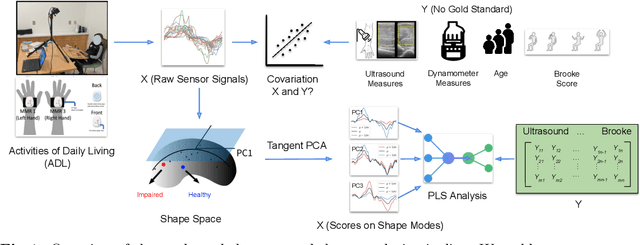
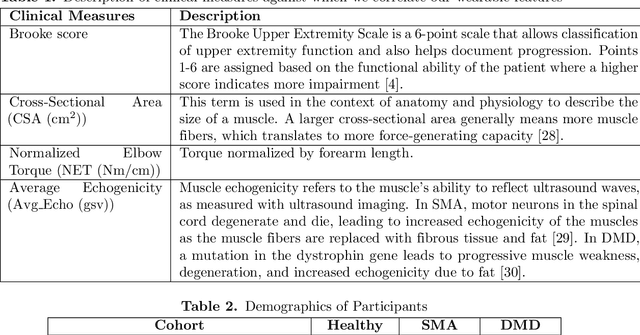
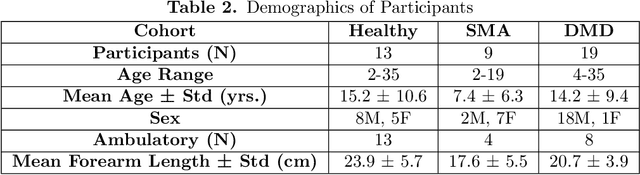
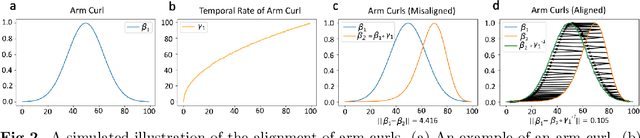
Clinical assessments for neuromuscular disorders, such as Spinal Muscular Atrophy (SMA) and Duchenne Muscular Dystrophy (DMD), continue to rely on subjective measures to monitor treatment response and disease progression. We introduce a novel method using wearable sensors to objectively assess motor function during daily activities in 19 patients with DMD, 9 with SMA, and 13 age-matched controls. Pediatric movement data is complex due to confounding factors such as limb length variations in growing children and variability in movement speed. Our approach uses Shape-based Principal Component Analysis to align movement trajectories and identify distinct kinematic patterns, including variations in motion speed and asymmetry. Both DMD and SMA cohorts have individuals with motor function on par with healthy controls. Notably, patients with SMA showed greater activation of the motion asymmetry pattern. We further combined projections on these principal components with partial least squares (PLS) to identify a covariation mode with a canonical correlation of r = 0.78 (95% CI: [0.34, 0.94]) with muscle fat infiltration, the Brooke score (a motor function score), and age-related degenerative changes, proposing a novel motor function index. This data-driven method can be deployed in home settings, enabling better longitudinal tracking of treatment efficacy for children with neuromuscular disorders.
Fused Gromov-Wasserstein Variance Decomposition with Linear Optimal Transport
Nov 15, 2024


Wasserstein distances form a family of metrics on spaces of probability measures that have recently seen many applications. However, statistical analysis in these spaces is complex due to the nonlinearity of Wasserstein spaces. One potential solution to this problem is Linear Optimal Transport (LOT). This method allows one to find a Euclidean embedding, called LOT embedding, of measures in some Wasserstein spaces, but some information is lost in this embedding. So, to understand whether statistical analysis relying on LOT embeddings can make valid inferences about original data, it is helpful to quantify how well these embeddings describe that data. To answer this question, we present a decomposition of the Fr\'echet variance of a set of measures in the 2-Wasserstein space, which allows one to compute the percentage of variance explained by LOT embeddings of those measures. We then extend this decomposition to the Fused Gromov-Wasserstein setting. We also present several experiments that explore the relationship between the dimension of the LOT embedding, the percentage of variance explained by the embedding, and the classification accuracy of machine learning classifiers built on the embedded data. We use the MNIST handwritten digits dataset, IMDB-50000 dataset, and Diffusion Tensor MRI images for these experiments. Our results illustrate the effectiveness of low dimensional LOT embeddings in terms of the percentage of variance explained and the classification accuracy of models built on the embedded data.