 Add to Chrome
 Add to Firefox
 Add to Edge
Leveraging systems' non-linearity to tackle the scarcity of data in the design of Intelligent Fault Diagnosis Systems
Jun 18, 2026
Deep Transfer Learning (DTL) allows for the efficient building of Intelligent Fault Diagnosis Systems (IFDS). On the other hand, DTL methods still heavily rely on large amounts of labelled data. Obtaining such an amount of data can be challenging when dealing with machines or structures faults. This document proposes a novel approach to the design of vibration-based IFDS using DTL in condition of strong data scarcity. A periodic multi-excitation level procedure leveraging intrinsic non-linearities of real-world systems is used to produce images that can be conveniently analysed by pre-trained Convolutional Neural Networks (CNNs) to diagnose faults. A new data visualization method and its augmentation technique are proposed in this paper to tackle the typical lack of data encountered during the design of IFDS. Experimental validation on a railway pantograph structure provides effective support for the proposed method.

An affordable hardware-aware neural architecture search for deploying convolutional neural networks on ultra-low-power computing platforms
Jun 15, 2026Hardware-aware neural architecture search (HW-NAS) allows the integration of Convolutional Neural Networks (CNNs) in microcontrollers devices by automatically designing neural architectures that can fit prearranged hardware constraints. However, state-of-the-art HW-NAS target high-performance microcontrollers, whose power consumption does not meet sensing nodes requirements. This work presents a HW-NAS generating tiny CNNs that can run on ultra-low-power microcontrollers, featuring a lightweight search procedure enabling its execution even on embedded devices. Empirical results on three well-known benchmarks for tiny computer vision proved that the proposed HW-NAS was able to generate tiny CNNs while preserving state-of-the-art classification accuracy.
Running hardware-aware neural architecture search on embedded devices under 512MB of RAM
Jun 12, 2026This document proposes a novel approach to hardware-aware neural architecture search (HW NAS) that considers the resources available on the computing platform running it, enabling its execution on various embedded devices. The presented HW NAS produces tiny convolutional neural networks (CNNs) targeting low-end microcontroller units (MCUs), typically involved in the Internet of Things (IoT) or wearable robotics, opening new use cases. A gateway could run it to tailor CNNs' architecture on the acquired data without using external servers, ensuring privacy. The proposed technique achieves state-of-the-art results in the human-recognition tasks on the Visual Wake Word dataset, a standard TinyML benchmark, on several embedded devices.
A Dual-Action Fabric-Based Soft Robotic Glove for Ergonomic Hand Rehabilitation
Apr 01, 2026Hand impairment following neurological disorders substantially limits independence in activities of daily living, motivating the development of effective assistive and rehabilitation strategies. Soft robotic gloves have attracted growing interest in this context, yet persistent challenges in customization, ergonomic fit, and flexion-extension actuation constrain their clinical utility. Here, we present a dual-action fabric-based soft robotic glove incorporating customized actuators aligned with individual finger joints. The glove comprises five independently controlled dual-action actuators supporting finger flexion and extension, together with a dedicated thumb abduction actuator. Leveraging computer numerical control heat sealing technology, we fabricated symmetrical-chamber actuators that adopt a concave outer surface upon inflation, thereby maximizing finger contact area and improving comfort. Systematic characterization confirmed that the actuators generate sufficient joint moment and fingertip force for ADL-relevant tasks, and that the complete glove system produces adequate grasping force for common household objects. A preliminary study with ten healthy subjects demonstrated that active glove assistance significantly reduces forearm muscle activity during object manipulation. A pilot feasibility study with three individuals with cervical spinal cord injury across seven functional tasks indicated that glove assistance promotes more natural grasp patterns and reduces reliance on tenodesis grasp, although at the cost of increased task completion time attributable to the current actuation interface. This customizable, ergonomic design represents a practical step toward personalized hand rehabilitation and assistive robotics.
A soft and lightweight fabric-based pneumatic interface for multimodal fingertip tactile feedback
Apr 01, 2026Wearable fingertip haptic devices are critical for realistic interaction in virtual reality, augmented reality, and teleoperation, yet existing approaches struggle to simultaneously achieve adequate tactile output, low mass, simple fabrication, and untethered portability. Here we show that fabric-based pneumatic actuation can address this gap. Our device comprises four pneumatic chambers fabricated from thermoplastic polyurethane-coated fabric via computer numerical control heat-sealing, yielding a soft, conformable interface weighing 2.1 g that operates untethered with a wrist-mounted control unit. Mechanical and dynamic characterization confirms that the fabric actuators produce sufficient force, displacement, and bandwidth for fingertip tactile rendering. A psychophysical study with 15 participants demonstrates classification accuracy exceeding 90% across three distinct tactile modes -- contact configuration, directional sliding, and vibrotactile frequency. These findings establish fabric-based pneumatic actuation as a viable technology route for lightweight, low-cost, and multimodal fingertip haptic interfaces.
A wearable haptic device for edge and surface simulation
Apr 01, 2026Object manipulation is fundamental to virtual reality (VR) applications, yet conventional fingertip haptic devices fail to render certain tactile features relevant for immersive and precise interactions, as i.e. detection of edges. This paper presents a compact, lightweight fingertip haptic device (24.3 g) that delivers distinguishable surface and edge contact feedback through a novel dual-motor mechanism. Pressure distribution characterization using a 6 x 6 flexible sensor array demonstrates distinct contact patterns between the two stimulation modes. A preliminary user study with five participants achieved 93% average classification accuracy across four conditions (edge/surface contact with light/heavy pressure), with mean response times of 2.79 seconds. The results indicate that the proposed device can effectively convey edge and surface tactile cues, potentially enhancing object manipulation fidelity in VR environments.
Optimal Prioritized Dissipation and Closed-Form Damping Limitation under Actuator Constraints for Haptic Interfaces
Mar 27, 2026In haptics, guaranteeing stability is essential to ensure safe interaction with remote or virtual environments. One of the most relevant methods at the state-of-the-art is the Time Domain Passivity Approach (TDPA). However, its high conservatism leads to a significant degradation of transparency. Moreover, the stabilizing action may conflict with the device's physical limitations. State-of-the-art solutions have attempted to address these actuator limits, but they still fail to account simultaneously for the power limits of each actuator while maximizing transparency. This work proposes a new damping limitation method based on prioritized dissipation actions. It prioritizes an optimal dissipation direction that minimizes actuator load, while any excess dissipation is allocated to the orthogonal hyperplane. The solution provides a closed-form formulation and is robust in multi-DoF scenarios, even in the presence of actuator and motion anisotropies. The method is experimentally validated using a parallel haptic interface interacting with a virtual environment and tested under different operating conditions.
Geometry-based pneumatic actuators for soft robotics
Feb 27, 2026Soft pneumatic actuators enable safe human-machine interaction with lightweight and powerful applied parts. On the other side, they suffer design limitations as regards complex actuation patterns, including minimum bending radii, multi-states capabilities and structural stability. We present geometry-based pneumatic actuators (GPAs), a design and implementation approach that introduces constraint layers with configurable CNC heat-sealed chambers. The approach achieves predictable deformation, near-zero bending radii, multi-states actuation, and enables customizable and repeatable complex actuated geometries. Mathematical modeling reveals predictable linear angle transformations and validates nonlinear torque-angle relationships across diverse configurations. We demonstrate versatility of the GPAs approach through three applications: a 49 g wrist exoskeleton reducing muscle activity by up to 51%, a 30.8 g haptic interface delivering 8 N force feedback with fast response, and a 208 g bipedal robot achieving multi-gait locomotion. GPAs establish a configurable platform for next-generation wearable robotics, haptic systems, and soft locomotion devices.
A Soft Fabric-Based Thermal Haptic Device for VR and Teleoperation
Aug 28, 2025This paper presents a novel fabric-based thermal-haptic interface for virtual reality and teleoperation. It integrates pneumatic actuation and conductive fabric with an innovative ultra-lightweight design, achieving only 2~g for each finger unit. By embedding heating elements within textile pneumatic chambers, the system delivers modulated pressure and thermal stimuli to fingerpads through a fully soft, wearable interface. Comprehensive characterization demonstrates rapid thermal modulation with heating rates up to 3$^{\circ}$C/s, enabling dynamic thermal feedback for virtual or teleoperation interactions. The pneumatic subsystem generates forces up to 8.93~N at 50~kPa, while optimization of fingerpad-actuator clearance enhances cooling efficiency with minimal force reduction. Experimental validation conducted with two different user studies shows high temperature identification accuracy (0.98 overall) across three thermal levels, and significant manipulation improvements in a virtual pick-and-place tasks. Results show enhanced success rates (88.5\% to 96.4\%, p = 0.029) and improved force control precision (p = 0.013) when haptic feedback is enabled, validating the effectiveness of the integrated thermal-haptic approach for advanced human-machine interaction applications.
Searching Neural Architectures for Sensor Nodes on IoT Gateways
May 29, 2025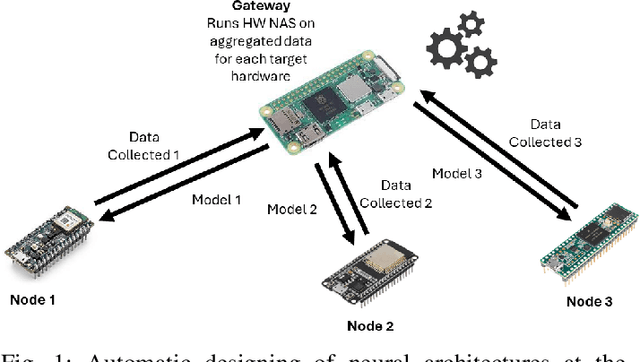
This paper presents an automatic method for the design of Neural Networks (NNs) at the edge, enabling Machine Learning (ML) access even in privacy-sensitive Internet of Things (IoT) applications. The proposed method runs on IoT gateways and designs NNs for connected sensor nodes without sharing the collected data outside the local network, keeping the data in the site of collection. This approach has the potential to enable ML for Healthcare Internet of Things (HIoT) and Industrial Internet of Things (IIoT), designing hardware-friendly and custom NNs at the edge for personalized healthcare and advanced industrial services such as quality control, predictive maintenance, or fault diagnosis. By preventing data from being disclosed to cloud services, this method safeguards sensitive information, including industrial secrets and personal data. The outcomes of a thorough experimental session confirm that -- on the Visual Wake Words dataset -- the proposed approach can achieve state-of-the-art results by exploiting a search procedure that runs in less than 10 hours on the Raspberry Pi Zero 2.