 Add to Chrome
 Add to Firefox
 Add to Edge
Leveraging systems' non-linearity to tackle the scarcity of data in the design of Intelligent Fault Diagnosis Systems
Jun 18, 2026
Deep Transfer Learning (DTL) allows for the efficient building of Intelligent Fault Diagnosis Systems (IFDS). On the other hand, DTL methods still heavily rely on large amounts of labelled data. Obtaining such an amount of data can be challenging when dealing with machines or structures faults. This document proposes a novel approach to the design of vibration-based IFDS using DTL in condition of strong data scarcity. A periodic multi-excitation level procedure leveraging intrinsic non-linearities of real-world systems is used to produce images that can be conveniently analysed by pre-trained Convolutional Neural Networks (CNNs) to diagnose faults. A new data visualization method and its augmentation technique are proposed in this paper to tackle the typical lack of data encountered during the design of IFDS. Experimental validation on a railway pantograph structure provides effective support for the proposed method.

An affordable hardware-aware neural architecture search for deploying convolutional neural networks on ultra-low-power computing platforms
Jun 15, 2026Hardware-aware neural architecture search (HW-NAS) allows the integration of Convolutional Neural Networks (CNNs) in microcontrollers devices by automatically designing neural architectures that can fit prearranged hardware constraints. However, state-of-the-art HW-NAS target high-performance microcontrollers, whose power consumption does not meet sensing nodes requirements. This work presents a HW-NAS generating tiny CNNs that can run on ultra-low-power microcontrollers, featuring a lightweight search procedure enabling its execution even on embedded devices. Empirical results on three well-known benchmarks for tiny computer vision proved that the proposed HW-NAS was able to generate tiny CNNs while preserving state-of-the-art classification accuracy.
Running hardware-aware neural architecture search on embedded devices under 512MB of RAM
Jun 12, 2026This document proposes a novel approach to hardware-aware neural architecture search (HW NAS) that considers the resources available on the computing platform running it, enabling its execution on various embedded devices. The presented HW NAS produces tiny convolutional neural networks (CNNs) targeting low-end microcontroller units (MCUs), typically involved in the Internet of Things (IoT) or wearable robotics, opening new use cases. A gateway could run it to tailor CNNs' architecture on the acquired data without using external servers, ensuring privacy. The proposed technique achieves state-of-the-art results in the human-recognition tasks on the Visual Wake Word dataset, a standard TinyML benchmark, on several embedded devices.
Searching Neural Architectures for Sensor Nodes on IoT Gateways
May 29, 2025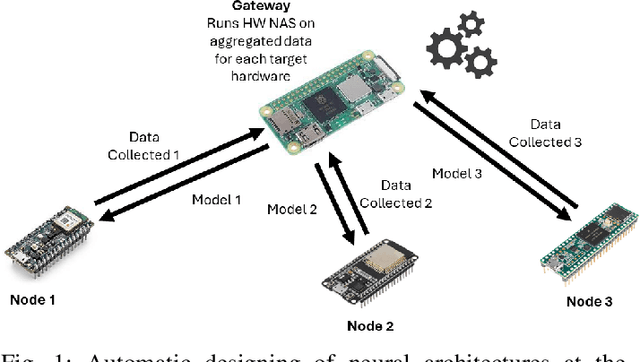
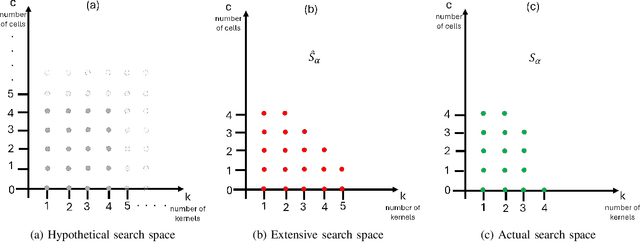
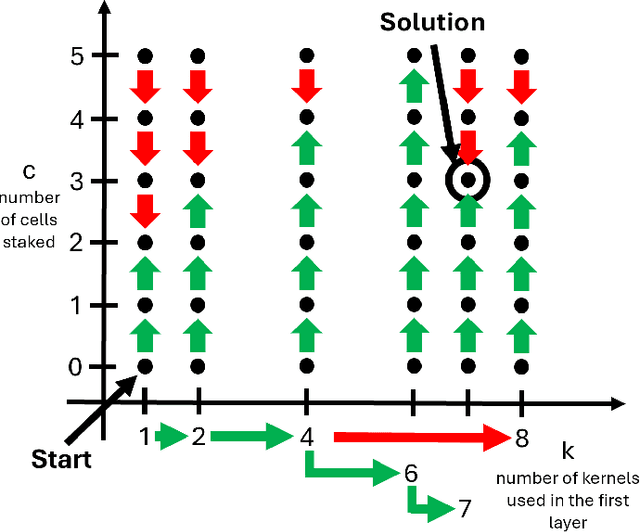
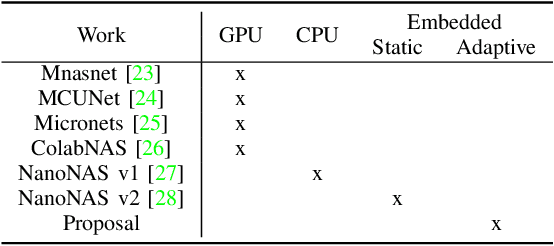
This paper presents an automatic method for the design of Neural Networks (NNs) at the edge, enabling Machine Learning (ML) access even in privacy-sensitive Internet of Things (IoT) applications. The proposed method runs on IoT gateways and designs NNs for connected sensor nodes without sharing the collected data outside the local network, keeping the data in the site of collection. This approach has the potential to enable ML for Healthcare Internet of Things (HIoT) and Industrial Internet of Things (IIoT), designing hardware-friendly and custom NNs at the edge for personalized healthcare and advanced industrial services such as quality control, predictive maintenance, or fault diagnosis. By preventing data from being disclosed to cloud services, this method safeguards sensitive information, including industrial secrets and personal data. The outcomes of a thorough experimental session confirm that -- on the Visual Wake Words dataset -- the proposed approach can achieve state-of-the-art results by exploiting a search procedure that runs in less than 10 hours on the Raspberry Pi Zero 2.
Colab NAS: Obtaining lightweight task-specific convolutional neural networks following Occam's razor
Dec 15, 2022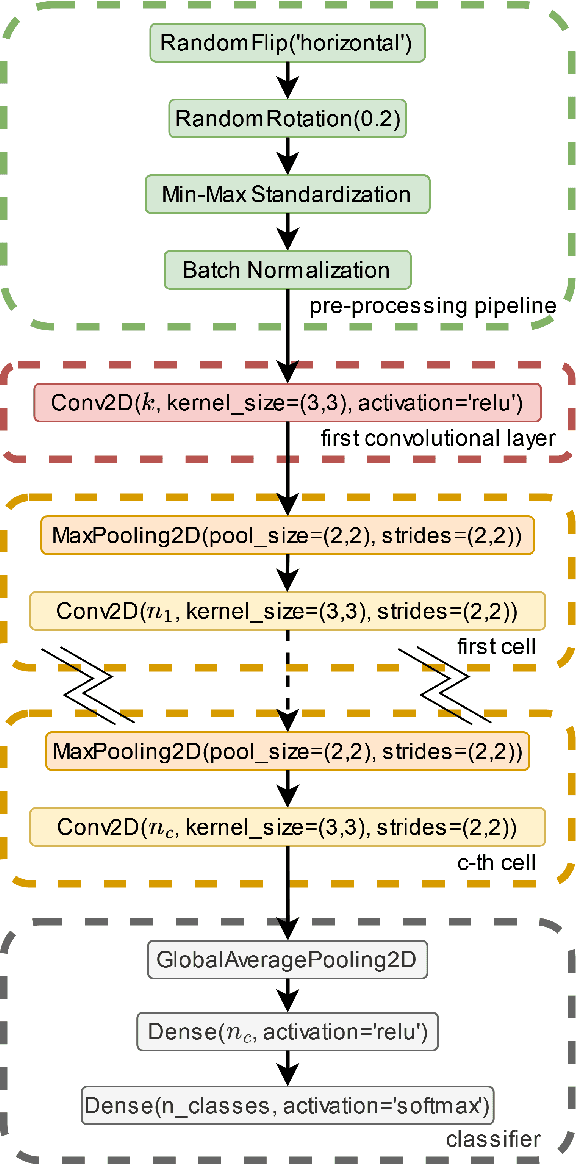
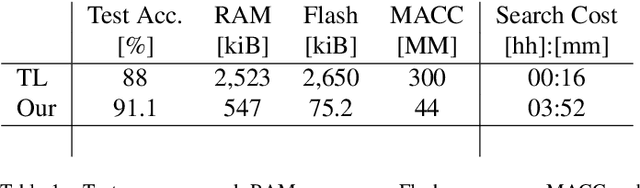
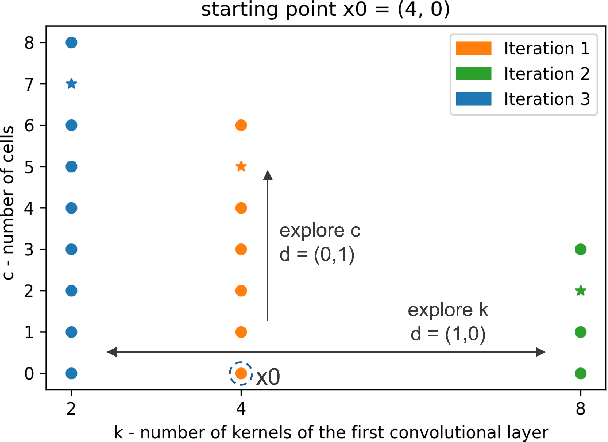
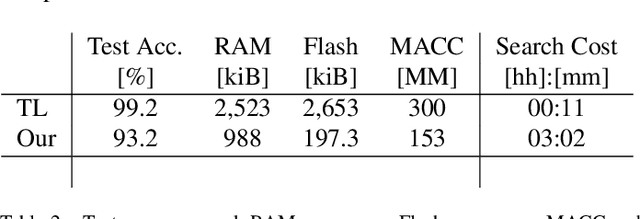
The current trend of applying transfer learning from CNNs trained on large datasets can be an overkill when the target application is a custom and delimited problem with enough data to train a network from scratch. On the other hand, the training of custom and lighter CNNs requires expertise, in the from-scratch case, and or high-end resources, as in the case of hardware-aware neural architecture search (HW NAS), limiting access to the technology by non-habitual NN developers. For this reason, we present Colab NAS, an affordable HW NAS technique for producing lightweight task-specific CNNs. Its novel derivative-free search strategy, inspired by Occam's razor, allows it to obtain state-of-the-art results on the Visual Wake Word dataset in just 4.5 GPU hours using free online GPU services such as Google Colaboratory and Kaggle Kernel.