 Add to Chrome
 Add to Firefox
 Add to Edge
A wearable haptic device for edge and surface simulation
Apr 01, 2026
Object manipulation is fundamental to virtual reality (VR) applications, yet conventional fingertip haptic devices fail to render certain tactile features relevant for immersive and precise interactions, as i.e. detection of edges. This paper presents a compact, lightweight fingertip haptic device (24.3 g) that delivers distinguishable surface and edge contact feedback through a novel dual-motor mechanism. Pressure distribution characterization using a 6 x 6 flexible sensor array demonstrates distinct contact patterns between the two stimulation modes. A preliminary user study with five participants achieved 93% average classification accuracy across four conditions (edge/surface contact with light/heavy pressure), with mean response times of 2.79 seconds. The results indicate that the proposed device can effectively convey edge and surface tactile cues, potentially enhancing object manipulation fidelity in VR environments.

An adaptive self-organizing fuzzy logic controller in a serious game for motor impairment rehabilitation
Apr 27, 2018


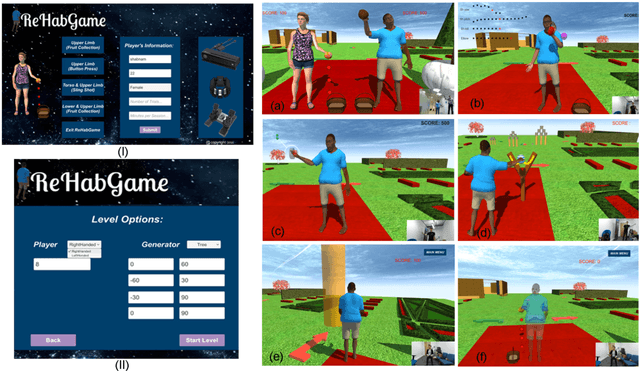
Rehabilitation robotics combined with video game technology provides a means of assisting in the rehabilitation of patients with neuromuscular disorders by performing various facilitation movements. The current work presents ReHabGame, a serious game using a fusion of implemented technologies that can be easily used by patients and therapists to assess and enhance sensorimotor performance and also increase the activities in the daily lives of patients. The game allows a player to control avatar movements through a Kinect Xbox, Myo armband and rudder foot pedal, and involves a series of reach-grasp-collect tasks whose difficulty levels are learnt by a fuzzy interface. The orientation, angular velocity, head and spine tilts and other data generated by the player are monitored and saved, whilst the task completion is calculated by solving an inverse kinematics algorithm which orientates the upper limb joints of the avatar. The different values in upper body quantities of movement provide fuzzy input from which crisp output is determined and used to generate an appropriate subsequent rehabilitation game level. The system can thus provide personalised, autonomously-learnt rehabilitation programmes for patients with neuromuscular disorders with superior predictions to guide the development of improved clinical protocols compared to traditional theraputic activities.
* 8 pages, 7 figures, 17096690