 Add to Chrome
 Add to Firefox
 Add to Edge
NEMO: Execution-Aware Optimization Modeling via Autonomous Coding Agents
Jan 29, 2026
In this paper, we present NEMO, a system that translates Natural-language descriptions of decision problems into formal Executable Mathematical Optimization implementations, operating collaboratively with users or autonomously. Existing approaches typically rely on specialized large language models (LLMs) or bespoke, task-specific agents. Such methods are often brittle, complex and frequently generating syntactically invalid or non-executable code. NEMO instead centers on remote interaction with autonomous coding agents (ACAs), treated as a first-class abstraction analogous to API-based interaction with LLMs. This design enables the construction of higher-level systems around ACAs that structure, consolidate, and iteratively refine task specifications. Because ACAs execute within sandboxed environments, code produced by NEMO is executable by construction, allowing automated validation and repair. Building on this, we introduce novel coordination patterns with and across ACAs, including asymmetric validation loops between independently generated optimizer and simulator implementations (serving as a high-level validation mechanism), external memory for experience reuse, and robustness enhancements via minimum Bayes risk (MBR) decoding and self-consistency. We evaluate NEMO on nine established optimization benchmarks. As depicted in Figure 1, it achieves state-of-the-art performance on the majority of tasks, with substantial margins on several datasets, demonstrating the power of execution-aware agentic architectures for automated optimization modeling.

Semi-supervised Soil Moisture Prediction through Graph Neural Networks
Dec 07, 2020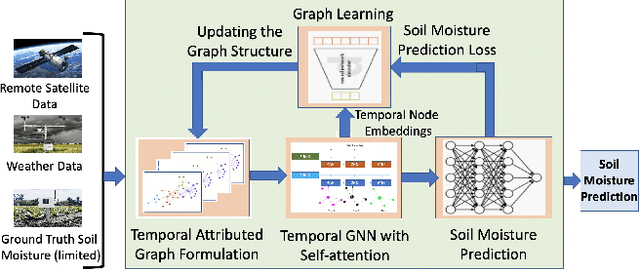
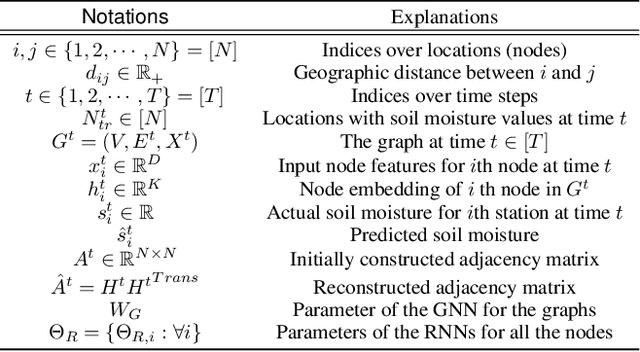
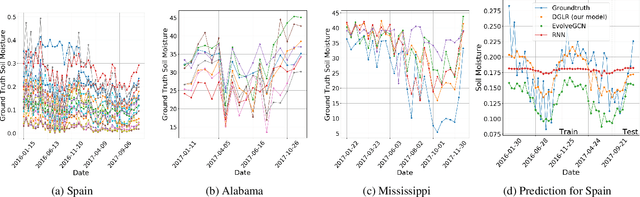
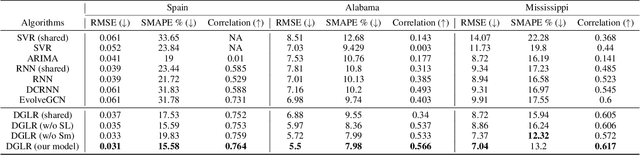
Recent improvement and availability of remote satellite and IoT data offers interesting and diverse applications of artificial intelligence in precision agriculture. Soil moisture is an important component of multiple agricultural and food supply chain practices. It measures the amount of water stored in various depth of soil. Existing data driven approaches for soil moisture prediction use conventional models which fail to capture the dynamic dependency of soil moisture values in near-by locations over time. In this work, we propose to convert the problem of soil moisture prediction as a semi-supervised learning on temporal graphs. We propose a dynamic graph neural network which can use the dependency of related locations over a region to predict soil moisture. However, unlike social or information networks, graph structure is not explicitly given for soil moisture prediction. Hence, we incorporate the problem of graph structure learning in the framework of dynamic GNN. Our algorithm, referred as DGLR, provides an end-to-end learning which can predict soil moisture over multiple locations in a region over time and also update the graph structure in between. Our solution achieves state-of-the-art results on real-world soil moisture datasets compared to existing machine learning approaches.