 Add to Chrome
 Add to Firefox
 Add to Edge
The RAIL Principles for Neurosymbolic AI: Reasoning, Assurances, Interfacing and Learning
Aug 04, 2026
Neurosymbolic AI systems that integrate machine learning and symbolic reasoning are rapidly gaining attention. They complement the data-intensive statistical approaches of neural networks and language models with symbolic reasoning algorithms to function in high-stakes domains or in low-data regimes that characterize many real-world applications. We argue that the neurosymbolic combination of machine learning and formal reasoning is not a niche approach within AI, but rather includes many already successful techniques that are of crucial importance to the development of reliable, efficient and, ultimately, trustworthy systems. This perspective prompts a re-examination of the design of current AI systems. We show that many leading AI systems, including some that are not traditionally considered as neurosymbolic, can be analysed from the perspective of four principles of neurosymbolic AI design: Reasoning, Assurances, Interfacing and Learning (RAIL). Applying the RAIL framework offers a unified view of seemingly disparate AI systems, ranging from physics-aware machine learning to neuro-guided search (such as Google DeepMind's Alpha-* suite), causal learning and tool-augmented Large Language Models. Importantly, the RAIL principles will enable engineers to make better-informed and more principled decisions about the design and deployment of production-level AI systems. In this article, we introduce the RAIL principles, examine how they can be applied across major areas of AI, and illustrate how they may guide practitioners to integrate neurosymbolic methods into next-generation AI technologies.

Exact Shapley Attributions in Quadratic-time for FANOVA Gaussian Processes
Aug 20, 2025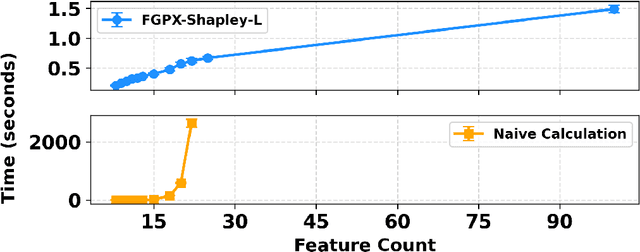
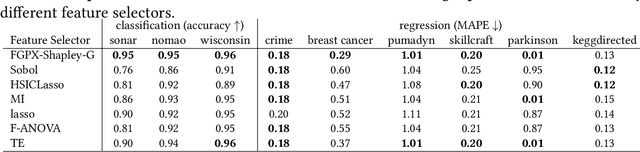
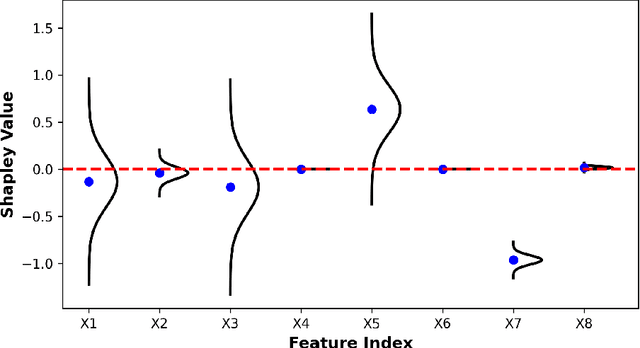
Shapley values are widely recognized as a principled method for attributing importance to input features in machine learning. However, the exact computation of Shapley values scales exponentially with the number of features, severely limiting the practical application of this powerful approach. The challenge is further compounded when the predictive model is probabilistic - as in Gaussian processes (GPs) - where the outputs are random variables rather than point estimates, necessitating additional computational effort in modeling higher-order moments. In this work, we demonstrate that for an important class of GPs known as FANOVA GP, which explicitly models all main effects and interactions, *exact* Shapley attributions for both local and global explanations can be computed in *quadratic time*. For local, instance-wise explanations, we define a stochastic cooperative game over function components and compute the exact stochastic Shapley value in quadratic time only, capturing both the expected contribution and uncertainty. For global explanations, we introduce a deterministic, variance-based value function and compute exact Shapley values that quantify each feature's contribution to the model's overall sensitivity. Our methods leverage a closed-form (stochastic) M\"{o}bius representation of the FANOVA decomposition and introduce recursive algorithms, inspired by Newton's identities, to efficiently compute the mean and variance of Shapley values. Our work enhances the utility of explainable AI, as demonstrated by empirical studies, by providing more scalable, axiomatically sound, and uncertainty-aware explanations for predictions generated by structured probabilistic models.