 Add to Chrome
 Add to Firefox
 Add to Edge
On Task Performance and Model Calibration with Supervised and Self-Ensembled In-Context Learning
Dec 22, 2023
Following the standard supervised fine-tuning (SFT) paradigm, in-context learning (ICL) has become an efficient approach propelled by the recent advancements in large language models (LLMs), yielding promising performance across various tasks in few-shot data setups. However, both paradigms are prone to suffer from the critical problem of overconfidence (i.e., miscalibration), especially in such limited data setups. In this work, we deliver an in-depth analysis of the behavior across different choices of learning methods from the perspective of both performance and calibration, as well as their interplay. Through extensive controlled experiments, we find that simultaneous gains for both task performance and calibration are difficult to achieve, and the problem of miscalibration exists across all learning methods in low-resource scenarios. To address this challenging trade-off between performance and calibration, we then investigate the potential of self-ensembling techniques applied at different modeling stages (e.g., variations of in-context examples or variations in prompts or different ensembling strategies). We justify the feasibility of self-ensembling on SFT in addition to ICL, to make the predictions more calibrated and have comparable or even better performance. Our work sheds light on which learning paradigm to choose and how to enhance both task performance and calibration of LLMs.

Are Large Language Models Temporally Grounded?
Nov 16, 2023Are Large language models (LLMs) temporally grounded? Since LLMs cannot perceive and interact with the environment, it is impossible to answer this question directly. Instead, we provide LLMs with textual narratives and probe them with respect to their common-sense knowledge of the structure and duration of events, their ability to order events along a timeline, and self-consistency within their temporal model (e.g., temporal relations such as after and before are mutually exclusive for any pair of events). We evaluate state-of-the-art LLMs (such as LLaMA 2 and GPT-4) on three tasks reflecting these abilities. Generally, we find that LLMs lag significantly behind both human performance as well as small-scale, specialised LMs. In-context learning, instruction tuning, and chain-of-thought prompting reduce this gap only to a limited degree. Crucially, LLMs struggle the most with self-consistency, displaying incoherent behaviour in at least 27.23% of their predictions. Contrary to expectations, we also find that scaling the model size does not guarantee positive gains in performance. To explain these results, we study the sources from which LLMs may gather temporal information: we find that sentence ordering in unlabelled texts, available during pre-training, is only weakly correlated with event ordering. Moreover, public instruction tuning mixtures contain few temporal tasks. Hence, we conclude that current LLMs lack a consistent temporal model of textual narratives. Code, datasets, and LLM outputs are available at https://github.com/yfqiu-nlp/temporal-llms.
SQATIN: Supervised Instruction Tuning Meets Question Answering for Improved Dialogue NLU
Nov 16, 2023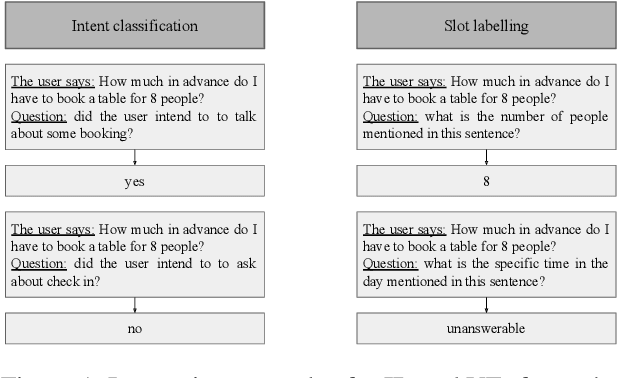
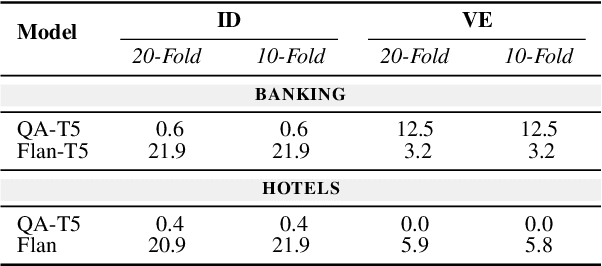
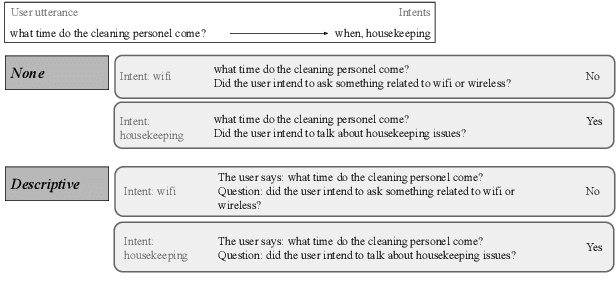
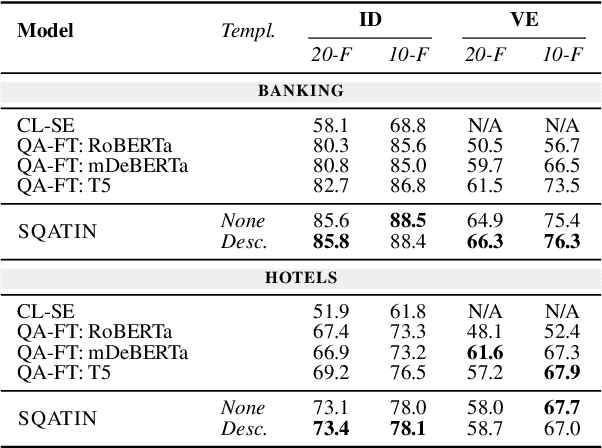
Task-oriented dialogue (ToD) systems help users execute well-defined tasks across a variety of domains (e.g., $\textit{flight booking}$ or $\textit{food ordering}$), with their Natural Language Understanding (NLU) components being dedicated to the analysis of user utterances, predicting users' intents ($\textit{Intent Detection}$, ID) and extracting values for informational slots ($\textit{Value Extraction}$, VE). In most domains, labelled NLU data is scarce, making sample-efficient learning -- enabled with effective transfer paradigms -- paramount. In this work, we introduce SQATIN, a new framework for dialog NLU based on (i) instruction tuning and (ii) question-answering-based formulation of ID and VE tasks. According to the evaluation on established NLU benchmarks, SQATIN sets the new state of the art in dialogue NLU, substantially surpassing the performance of current models based on standard fine-tuning objectives in both in-domain training and cross-domain transfer. SQATIN yields particularly large performance gains in cross-domain transfer, owing to the fact that our QA-based instruction tuning leverages similarities between natural language descriptions of classes (i.e., slots and intents) across domains.
Quantifying the Dialect Gap and its Correlates Across Languages
Oct 23, 2023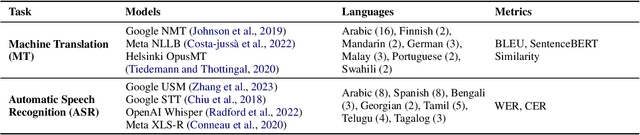
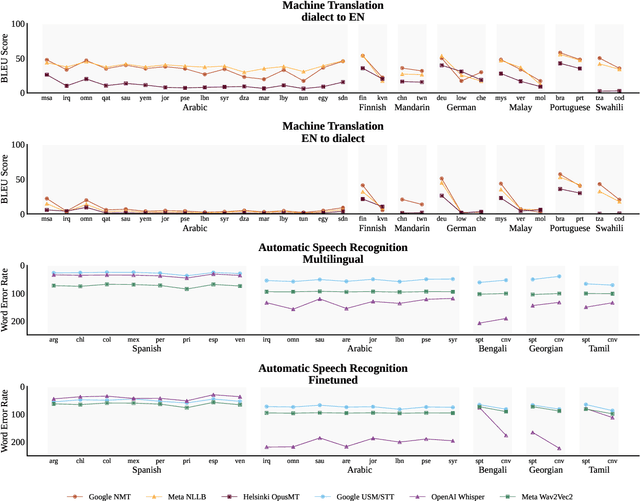
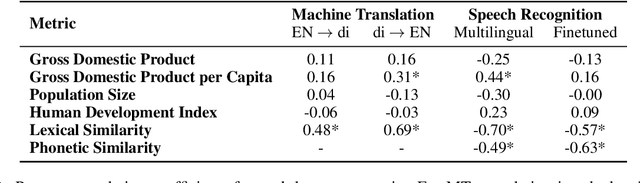
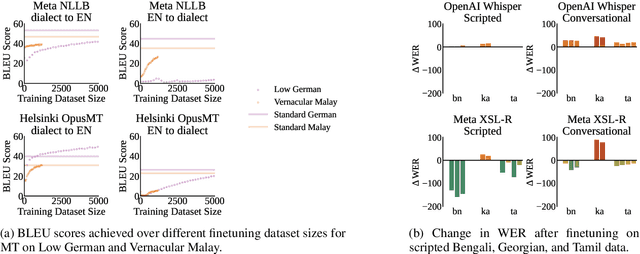
Historically, researchers and consumers have noticed a decrease in quality when applying NLP tools to minority variants of languages (i.e. Puerto Rican Spanish or Swiss German), but studies exploring this have been limited to a select few languages. Additionally, past studies have mainly been conducted in a monolingual context, so cross-linguistic trends have not been identified and tied to external factors. In this work, we conduct a comprehensive evaluation of the most influential, state-of-the-art large language models (LLMs) across two high-use applications, machine translation and automatic speech recognition, to assess their functionality on the regional dialects of several high- and low-resource languages. Additionally, we analyze how the regional dialect gap is correlated with economic, social, and linguistic factors. The impact of training data, including related factors like dataset size and its construction procedure, is shown to be significant but not consistent across models or languages, meaning a one-size-fits-all approach cannot be taken in solving the dialect gap. This work will lay the foundation for furthering the field of dialectal NLP by laying out evident disparities and identifying possible pathways for addressing them through mindful data collection.
On Bilingual Lexicon Induction with Large Language Models
Oct 21, 2023Bilingual Lexicon Induction (BLI) is a core task in multilingual NLP that still, to a large extent, relies on calculating cross-lingual word representations. Inspired by the global paradigm shift in NLP towards Large Language Models (LLMs), we examine the potential of the latest generation of LLMs for the development of bilingual lexicons. We ask the following research question: Is it possible to prompt and fine-tune multilingual LLMs (mLLMs) for BLI, and how does this approach compare against and complement current BLI approaches? To this end, we systematically study 1) zero-shot prompting for unsupervised BLI and 2) few-shot in-context prompting with a set of seed translation pairs, both without any LLM fine-tuning, as well as 3) standard BLI-oriented fine-tuning of smaller LLMs. We experiment with 18 open-source text-to-text mLLMs of different sizes (from 0.3B to 13B parameters) on two standard BLI benchmarks covering a range of typologically diverse languages. Our work is the first to demonstrate strong BLI capabilities of text-to-text mLLMs. The results reveal that few-shot prompting with in-context examples from nearest neighbours achieves the best performance, establishing new state-of-the-art BLI scores for many language pairs. We also conduct a series of in-depth analyses and ablation studies, providing more insights on BLI with (m)LLMs, also along with their limitations.
A Systematic Study of Performance Disparities in Multilingual Task-Oriented Dialogue Systems
Oct 19, 2023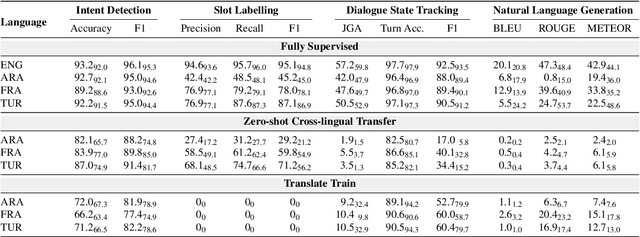
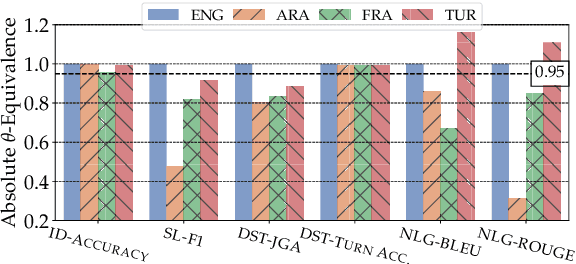
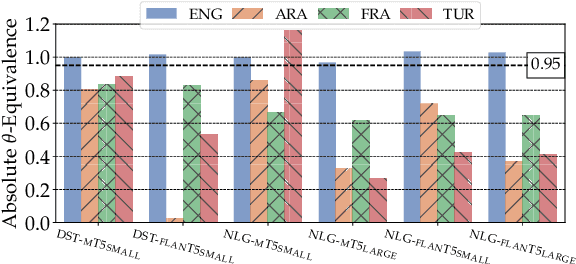
Achieving robust language technologies that can perform well across the world's many languages is a central goal of multilingual NLP. In this work, we take stock of and empirically analyse task performance disparities that exist between multilingual task-oriented dialogue (ToD) systems. We first define new quantitative measures of absolute and relative equivalence in system performance, capturing disparities across languages and within individual languages. Through a series of controlled experiments, we demonstrate that performance disparities depend on a number of factors: the nature of the ToD task at hand, the underlying pretrained language model, the target language, and the amount of ToD annotated data. We empirically prove the existence of the adaptation and intrinsic biases in current ToD systems: e.g., ToD systems trained for Arabic or Turkish using annotated ToD data fully parallel to English ToD data still exhibit diminished ToD task performance. Beyond providing a series of insights into the performance disparities of ToD systems in different languages, our analyses offer practical tips on how to approach ToD data collection and system development for new languages.
Survival of the Most Influential Prompts: Efficient Black-Box Prompt Search via Clustering and Pruning
Oct 19, 2023Prompt-based learning has been an effective paradigm for large pretrained language models (LLM), enabling few-shot or even zero-shot learning. Black-box prompt search has received growing interest recently for its distinctive properties of gradient-free optimization, proven particularly useful and powerful for model-as-a-service usage. However, the discrete nature and the complexity of combinatorial optimization hinder the efficiency of modern black-box approaches. Despite extensive research on search algorithms, the crucial aspect of search space design and optimization has been largely overlooked. In this paper, we first conduct a sensitivity analysis by prompting LLM, revealing that only a small number of tokens exert a disproportionate amount of influence on LLM predictions. Leveraging this insight, we propose the Clustering and Pruning for Efficient Black-box Prompt Search (ClaPS), a simple black-box search method that first clusters and prunes the search space to focus exclusively on influential prompt tokens. By employing even simple search methods within the pruned search space, ClaPS achieves state-of-the-art performance across various tasks and LLMs, surpassing the performance of complex approaches while significantly reducing search costs. Our findings underscore the critical role of search space design and optimization in enhancing both the usefulness and the efficiency of black-box prompt-based learning.
Navigating Cultural Chasms: Exploring and Unlocking the Cultural POV of Text-To-Image Models
Oct 03, 2023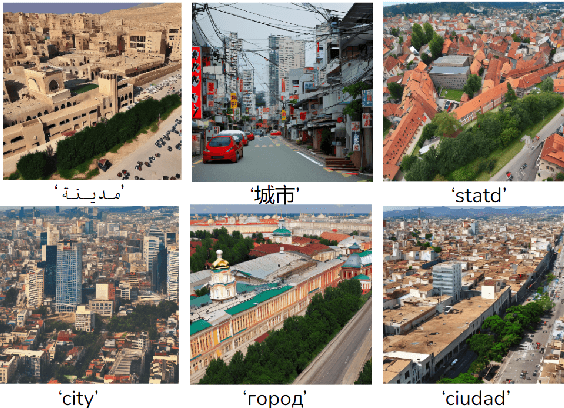
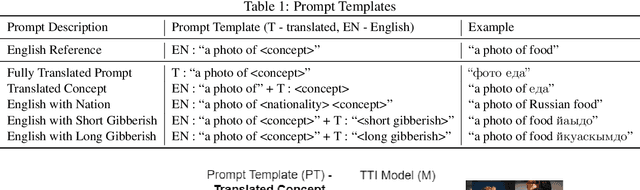

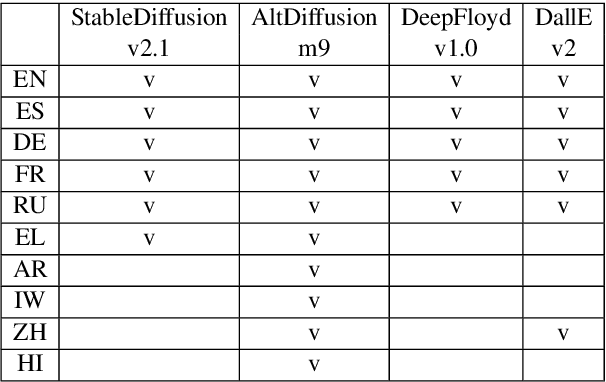
Text-To-Image (TTI) models, exemplified by DALL-E and StableDiffusion, have recently gained prominence for their remarkable zero-shot capabilities in generating images guided by textual prompts. Language, as a conduit of culture, plays a pivotal role in these models' multilingual capabilities, which in turn shape their cultural agency. In this study, we explore the cultural perception embedded in TTI models by characterizing culture across three hierarchical tiers: cultural dimensions, cultural domains, and cultural concepts. We propose a comprehensive suite of evaluation techniques, including intrinsic evaluations using the CLIP space, extrinsic evaluations with a Visual-Question-Answer (VQA) model, and human assessments, to discern TTI cultural perceptions. To facilitate our research, we introduce the CulText2I dataset, derived from four diverse TTI models and spanning ten languages. Our experiments reveal insights into these models' cultural awareness, cultural distinctions, and the unlocking of cultural features, releasing the potential for cross-cultural applications.
Multi3WOZ: A Multilingual, Multi-Domain, Multi-Parallel Dataset for Training and Evaluating Culturally Adapted Task-Oriented Dialog Systems
Jul 26, 2023Creating high-quality annotated data for task-oriented dialog (ToD) is known to be notoriously difficult, and the challenges are amplified when the goal is to create equitable, culturally adapted, and large-scale ToD datasets for multiple languages. Therefore, the current datasets are still very scarce and suffer from limitations such as translation-based non-native dialogs with translation artefacts, small scale, or lack of cultural adaptation, among others. In this work, we first take stock of the current landscape of multilingual ToD datasets, offering a systematic overview of their properties and limitations. Aiming to reduce all the detected limitations, we then introduce Multi3WOZ, a novel multilingual, multi-domain, multi-parallel ToD dataset. It is large-scale and offers culturally adapted dialogs in 4 languages to enable training and evaluation of multilingual and cross-lingual ToD systems. We describe a complex bottom-up data collection process that yielded the final dataset, and offer the first sets of baseline scores across different ToD-related tasks for future reference, also highlighting its challenging nature.
Cross-Lingual Transfer with Target Language-Ready Task Adapters
Jun 05, 2023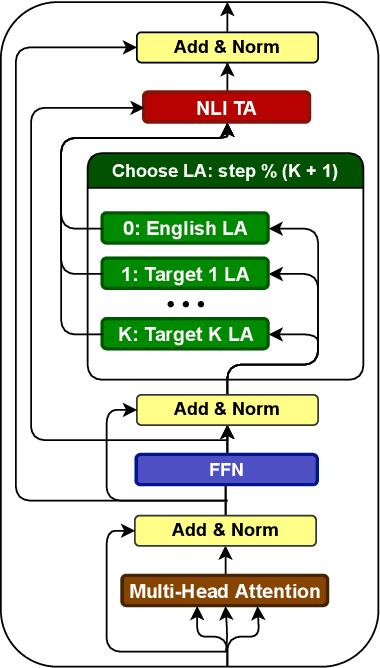
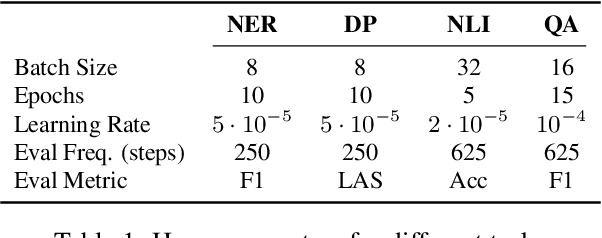
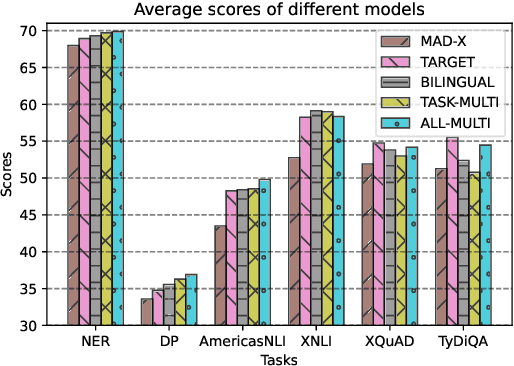
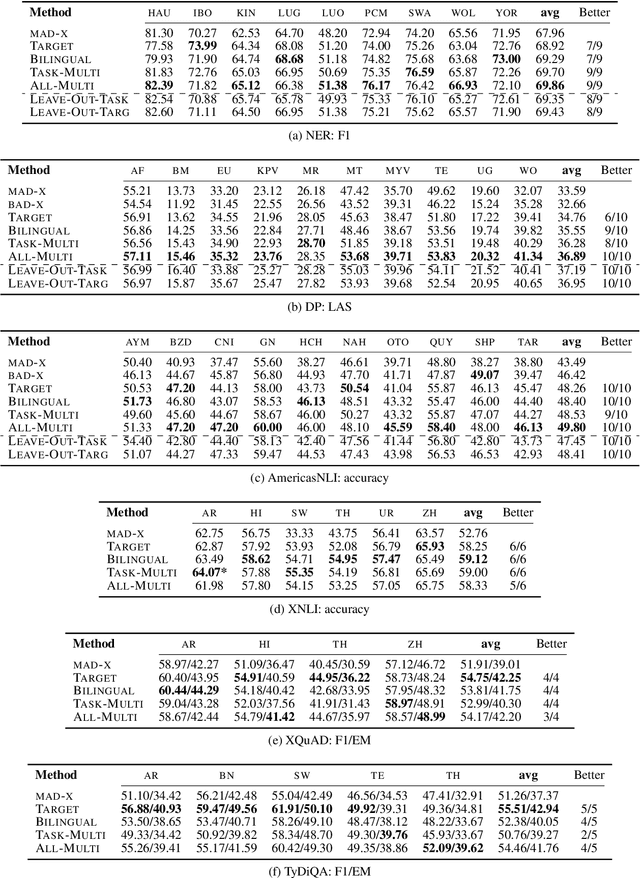
Adapters have emerged as a modular and parameter-efficient approach to (zero-shot) cross-lingual transfer. The established MAD-X framework employs separate language and task adapters which can be arbitrarily combined to perform the transfer of any task to any target language. Subsequently, BAD-X, an extension of the MAD-X framework, achieves improved transfer at the cost of MAD-X's modularity by creating "bilingual" adapters specific to the source-target language pair. In this work, we aim to take the best of both worlds by (i) fine-tuning task adapters adapted to the target language(s) (so-called "target language-ready" (TLR) adapters) to maintain high transfer performance, but (ii) without sacrificing the highly modular design of MAD-X. The main idea of "target language-ready" adapters is to resolve the training-vs-inference discrepancy of MAD-X: the task adapter "sees" the target language adapter for the very first time during inference, and thus might not be fully compatible with it. We address this mismatch by exposing the task adapter to the target language adapter during training, and empirically validate several variants of the idea: in the simplest form, we alternate between using the source and target language adapters during task adapter training, which can be generalized to cycling over any set of language adapters. We evaluate different TLR-based transfer configurations with varying degrees of generality across a suite of standard cross-lingual benchmarks, and find that the most general (and thus most modular) configuration consistently outperforms MAD-X and BAD-X on most tasks and languages.