 Add to Chrome
 Add to Firefox
 Add to Edge
AutoSOTA: An End-to-End Automated Research System for State-of-the-Art AI Model Discovery
Apr 07, 2026
Artificial intelligence research increasingly depends on prolonged cycles of reproduction, debugging, and iterative refinement to achieve State-Of-The-Art (SOTA) performance, creating a growing need for systems that can accelerate the full pipeline of empirical model optimization. In this work, we introduce AutoSOTA, an end-to-end automated research system that advances the latest SOTA models published in top-tier AI papers to reproducible and empirically improved new SOTA models. We formulate this problem through three tightly coupled stages: resource preparation and goal setting; experiment evaluation; and reflection and ideation. To tackle this problem, AutoSOTA adopts a multi-agent architecture with eight specialized agents that collaboratively ground papers to code and dependencies, initialize and repair execution environments, track long-horizon experiments, generate and schedule optimization ideas, and supervise validity to avoid spurious gains. We evaluate AutoSOTA on recent research papers collected from eight top-tier AI conferences under filters for code availability and execution cost. Across these papers, AutoSOTA achieves strong end-to-end performance in both automated replication and subsequent optimization. Specifically, it successfully discovers 105 new SOTA models that surpass the original reported methods, averaging approximately five hours per paper. Case studies spanning LLM, NLP, computer vision, time series, and optimization further show that the system can move beyond routine hyperparameter tuning to identify architectural innovation, algorithmic redesigns, and workflow-level improvements. These results suggest that end-to-end research automation can serve not only as a performance optimizer, but also as a new form of research infrastructure that reduces repetitive experimental burden and helps redirect human attention toward higher-level scientific creativity.

SkillTester: Benchmarking Utility and Security of Agent Skills
Mar 28, 2026This technical report presents SkillTester, a tool for evaluating the utility and security of agent skills. Its evaluation framework combines paired baseline and with-skill execution conditions with a separate security probe suite. Grounded in a comparative utility principle and a user-facing simplicity principle, the framework normalizes raw execution artifacts into a utility score, a security score, and a three-level security status label. More broadly, it can be understood as a comparative quality-assurance harness for agent skills in an agent-first world. The public service is deployed at https://skilltester.ai, and the broader project is maintained at https://github.com/skilltester-ai/skilltester.
ChatPD: An LLM-driven Paper-Dataset Networking System
May 28, 2025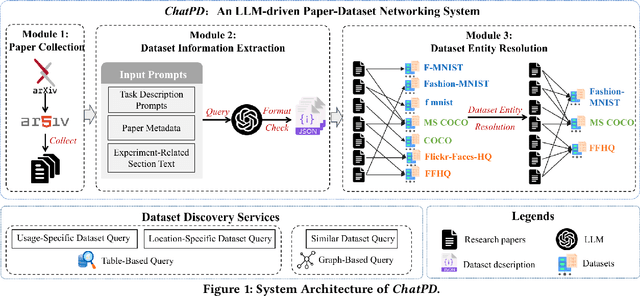
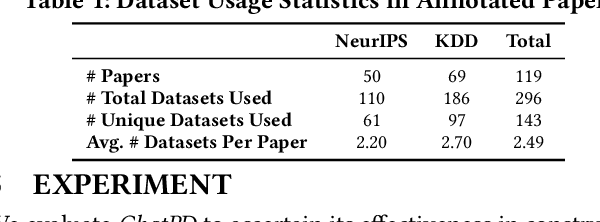
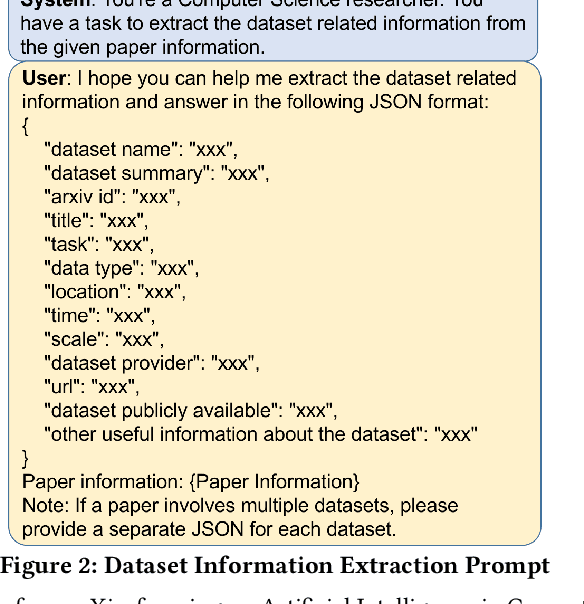
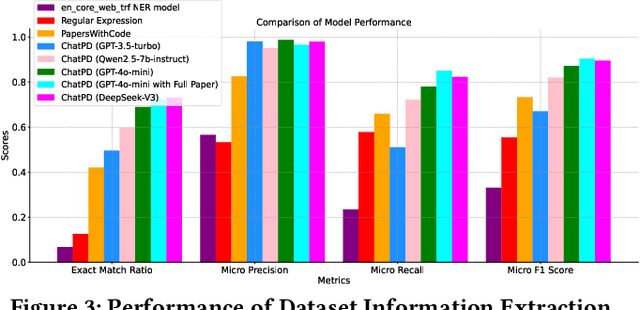
Scientific research heavily depends on suitable datasets for method validation, but existing academic platforms with dataset management like PapersWithCode suffer from inefficiencies in their manual workflow. To overcome this bottleneck, we present a system, called ChatPD, that utilizes Large Language Models (LLMs) to automate dataset information extraction from academic papers and construct a structured paper-dataset network. Our system consists of three key modules: \textit{paper collection}, \textit{dataset information extraction}, and \textit{dataset entity resolution} to construct paper-dataset networks. Specifically, we propose a \textit{Graph Completion and Inference} strategy to map dataset descriptions to their corresponding entities. Through extensive experiments, we demonstrate that ChatPD not only outperforms the existing platform PapersWithCode in dataset usage extraction but also achieves about 90\% precision and recall in entity resolution tasks. Moreover, we have deployed ChatPD to continuously extract which datasets are used in papers, and provide a dataset discovery service, such as task-specific dataset queries and similar dataset recommendations. We open source ChatPD and the current paper-dataset network on this [GitHub repository]{https://github.com/ChatPD-web/ChatPD}.